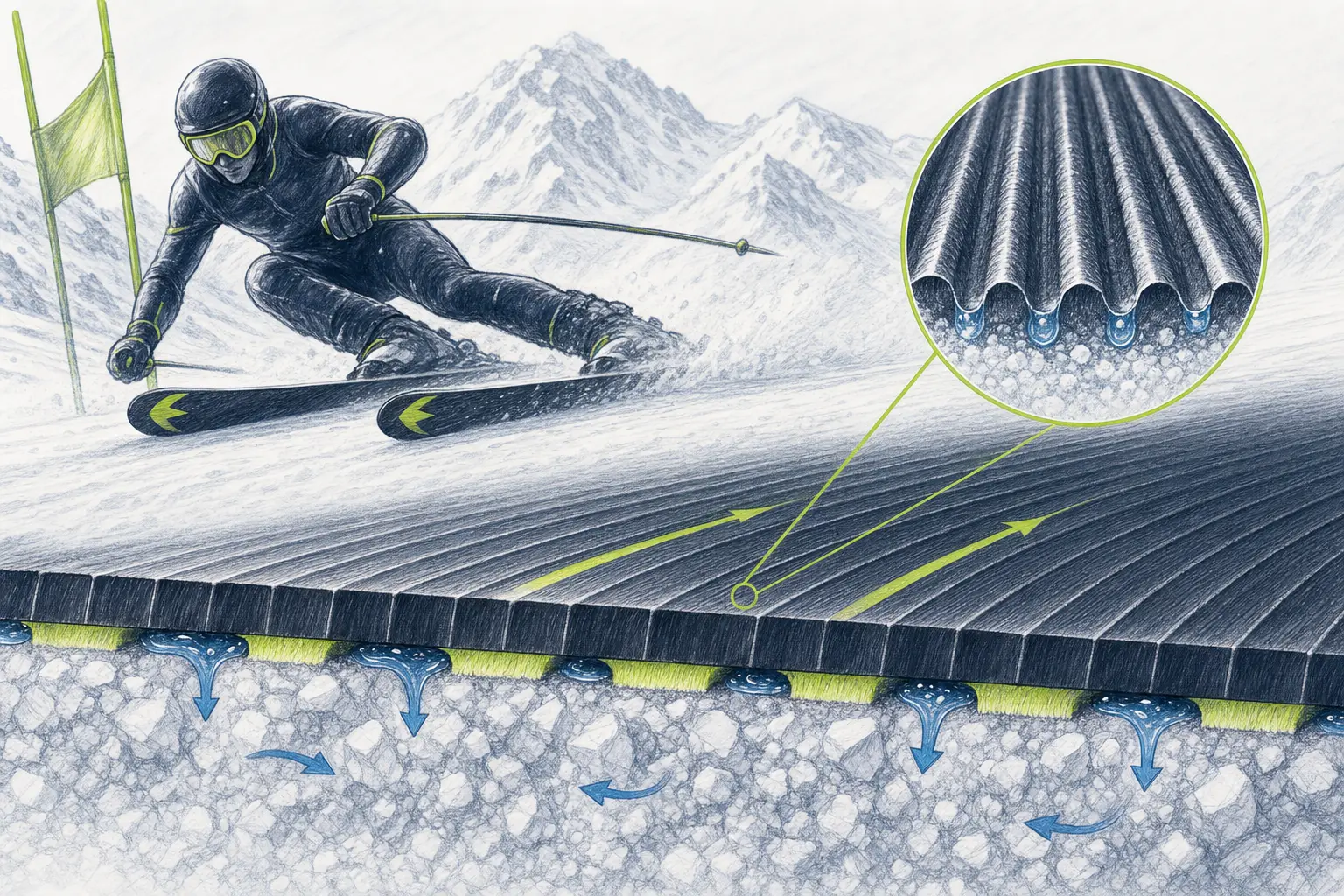
Base structure is a deliberately created surface relief made up of grooves and supporting contact points on the sliding side of the ski. It is most often created by grinding the base on a rotary stone. The grinding process removes part of the polyethylene material and, when set correctly, creates a regular pattern of ridges and recesses. So it is not the ski’s internal structure or random gouges from stones. [1, 3]
Ski bases for sports skis are commonly made of ultra-high-molecular-weight polyethylene (UHMWPE). When skiing, the entire apparent surface of the base does not touch the snow. Real contact occurs only on part of the surface irregularities and changes according to the base structure, snow properties, ski flex, load, and speed. [1, 3, 4]
Why the base has structure
Friction between the ski and the snow is not caused by a single mechanism. It involves, among other things, deformation and compression of the snow, contact with crystals, displacement of water, resistance from a thin water film, and dirt. The amount of water at the interface is not constant: it is affected by the state of the snow, the surface temperature of the base, pressure, and ski speed. The structure helps create the right balance between supporting contact points and spaces into which water can move. [1, 4, 5]
It is therefore overly simplistic to say that grooves only “drain water.” Their role is to change the actual contact area and the friction conditions. Laboratory measurements have shown that in snow close to the melting point, a surface with wider grooves and narrower supporting contact points may be better. In cold conditions, a surface with narrower grooves and a larger share of supporting area achieved lower friction. However, this is the result of specific controlled measurements, not a universal rule for every ski and every kind of snow. [2]
Fine, coarse, and combined structure
In service practice, structures are described according to the fineness, depth, spacing, and direction of the pattern. Service machines can create simple longitudinal structures as well as more complex combined or variable patterns. However, the structure designation and machine setting are not automatically comparable between different manufacturers. [6, 7]
As a general service rule, a finer and more closed surface is associated more with cold, dry, fine-grained snow. A more open structure is used more in warmer or wetter snow, when the importance of water between the base and the snow increases. Choosing only according to air temperature is a mistake. More important may be the snow temperature and transformation, water content, grain size, natural or artificial snow origin, speed, and ski load. [1, 2, 5, 8]
Children and racing skiing
For children’s recreational skis, it does not make sense to look for a special race structure for every day. From the coach’s and service’s point of view, a flat, undamaged, and properly maintained base, correctly prepared edges, and predictable ski behavior are more important. Every stone grinding removes material, so it should not be done automatically after every minor surface scratch.
In racing skiing, a suitable structure can affect glide especially in sections where the racer skis flat or needs to maintain speed. However, the pattern itself cannot be judged separately from the ski construction, the condition of the base, surface preparation, and the current snow. For important races, the choice is the result of service experience and comparative testing, not just a look at the grooves.
Common misconceptions
- A deeper structure is not automatically faster. An unsuitable open surface can increase drag in cold, dry snow.
- Scratches are not structure. Structure is a regular and repeatable pattern; gouges from stones are damage.
- One structure is not the best in all conditions. The optimal surface changes with the snow, water, speed, and load.
- Structure does not replace the entire service. It is only one part of ski base preparation.
- Race preparation may not be suitable for a child’s training ski. For children, priority goes to suitability, equipment durability, and reliable control.
Grinding and changing the structure should be entrusted to an experienced ski service. At the same time, the technician must assess the flatness of the ski base, the extent of damage, the condition of the edges, and the amount of material that can be safely removed.
Sources and further reading
- 1. Frontiers in Physiology – A Scientific Perspective on Reducing Ski-Snow Friction
- 2. Tribology Letters – Effect of Different Bearing Ratios on the Friction between UHMWPE Ski Bases and Snow
- 3. Frontiers in Mechanical Engineering – On the Influence of Microtopography on the Sliding Performance of Cross Country Skis
- 4. Tribology Letters – Mechanics of the Ski–Snow Contact
- 5. Medicine & Science in Sports & Exercise – A Review of the Friction of Snow Skis
- 6. MONTANA – CRYSTAL ONE 2.0, Stone Grinding and Structure System
- 7. WINTERSTEIGER – Ski Service Accessories and Structure Patterns 2024/2025
- 8. Tribology International – Tribological Aspects of Snow Skiing: A Comprehensive Review