What gliding is
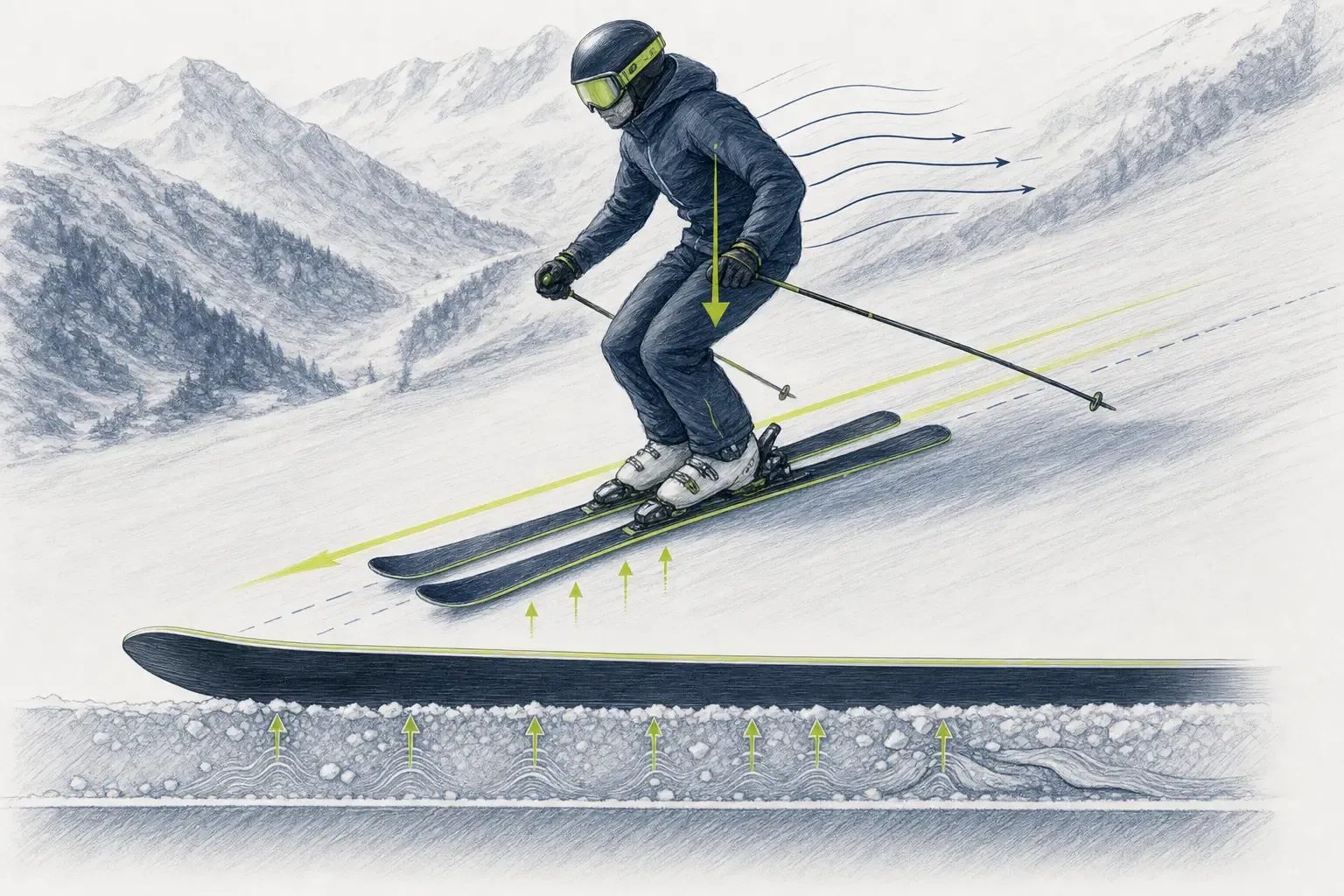
Gliding is the movement of the skis over snow, mostly in their longitudinal direction. The skier maintains dynamic balance, regulates the load on the skis, and limits movements that would unnecessarily increase resistance. Gliding can happen straight ahead, in a traverse, and during a turn. It is not the same as side slipping: in side slipping, the ski moves more noticeably across its longitudinal axis and deforms the snow with its edge or base.
The goal is not always to reach the highest speed. Controlled movement by a beginner on a gentle slope, where the child keeps stable, stays on course, and stops safely in the designated area, is also good gliding.
What determines gliding
A skier's speed is influenced mainly by slope and gravity, resistance between the skis and the snow, and air resistance. The contact between the ski base and the snow is a complex physical process. It depends on the temperature and structure of the snow, its moisture and contamination, speed, ski load, the properties of the base, and its surface texture.
The common claim that a ski simply “glides on a layer of water” is incomplete. Research describes a combination of several mechanisms: friction at points of contact, deformation and breaking up of snow grains, a possible thin layer of water, viscous resistance, and capillary effects in very wet snow. That is why the same skis may not glide the same way on cold powder, hard artificial snow, or wet spring snow.
From a technical point of view, smooth gliding is helped mainly by:
- a stable stance above the supporting surface of the skis,
- appropriately relaxed ankles, knees, and hips,
- the ability to adapt body position to changes in slope and terrain,
- calm ski steering without unwanted spreading of the tips and tails,
- an appropriate edge angle,
- smooth weighting without sudden or unnecessary movements.
“Flat ski” does not mean the base must be perfectly parallel to the snow at all times. In a traverse or turn, the skier needs an edge angle that matches the direction, slope, and required control. Excessive edging, however, can cause an unwanted change of direction or braking.
Gliding in children
For a child, gliding is primarily a balance task. A beginner needs to learn the feeling that the skis are moving even though the body is neither walking nor running. A suitable setting has a gentle slope, a sufficiently long and open runout, and a clearly defined stopping point.
In training practice, short straight runs onto flat ground, passes over gentle terrain waves, changes in track width, or touching a marked point on the body with the hands are used, for example. More experienced children can be given tasks involving shifting balance between the skis. However, the choice of exercise depends on the child’s age, speed, terrain, and ability; skiing on one ski or a low alpine stance is not automatically suitable for everyone.
The coach pays more attention to the quality of movement than to the length of the runout itself. A child may travel far thanks to a higher entry speed or a faster ski base, even though their stance and ski steering are not good. Comparative tests therefore only make sense with similar starts, tracks, snow, and equipment.
Importance in racing skiing
In races, gliding is used between turns, after exiting a turn, on gentler sections, and also when crossing the finish line. The racer tries to keep the speed already gained while staying ready for the next gate. Unnecessary sideways drift, sudden ski rotation, or delayed recovery after a turn can increase drag and disrupt the line.
At higher speed, the importance of air resistance grows. A lowered racing stance can reduce the body’s frontal area, but it is not a goal in itself. If a racer in a low stance loses mobility, visibility, or proper ski pressure, the aerodynamic advantage may not outweigh poorer ski control. For children, the racing stance is therefore developed gradually and only on a safe, clearly visible section, according to the coach’s instructions.
Typical mistakes and misunderstandings
- Leaning back: the skier rests on the back of the ski boots and reacts less well to changes in terrain.
- Stiff legs: the joints cannot continuously absorb unevenness, and pressure on the skis fluctuates.
- Looking just in front of the skis: this reduces the ability to anticipate direction and terrain.
- Unwanted snowplow or excessive edging: the skis create more resistance and change direction.
- Premature low stance: the skier may look “race-ready,” but loses balance and the ability to react.
- Confusing gliding with uncontrolled speed: a good skier knows not only how to accelerate, but also how to choose a safe way to control speed in time.
- Blaming every problem on wax: the base and service affect friction, but bad direction, sideways drift, or an unsuitable stance cannot be fixed by service.
Coach’s view
Gliding should be evaluated using three questions: Are the skis being guided calmly? Does the skier stay balanced when speed and terrain change? Can they move smoothly from gliding into a turn or a stop? Only then does it make sense to address the aerodynamic stance or compare the speed of the bases.
The base preparation, choice of structure, and service must match the specific skis and snow conditions. For children’s and racing equipment, a general recommendation does not replace checking by a qualified service technician or the manufacturer’s instructions.
Sources and further reading
- U.S. Ski & Snowboard – SkillsQuest Drills: developmental assessment of fundamental skiing skills
- Gilgien et al. – Recent Kinematic and Kinetic Advances in Olympic Alpine Skiing: Pyeongchang and Beyond
- Wolfsperger, Meyer, Gilgien – The Snow-Friction of Freestyle Skis and Snowboards Predicted From Snow Physical Quantities
- A Scientific Perspective on Reducing Ski-Snow Friction to Improve Performance in Olympic Cross-Country Skiing, the Biathlon and Nordic Combined
- Bäurle et al. – Mechanics of the Ski–Snow Contact
- The Kinetic Friction on Snow and Ice – Journal of Glaciology
- Tribological aspects of snow skiing: A comprehensive review – Tribology International