The gliding turn is a basic transition turn in which the skier starts from a slight wedge, initiates the change of direction mainly on the outside ski, and gradually brings the inside ski into a parallel position. The word gliding describes a small braking effect, not skiing purely on the edges.
In skiing methods, the term is not completely uniform. You may come across expressions like gliding wedge, turn from a wedge on both sides in a gliding form or a description of a transition turn from a wedge into parallel skiing. The common feature is smooth gliding, less edging than in a braking wedge, and the gradual bringing together of the skis.
How the gliding turn works
The skier starts from a narrow wedge stance: the ski tips are closer together and the tails are slightly apart. The skis stay in contact with the snow and their edges do not create as much resistance as in a braking wedge.
At the start of the turn, support on the future outside ski gradually becomes more pronounced. For example, in a right turn, the left ski is the outside ski. Changing its pressure and edging, together with guiding the skis, causes the turn. The inside ski is lightened enough for the skier to smoothly bring it toward the outside ski. It should not be lifted suddenly or forcefully turned.
For a beginner, bringing the skis together may happen only at the end of the turn. As balance and confidence grow, the wedge becomes shorter and the skis move into a parallel position sooner. The goal is not to mechanically bring the ski tails together, but to keep balance, a smooth line, and an appropriate speed.
Difference between a gliding and a braking wedge
In a braking wedge the skis are usually farther apart and set more strongly on their inside edges. This creates more resistance and the skier slows down or stops.
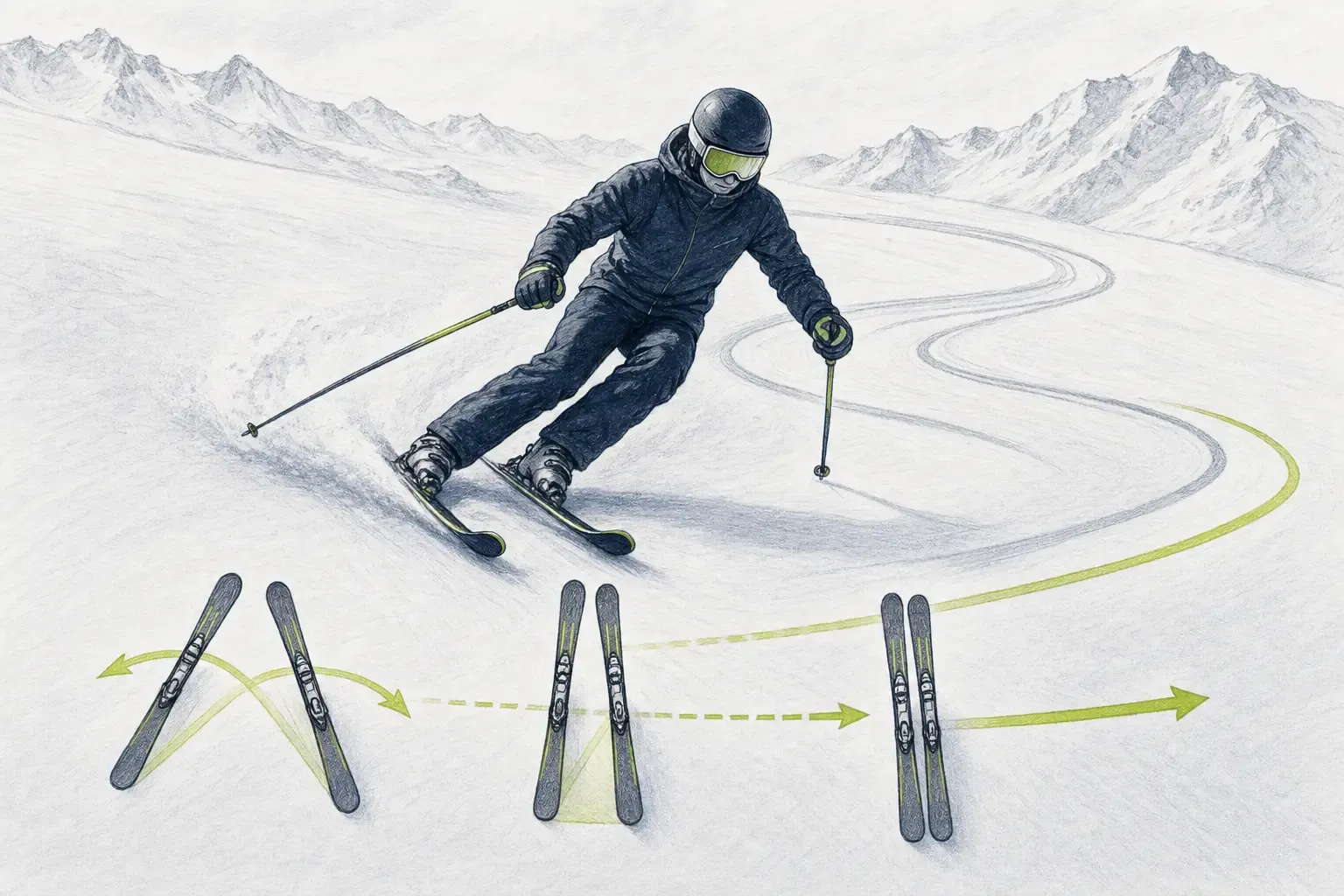
In a gliding wedge and gliding turn the stance is narrower, the skis rely more on their bases, and the braking effect is smaller. Speed is controlled mainly by choosing gentle terrain and the shape of the turn. However, the gliding turn is not a carved turn: the skis may still skid sideways a little, and they may not leave two clean, narrow tracks in the snow.
Its importance in teaching children
The gliding turn bridges stable snowplough turns and parallel skiing. In it, the child learns:
- to distinguish the inside ski from the outside ski,
- to create support mainly on the outside ski,
- to relax and bring the inside ski in,
- to change direction without abrupt braking,
- to link turns into a smooth ride.
Practice belongs on a gentle, clear, and sufficiently wide slope. If a child needs to brake hard all the time or is afraid of speed building up, the terrain is probably too demanding for the gliding form. The speed of the transition to parallel skis is determined not only by age, but mainly by balance, coordination, experience, and a sense of safety. The snowplough turn is a legitimate basic skill in teaching children; forcing it away too early can lead to an uncertain stance and abrupt movements.
Typical mistakes
- Too wide a snowplough: the skis brake hard and the inside ski is hard to bring in.
- Support on the inside ski: the outside ski loses its guiding role and the skier stays between the skis or falls into the turn.
- Leaning back: it makes it harder to control the front of the skis and to relax the inside leg.
- Turning the shoulders instead of the skis: the movement is jerky and balance shifts onto the inside ski.
- Lifting the inside ski: it can help briefly, but it is not the intended way to bring it in.
- Forcing the skis together: a sudden pull of the heel can disrupt both direction and stability.
- Unsuitable slope: on a steep or crowded section, the gliding turn turns into defensive braking.
Coach's view
The coach does not watch only whether the skis are parallel at the end of the turn. More important are a smooth line, calm balance, adequate support on the outside ski, and the ability to start the next turn without a sudden movement.
In race preparation, the gliding turn is not the target technique for passing gates. However, it can serve as a simple drill at low speed, especially for awareness of the outside ski, relaxing the inside leg, and a smooth transition between turns. It is a training practice that the coach adapts to the child's level, the terrain, and the current task.
Sources and further reading
- Charles University, Faculty of Physical Education and Sport – Skiing: common foundation
- Charles University, Faculty of Physical Education and Sport – Skiing: skidded turns
- Masaryk University, Faculty of Sports Studies – general ski training and games
- Technical University of Liberec – Comparison of the methodology for teaching alpine skiing
- University of South Bohemia – university paper on teaching alpine skiing
- Palacký University Olomouc – university paper on teaching children to ski
- Technical University of Liberec – terminology and methodology of basic ski skills
- Martin Hattala Gymnasium – content of the skiing education and training course