What Is the Outside Ski
The outside ski is the ski that lies farther from the center of the turn being made. In a left turn, it is the right ski; in a right turn, the left ski. It is determined by the direction of the turn, not by the skis' current position relative to the slope.
Terms outside ski and downhill ski are therefore not exact synonyms. In the second part of a normal turn, the outside ski is usually also the downhill ski, but when the turn begins and during the transition between turns, their relation to the fall line changes.
Why It Matters
The PSIA-AASI and U.S. Ski & Snowboard methodologies include pressure management among the basic skiing skills. A skier should be able to vary pressure between the skis and direct it mainly to the outside ski according to the situation. The ability to stay balanced on it is also one of the development indicators of a young alpine skier.
When a skier is properly supported by the outside ski, they can more effectively:
- keep balance against the forces created in the turn,
- create and maintain the needed edge angle,
- load and flex the ski so it follows the turn,
- control direction, turn radius, and speed,
- prepare a smooth transition into the next turn.
The word pressure is often used in skiing as a shortened term for loading and the forces acting between the ski and the snow. It does not mean pushing hard with the leg. Loading comes from the interaction of speed, turn shape, body position, edging, leg movement, and the reaction of the snow.
Loading During the Turn
The load on the outside ski is not the same throughout the entire turn. During the transition between turns, the skier releases the old outside ski, changes edges, and creates support on the new outside ski. As the turn develops, this support usually increases. Before the next change of direction, the ski must be able to release again.
The exact timing depends on speed, turn radius, slope, snow quality, discipline, and the intended line. That is why there is no single universal position in which the outside ski must always be most loaded. Technical methods emphasize controlling the amount of pressure, how it is distributed between the skis, and how it changes along the length of the ski, not a one-time “stomp” into the turn.
A greater edge angle also does not come only from leaning the whole body inward into the turn. The skier combines inclination with angulation and adjusts the bending of the ankles, knees, hips, and spine. The outside leg is usually relatively longer than the inside one, but it should not be stiffly straightened or locked.
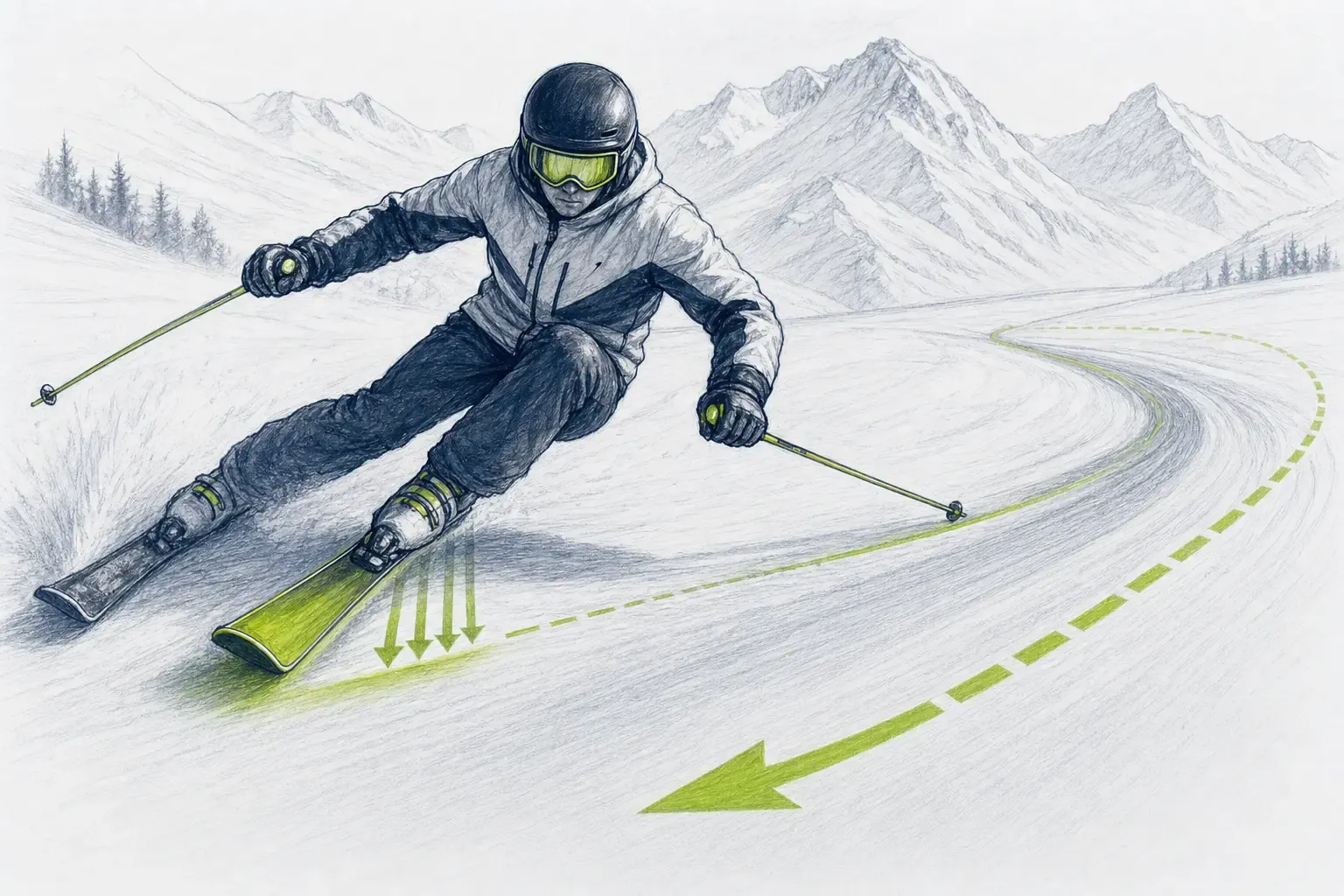
The outside ski does not mean just one ski
A common misunderstanding is the idea that a correct turn is always skied with all the weight on the outside ski and with the inside ski unweighted or lifted. In real skiing, both legs usually stay active. The inside ski helps with balance, edging, guiding a parallel track, and adapting to uneven terrain.
The load distribution changes according to the task. Skiing on a smooth groomed slope, a short skidded turn, giant slalom, a steep slope, and uneven terrain do not require the same distribution of forces. Advanced drills may even intentionally change the usual timing or pressure distribution. Such a drill isolates a certain skill, but by itself it may not represent the final technique in free skiing or racing.
Children's and racing context
For a beginner, support on the outside ski develops already in wedge turns. However, a child does not need a detailed biomechanical explanation. A simple task, gentle and safe terrain, low speed, and feedback focused on the result of the movement are more suitable.
Training practice: the coach can use, for example, stepping during the turn, touching the knees with the hands, different arm positions, or short sections of skiing with stronger support on the outside ski. U.S. Ski & Snowboard includes similar drills in the category of pressure regulation tasks. Their choice must match the child's age, skill level, terrain, and current fatigue.
Long lifting of the inside ski or skiing on one ski are not a required condition for learning. They can serve as a short balance drill under the coach's supervision, but for a less experienced child they may lead to a stiff posture, loss of stability, or focusing on lifting the ski instead of making a good turn.
In racing skiing, precise and timely support on the outside ski makes it possible to use edging and ski flex without unnecessary skidding. However, the racer does not switch skis mechanically according to one learned moment. They adapt the transfer of support to the line, gate spacing, slope, surface, and discipline. The ability to ski in balance from one outside ski to the other is a technical foundation, not the whole description of a racing turn.
Typical mistakes and misunderstandings
- Confusing the outside and lower ski: the outside ski is determined by the direction of the turn.
- Late transfer of support: the skier stays too long on the old outside ski, which is already becoming the inside ski of the new turn.
- Falling inward: the whole body leans without enough support from the outside leg and without proper angulation.
- Hard pushing: a one-time “stomp” disrupts smoothness and can cause skidding.
- Locked knee: an overly straight outside leg limits the ability to react to the terrain and regulate pressure.
- Passive inside ski: the inside ski moves away, the skis develop different edge angles, or the inside ski catches in the snow.
- Absolute rule about the full body weight: the load distribution is dynamic and depends on the situation.
Coach's view
The coach does not judge the outside ski based on a single photo or on whether the child lifted the inside foot. They watch the whole turn: the smoothness of the edge change, the direction of the center of mass, the stability of the support, the ski tracks, the ability to release the old turn, and readiness to react to the terrain.
Good support on the outside ski is dynamic balance, not a rigid stance. The goal is for the young skier to be able to change pressure between the skis consciously and appropriately, not to imitate one universal position at all times.
Sources and further reading
- PSIA-Rocky Mountain: Alpine Assessment Guide 2025–26
- PSIA-Rocky Mountain: Level 3 Training and Development Guides
- U.S. Ski & Snowboard: Athlete Performance Profile
- U.S. Ski & Snowboard: Pressure – technical exercises
- U.S. Ski & Snowboard: Level 100 Updates – Basic Skiing Drills
- U.S. Ski & Snowboard: Alpine Ski Fundamentals Level 100 Instructor Manual