What is a carving turn
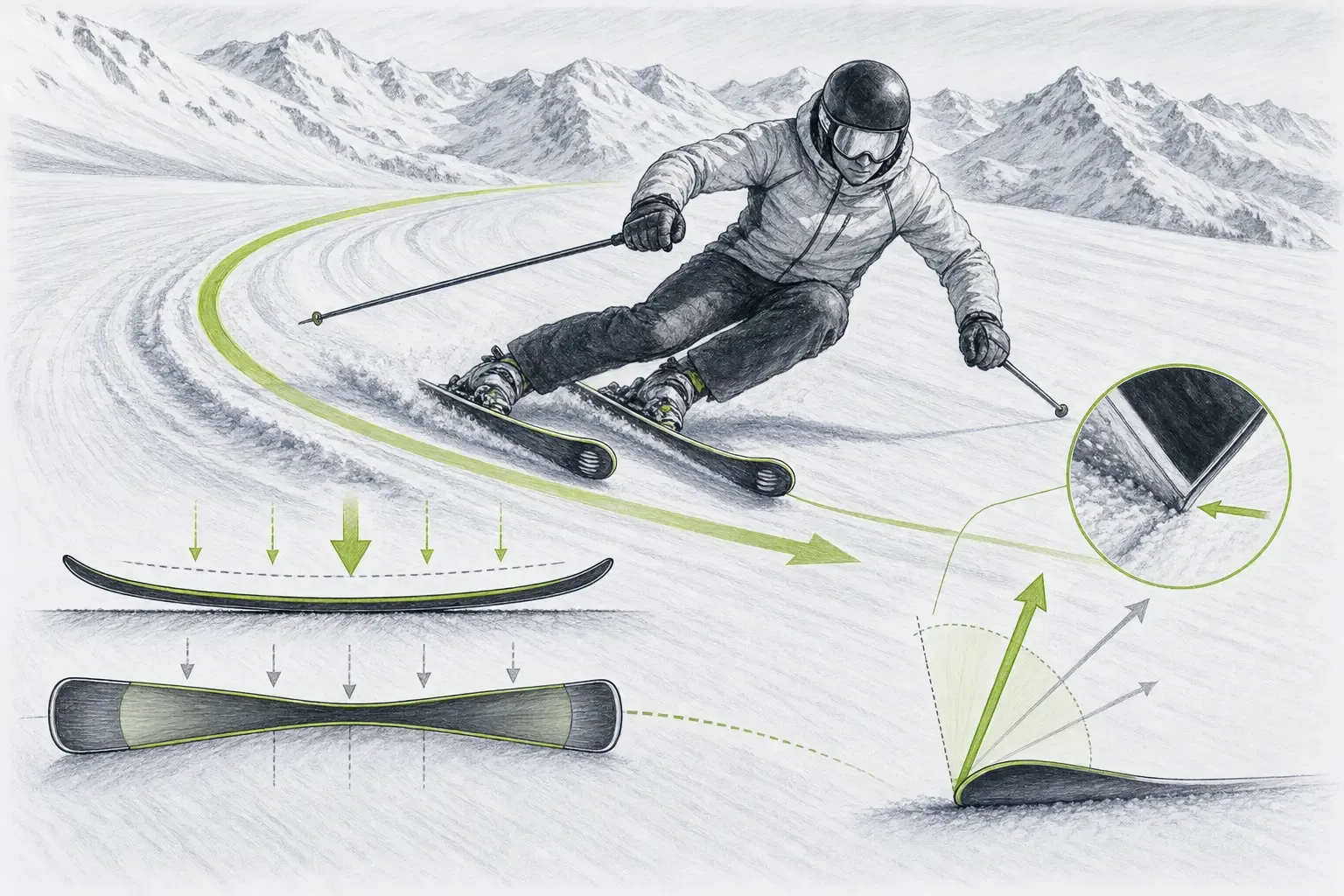
Carving turn is a ski turn in which the skis move mainly in the direction of their longitudinal axes and their edges create a curved track in the snow. Sideways slip is minimal. In an ideal clean carve, the tail of the ski follows approximately the same track as its tip. In real skiing, however, part of the turn can be carved and part slightly skidded. Therefore, it is not appropriate to judge the whole turn only as “carved” or “skidded” without taking its individual phases into account.
A carving turn is not a synonym for a parallel turn. Skis can remain parallel and still skid significantly. Likewise, simply putting the skis on edge does not yet mean carving if the skis are moving sideways relative to the direction they are pointing.
How a carving turn is created
A modern downhill ski is shaped: the tip and tail are wider than the waist. When the skier tips the ski onto its edge and loads it against the snow, the ski bends into an arc. The edge cuts into the snow and the shape of the bent ski helps guide a curved track. Research on ski motion confirms that important factors include edge angle, ski deformation, radial force and ski geometry.
The radius stated on the ski is the design sidecut radius, not an order telling you what radius every turn must have. The actual path also depends on the degree of edging, ski flex, pressure distribution, snow hardness, speed and the skier’s movements. Simplified geometric models explain the basic principle well, but they cannot accurately describe every situation on the slope. Especially with a small edge angle or with sideways slip, the actual radius can differ significantly from the geometric estimate.
The skier creates edge angle by combining the lean of the whole body into the turn with angulation at the ankles, knees and hips. At the same time, they must maintain support against the outside ski and control pressure along the length of the skis. In a dynamic turn, the outside ski is usually loaded more, while the inside ski remains active and helps with balance, steering and the transition into the next turn. The exact load split is not a universal number and changes according to the phase of the turn, the terrain and the task.
Practical significance
A shaped ski guides the turn smoothly and precisely, but a clean carve has less braking effect than a strongly skidded turn. The skier therefore controls speed mainly through the shape of the turn, by steering more across the slope, by choosing the terrain and, when needed, by using controlled skid. Trying to carve at all costs on a steep, narrow or crowded slope can lead to excessive speed and taking up too much of the run.
A simple check is the tracks in the snow. Two narrow, continuous curved lines suggest little sideways skidding. A wide, blurred track means more slip. However, the track alone does not show the quality of balance, the timing of movements or whether the skiing was appropriate for the situation.
Carving for children
With children, age is not the only factor. More important is the ability to stop safely, change direction, regulate speed, keep balance on parallel skis and perceive instructions as well as other skiers. Teaching should take place on a gentle, clear and lightly used slope where the child does not need a large edge angle or high speed.
In training practice, edge feel is developed gradually: by skiing on a slightly edged ski, turns finished into the slope, garlands and linking longer turns. The aim is not the lowest possible stance or touching the snow with the hand, but calm balance, smooth edge changes and guiding the skis along the chosen line. The coach must adapt the exercise to the child’s motor level, the conditions and the equipment; there is no universal method for everyone.
A common problem is introducing carving on a slope that is too steep. The child then gains speed, is afraid to let the skis run down the fall line and tries to finish the turn with a sharp pivot or by pushing the tails out. Such movement creates a skid, even though the skis were initially set on edge. A suitably easy slope allows the child to understand the ski’s response without forceful substitute movements.
Race context
In slalom and giant slalom, effective skiing on the edges is important, but a race turn is not usually a clean carve from start to finish. Measurements from slalom show a combination of shaped skiing and varying degrees of sideways slip. Depending on the gate set, slope, surface and chosen line, the racer deliberately adjusts ski steering, edge angle and pressure.
The largest edge angle or the cleanest track does not automatically mean the fastest run. What matters is whether the technique allows the skier to take the correct line, handle the forces in the turn and prepare for the next gate. FIS rules do not require a carving style; among other things, they set the correct passage of the course, timing and requirements for race equipment. The specific ski parameters differ according to discipline, age or competition category and current regulations, so adult FIS rules should not be automatically transferred to children’s categories.
Typical mistakes and misunderstandings
- Sharp edging of the skis: instead of a smooth engagement, there may be a sudden edge catch or a loss of balance.
- Pushing the tails sideways: the skier turns the arc by force and creates skidding instead of using the ski's bend.
- Rotation of the shoulders and pelvis into the turn: the whole body turns together with the skis, which makes independent leg work and edge control harder.
- Backseat position: pressure shifts too far back and the ski tip cannot reliably guide the start of the turn.
- Passive inside ski: it can drift apart, catch the inside edge, or limit balance.
- Carving as the only correct technique: a controlled skidded or mixed turn is needed to control speed, in confined space, on steep slopes, and in racing tactics.
Coach's view
The coach does not only watch the depth of the track. They assess where and how the skier changes edges, whether pressure builds smoothly, whether the skis follow the chosen shape, and whether the body stays balanced against the forces that arise. A good carving turn is the result of a combination of edging, pressure control, balance, and appropriate steering of the skis — not one isolated body position.
For a young skier, technical cleanliness makes sense only together with speed control and safe decision-making. If a child cannot interrupt, lengthen, or change a turn into a skidded one at any time, carving is not yet fully under control.
Sources and further reading
- FIS – Alpine Skiing Documents: current rules and documents for alpine skiing
- PSIA-Rocky Mountain – Alpine Assessment Guide 2025/26
- Yoneyama et al. – Joint motion and reaction forces in the carving ski turn compared with the conventional ski turn
- Reid et al. – Alpine Ski Motion Characteristics in Slalom, Frontiers in Sports and Active Living
- Snyder et al. – Connected skiing: Validation of edge angle and radial force estimation
- Technique-Dependent Relationship between Local Ski Bending Curvature, Roll Angle and Radial Force in Alpine Skiing
- Federolf et al. – Parameter Study Using a Finite Element Simulation of a Carving Alpine Ski
- Spörri et al. – Sidecut radius and the mechanics of turning