What Is Dynamic Balance
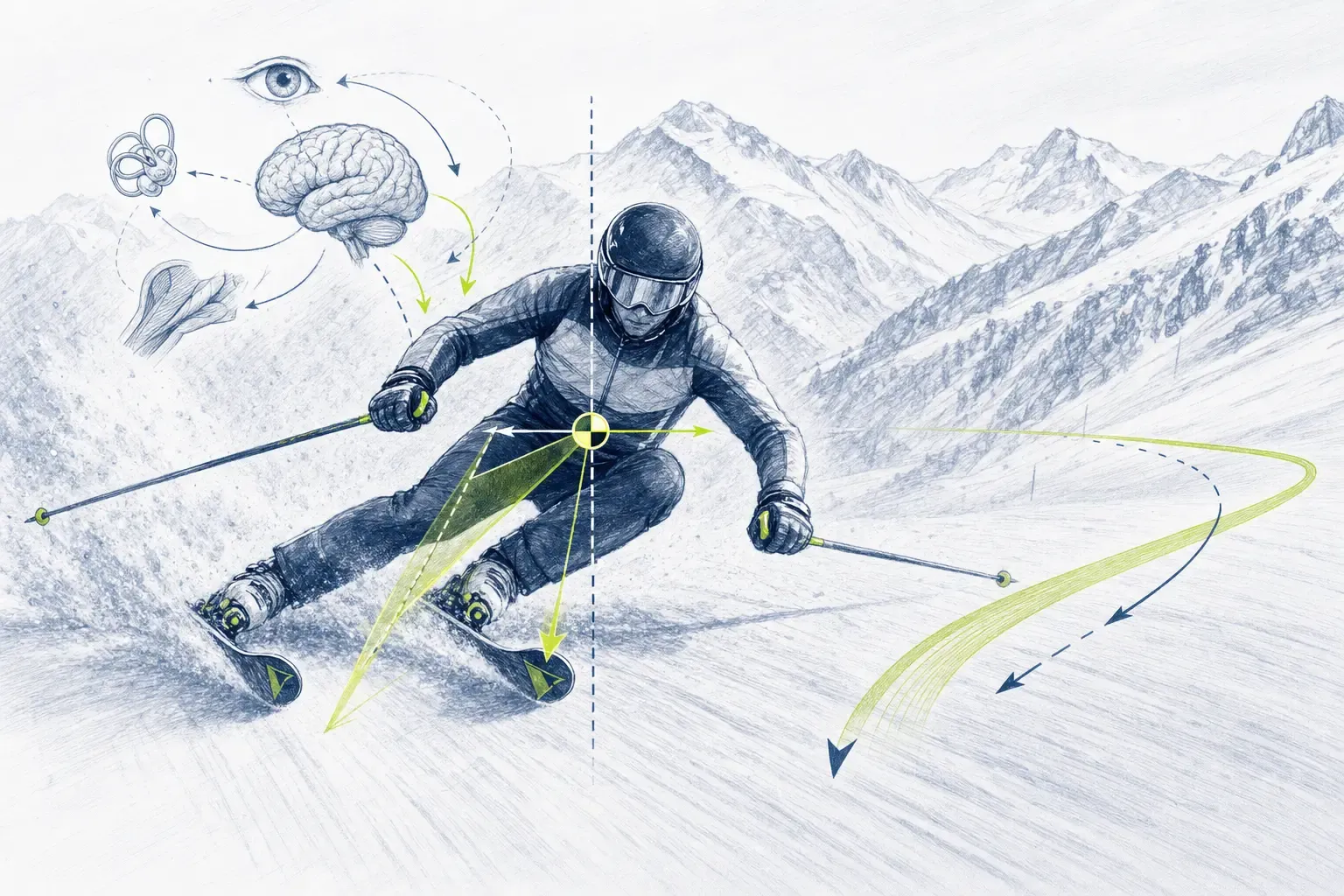
Dynamic Balance is the ability to continuously control and restore stability during movement. In skiing, it means constantly adjusting the relationship between the body, skis, snow, and external forces. The skier changes speed, direction, edging, pressure distribution, and the size of the support area. Balance is therefore not one fixed position, but the result of continuous postural control.
The common explanation that the center of mass should always stay “above the skis” is overly simplified. In a turn, the center of mass moves relative to the skis, the body leans into the turn, and support may be concentrated mainly on one ski. What matters is whether the skier can maintain effective contact of the skis with the snow, regulate their load, and continue the intended movement.
How It Works in Skiing
The nervous system combines information from vision, the balance organ in the inner ear, and the somatosensory system, meaning receptors in the muscles, joints, and skin. Based on this information, it prepares or corrects posture. Postural control in children is still developing, and the way individual sensory inputs are used changes throughout childhood.
On the slope, a skier must react to, for example:
- acceleration and deceleration,
- the transition from one edge to the other,
- increasing load on the outside ski,
- bumps, waves, and changes in slope,
- soft, hard, or broken snow,
- changes in the radius and rhythm of turns,
- a movement error or an unexpected slip.
Dynamic balance is therefore closely related to edging, ski rotation, and pressure regulation. The American SkillsQuest system lists it alongside these abilities as one of the basic areas of skiing technique. In real skiing, however, individual skills are not separate: a change in edging or pressure immediately also changes the demands on balance.
Good balance does not mean skiing without movement of the torso and limbs. An experienced skier often moves quite a lot, but purposefully. They can anticipate changes in forces, adapt the range of leg flexion and extension, stabilize the torso, and return to effective support after being thrown off balance. So the ability not only to maintain stability, but also to restore it quickly, is important.
Dynamic Balance in Children
When assessing a child, age alone is not enough. What matters are experience on snow, general movement readiness, current growth, fatigue, attention, and the difficulty of the environment. Research into postural control points to significant maturation roughly between 6 and 10 years of age, but the pace of development is individual.
During periods of rapid growth, body proportions may change faster than coordination can adapt to them. A longitudinal study of young alpine skiers highlighted links between growth changes and balance especially at around 11 to 14 years of age. This is the result of a specific study, not a rule that applies equally to every child. Temporarily less precise movement therefore does not necessarily mean a lack of effort or a loss of talent.
For younger children, a broad movement foundation is appropriate: running, jumping, safe landings, changes of direction, skating, climbing, and games with different forms of support. Official development materials from U.S. Ski & Snowboard emphasize the foundations of agility, balance, and coordination, varied movement experiences, and progression appropriate to age and sport level.
Competitive significance
In competitive skiing, the demands increase with speed, greater load on the skis, course complexity, and less time to correct a mistake. The racer needs to stay functionally balanced when the rhythm changes, when crossing a terrain wave, when contacting a gate, and during brief unloading of the skis. For example, removing a slalom pole should not disrupt the mechanics of a balanced turn.
Dynamic balance is not a separate race result or a technique used in isolation. It is a prerequisite for the racer to guide the skis precisely, hold the chosen line, and react to deviations without unnecessary loss of speed. The FIS expert consensus includes balance, postural stability, sensorimotor abilities, and movement quality among the important areas of preparation and testing for skiers. The choice of tests should match age, gender, performance level, and the goal of assessment.
Coach’s view and training practice
Training practice, not a universal rule: balance on snow is developed mainly through varied skiing and appropriate movement tasks. This can include skating, turns of different radii, changes of lane, skiing over gentle terrain bumps, conscious changes in pressure, or short sections with pronounced support on one ski. U.S. Ski & Snowboard uses skating to support dynamic balance, ankle work, independent leg action, and flexion and extension movements.
Off snow, balance can be supported by games with changes of direction, controlled jumps and landings, movement on one leg, or tasks that combine stability with response to a stimulus. A systematic review of school-based neuromuscular training reported improvements in postural control, fundamental movement skills, and strength in children. However, this does not allow us to derive one best set of exercises or the same dosage for all children.
The coach looks not only at whether the child completes the task. They watch whether:
- the child can anticipate the terrain change and prepare for it,
- the child responds with the legs or saves themselves with a sudden movement of the whole body,
- the child maintains a functional position even when tired,
- the child can regain stability after a mistake,
- the child uses both sides of the body appropriately,
- the child transfers the skill from exercise to free skiing and the course.
A typical misunderstanding is to equate balance with a motionless or rigid stance. Locked joints, an exaggerated effort to keep the torso still, or constant waving of the arms can be signs of limited adaptability. Success on a balance aid off snow is also not enough: skiing involves speed, glide, changing forces, terrain, and decision-making.
The difficulty of tasks must match the child’s abilities and the conditions on the slope. Speed, incline, space, and the number of distracting stimuli increase gradually. An exercise in which the child repeatedly loses control of direction or speed no longer develops quality dynamic balance in a safe way.
Sources and further reading
- International Ski and Snowboard Federation (FIS) consensus statement on training and testing in competitive alpine and freestyle skiers and snowboarders
- U.S. Ski & Snowboard – SkillsQuest
- U.S. Ski & Snowboard – Athlete Performance Profile
- U.S. Ski & Snowboard – Skating: Balanced Athletic Position
- U.S. Ski & Snowboard – Alpine Training Systems
- Accelerometric Assessment of Postural Balance in Children: A Systematic Review
- Balance, Basic Anthropometrics and Performance in Young Alpine Skiers
- Effects of school-based neuromuscular training on fundamental movement skills and physical fitness in children: a systematic review
- Enhancing Return to Alpine Skiing: Integrating Perceptual-Motor-Cognitive Considerations in Testing and Progressions
- Postural Balance and Human Movement: An Integrative Framework for Mechanisms, Assessment, and Functional Implications