What is balance in skiing
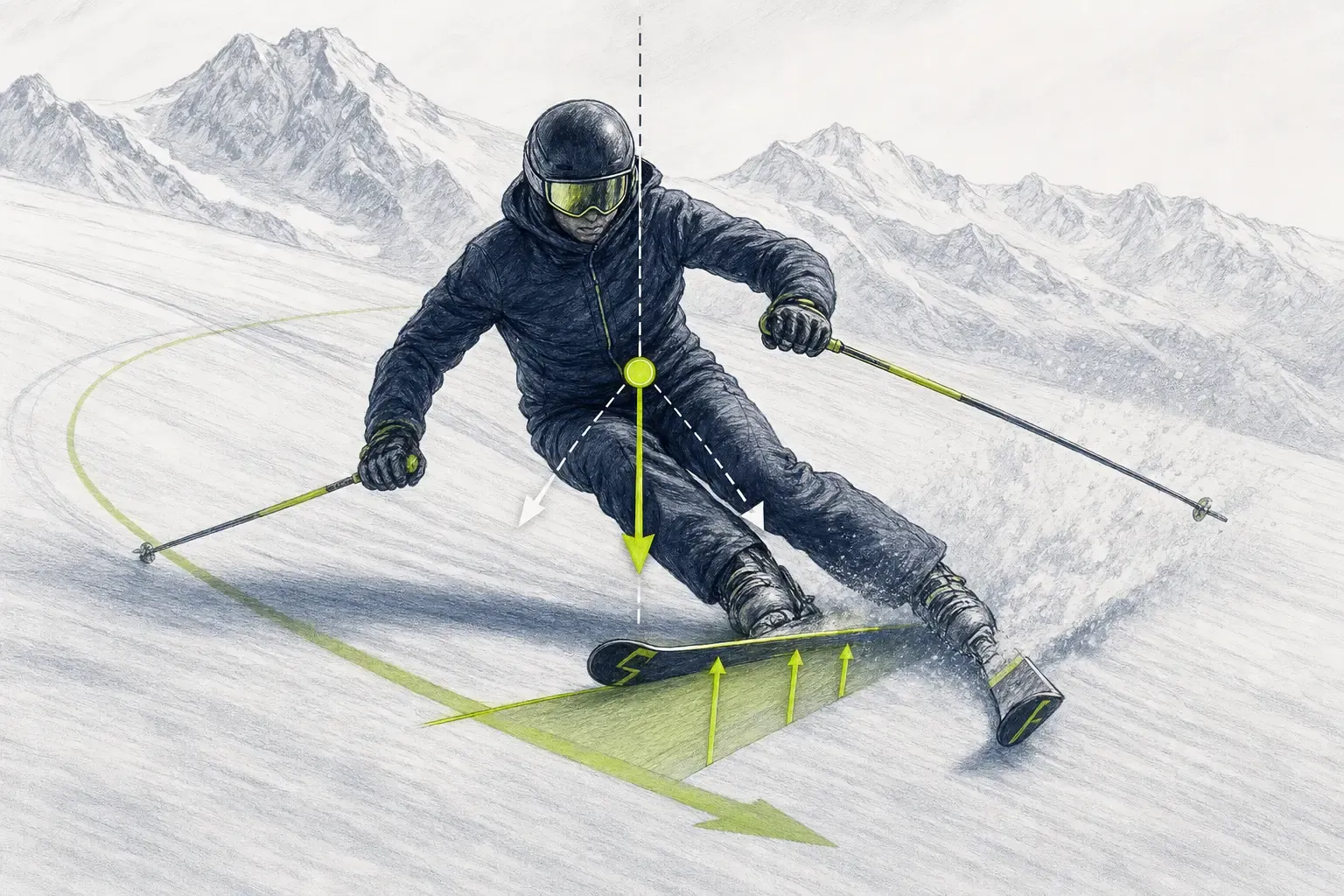
Balance is the skier’s ability to continuously control the relationship between the body’s center of mass and the support provided by the skis. Its goal is not to stay in one position at all costs, but to maintain or restore a body organization in which pressure, edging, and ski direction can be changed effectively. Expert training methods therefore describe balance as a dynamic ability available throughout the whole turn, not as one single correct stance.
The skier moves on an inclined and often uneven surface. Speed, direction, turn radius, and edge angle all change. The forces acting on the body therefore change constantly, and the body must respond with movements in the ankles, knees, hips, and trunk. A well-balanced skier does not have to look motionless: they may move a lot, but their movements remain purposeful and allow them to keep controlling the skis.
Directions of balance
In coaching practice, balance is often observed in three interconnected areas:
- Fore-aft balance determines where the body is in relation to the feet and how pressure is distributed along the ski. The skier must be able to respond to acceleration, changes in slope, and the transition between turns. This does not mean being continuously “as far forward as possible.”
- Lateral balance relates to moving the body inward and outward of the turn, to angulation, and to the distribution of support between the skis. As speed and edging increase, the center of mass can be found significantly inside the turn, while the skis on the snow still provide support.
- Control of body rotation some methods refer to this as rotational balance. It is the ability to regulate the rotation of the legs, pelvis, and trunk so that the individual parts of the body support one another and uncontrolled rotation does not develop.
Balance uses information from vision, the vestibular system of the inner ear, and proprioception, that is, the perception of the position and movement of one’s own body. In skiing, the nervous system must process this information while accelerating, turning, and continually changing surfaces.
Balance in children
Balance abilities continue to develop throughout childhood and adolescence. Among children of the same age, there can be large differences caused by motor experience, physical growth, maturation, and current fatigue. Therefore, it is not appropriate to assess a child only according to one test or to compare them automatically with older or physically more developed skiers.
A longitudinal study of young racers found a stronger connection between balance test results and race performance in category U14 than later in U16. Additional data from a group of more than 500 skiers aged 11 to 18 years showed that balance test results change with age and maturation. These are correlations, not proof that balance training alone will automatically make a child faster in races.
The international FIS expert position recommends developing a broad base of movement skills in young athletes and respecting age-related as well as individual differences. Balance and sensorimotor control are among the important areas of preparation, but they should not replace learning skiing technique, strength, coordination, or experience in different conditions.
In children’s training, balance is usually developed best through appropriate movement tasks and games: changes of stance, rhythm, and turn radius, safe crossing of terrain waves, skating, turns, jumps, or short sections with a different distribution of support. The difficulty must match the age, speed, slope quality, and skiing level. Exercises on one ski or highly unstable tasks belong on suitable terrain and under the coach’s supervision.
Importance in racing skiing
In races, balance allows a skier to adjust movement more precisely to the changing line, gates, speed, and course surface. But it is not a separate isolated element. It shows in whether the racer can create and release pressure at the right time, change edge angle, regulate ski rotation, and quickly regain control after a mistake.
Research on young racers suggests that ski-specific balance tests may relate to performance ranking better than general static tests. Even such a test, however, cannot replace watching skiing on snow: standing on one leg in the gym and balance in a racing turn are not the same task.
Coach's view
The coach does not only watch whether the child falls. They mainly notice whether the skier:
- can change position without stiffening up and without excessive bending at the waist,
- keeps the skis in contact with the snow and can restore that contact after a bump,
- reacts to changes in slope, speed, and turn radius,
- handles a small mistake without stopping or uncontrolled rotation,
- uses both sides of the body and can solve different movement tasks.
Training practice usually progresses from simpler tasks on a stable surface to dynamic, sport-specific situations. A small intervention study of young skiers recorded improvement in selected indicators of dynamic balance after a comprehensive eight-week program. The result supports varied preparation, but it is not a universal training prescription for every child.
Typical misconceptions
- “Being balanced means staying in the middle all the time.” During skiing, the body position and pressure distribution change continuously.
- “Just lean forward more.” Constantly pushing the body forward can limit mobility and does not address side or rotational control.
- “A calm torso must be motionless.” Stability does not mean stiffness; the torso must functionally adapt to the movement of the legs and the forces acting on it.
- “Whoever can stand on a balance pad for a long time will automatically be a good skier.” General balance is a useful foundation, but transferring it to skiing depends on how similar the task is and on technical experience on snow.
- “The more unstable the exercise, the better.” An overly difficult task often leads only to defensive tension or substitute movements. The point is a manageable challenge and a quality response, not losing control at any cost.
Resources and further reading
- International Ski and Snowboard Federation (FIS) consensus statement on training and testing in competitive alpine and freestyle skiers and snowboarders
- Professional Ski Instructors of America – Fundamental Mechanics of Alpine Skiing
- U.S. Ski & Snowboard – Alpine Level 100 Manual
- Balance, Basic Anthropometrics and Performance in Young Alpine Skiers
- Sex Differences in Balance Among Alpine Ski Racers: Cross-Sectional Age Comparisons
- Effects of 8-Week Complex Balance Training in Young Alpine Skiers: A Pilot Study
- Sport-specific balance tests account for youth alpine skiers’ ranking
- Gender Differences in Postural Stability among 13-Year-Old Alpine Skiers