What is agility
In sports science, agility is most often defined as a rapid movement of the whole body with a change in speed or direction, which occurs in response to a stimulus. It therefore includes not only movement skills, but also perception of the situation, anticipation and decision-making.
For ski training purposes, we can understand coordination more broadly: as the ability to effectively handle a new or changing movement situation. This includes movement coordination, balance, body awareness, an appropriate change of direction and the ability to adapt a movement already underway. Agility is therefore an important part of coordination, but not its complete synonym.
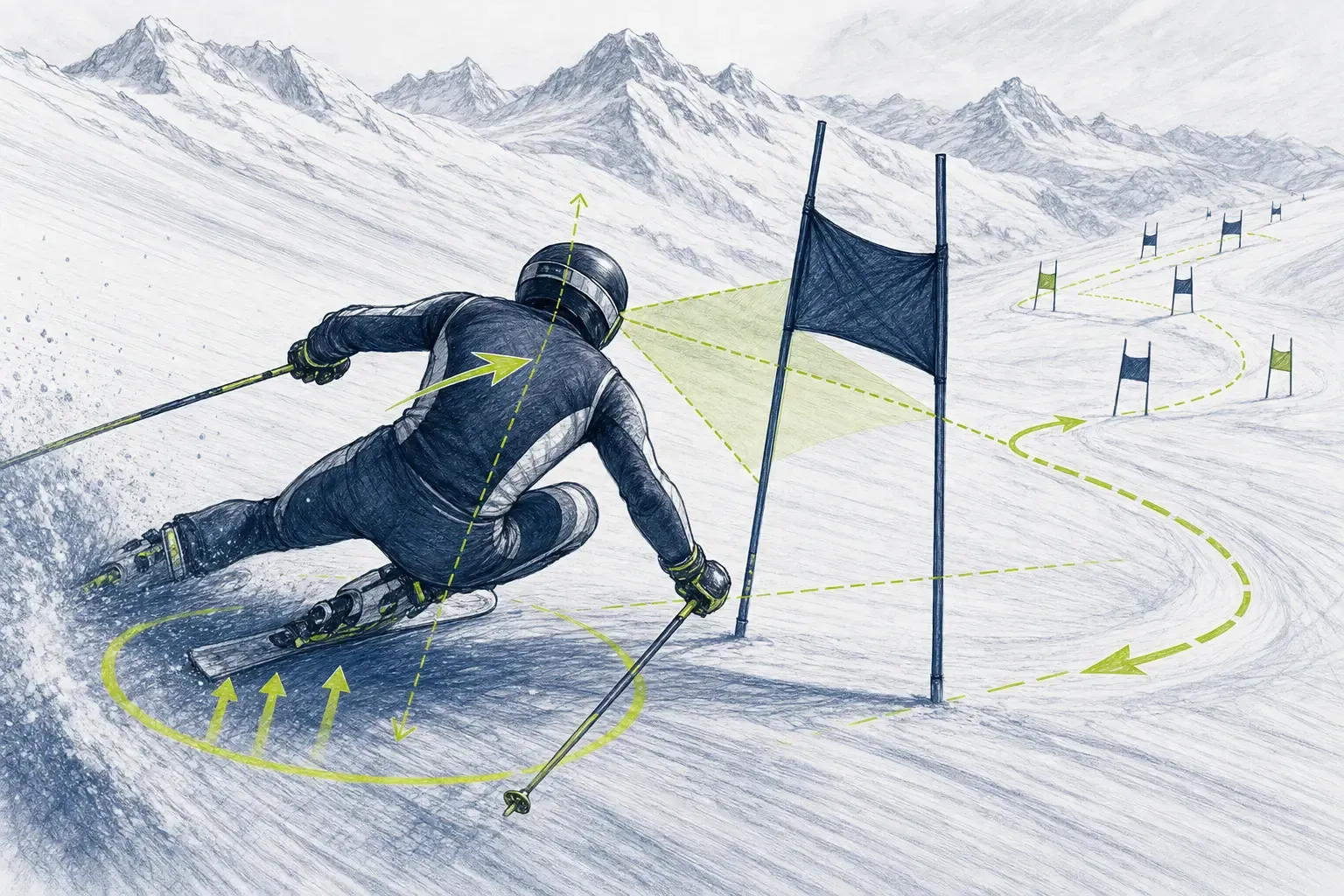
Agility on skis
A skier continuously processes information about the slope and terrain features, the snow surface, speed, the distance from a gate or other skiers. Based on this, they adjust the line, timing of movement, edging and pressure distribution. In a race course, the order of the gates is known in advance, but the exact solution of the turn must constantly adapt to the current speed, conditions and the movement that came before it.
Agility is therefore not just “quick feet.” It is built on technical ski skills – pressure management, edging, turning the skis and balance. U.S. Ski & Snowboard uses exactly these four areas in the progressive assessment of basic skills in young skiers.
It is important to distinguish between agility and pre-planned change of direction (change of direction, COD). Running between cones along a known course can test acceleration, braking and turning technique, but without an unpredictable stimulus it does not assess agility as a whole. Research therefore recommends distinguishing between predetermined movement tests and tasks in which the athlete must first perceive and decide.
Children's context
The development of agility in children is not even. It is influenced by age, biological maturation, movement experience and the nature of the sport. As children get older, the importance of anticipation and decision-making may increase, while in younger children performance relies more on basic coordination, speed and the ability to handle a change of direction. Results therefore cannot be assessed only by calendar age, nor can all children in a group be compared mechanically.
In training practice a young skier's coordination is developed mainly through varied tasks, not premature narrow specialization. Off snow, you can use tag games, ball games, simple obstacle courses, movement on a signal, changes of direction and tasks with different forms of locomotion. On snow, suitable options include games and exercises with changing tracks, skiing in varied terrain, following a partner, reacting to a cue or choosing between several line options. The difficulty should match the child's technical level and the conditions on the slope.
The official SkillsQuest methodology emphasizes fundamental movement patterns, coordination in different positions and situations, and progression appropriate to the athlete's stage of development in the long-term development of skiers.
Typical misconceptions
- A fast ladder automatically means good agility. A coordination ladder can serve as one of the tools, but a predictable sequence without decision-making mainly tests a learned movement pattern.
- The faster the task, the better the training. If a child is losing balance, directional control, or proper posture, higher speed may only reinforce incorrect movement.
- Agility can be assessed with a single time. The result is influenced by technique, speed, strength, experience, and the ability to recognize a stimulus. One test does not show a child’s full movement profile.
- Any random task is useful. Unpredictability should have a clear purpose and must not exceed the child’s ability to resolve the situation safely.
The coach’s view
The coach does not only watch how quickly the child finishes the task. They notice whether the child picks up the stimulus in time, chooses an appropriate solution, can brake and accelerate, changes direction to both sides, and stays balanced throughout. Reactive components of agility can be trained, but evidence of their development in youth also shows the importance of age, maturation, and the specific sports environment.
Appropriate progression leads from mastering the basic movement, through choosing from several options, to a more open situation. On the slope, speed, task complexity, traffic density, and terrain difficulty should not increase at the same time. The coach chooses specific exercises and their conditions according to age, skiing level, fatigue, and the group’s safety.
Sources and further reading
- Sheppard, J. M.; Young, W. B.: Agility literature review: classifications, training and testing
- Thieschäfer, L.; Büsch, D.: Development and trainability of agility in youth – a systematic scoping review
- Young, W.; Rayner, R.; Talpey, S.: It's Time to Change Direction on Agility Research
- Serpell, B. G. et al.: Are the perceptual and decision-making components of agility trainable?
- Horníková, H.; Hadža, R.; Zemková, E.: The Contribution of Perceptual-Cognitive Skills to Reactive Agility in Early and Middle Adolescent Soccer Players
- U.S. Ski & Snowboard: SkillsQuest
- U.S. Ski & Snowboard: SkillsQuest-Fitness Manual 2024
- U.S. Ski & Snowboard: Descriptions SkillsQuest Drills 2017