What Ski Training Is
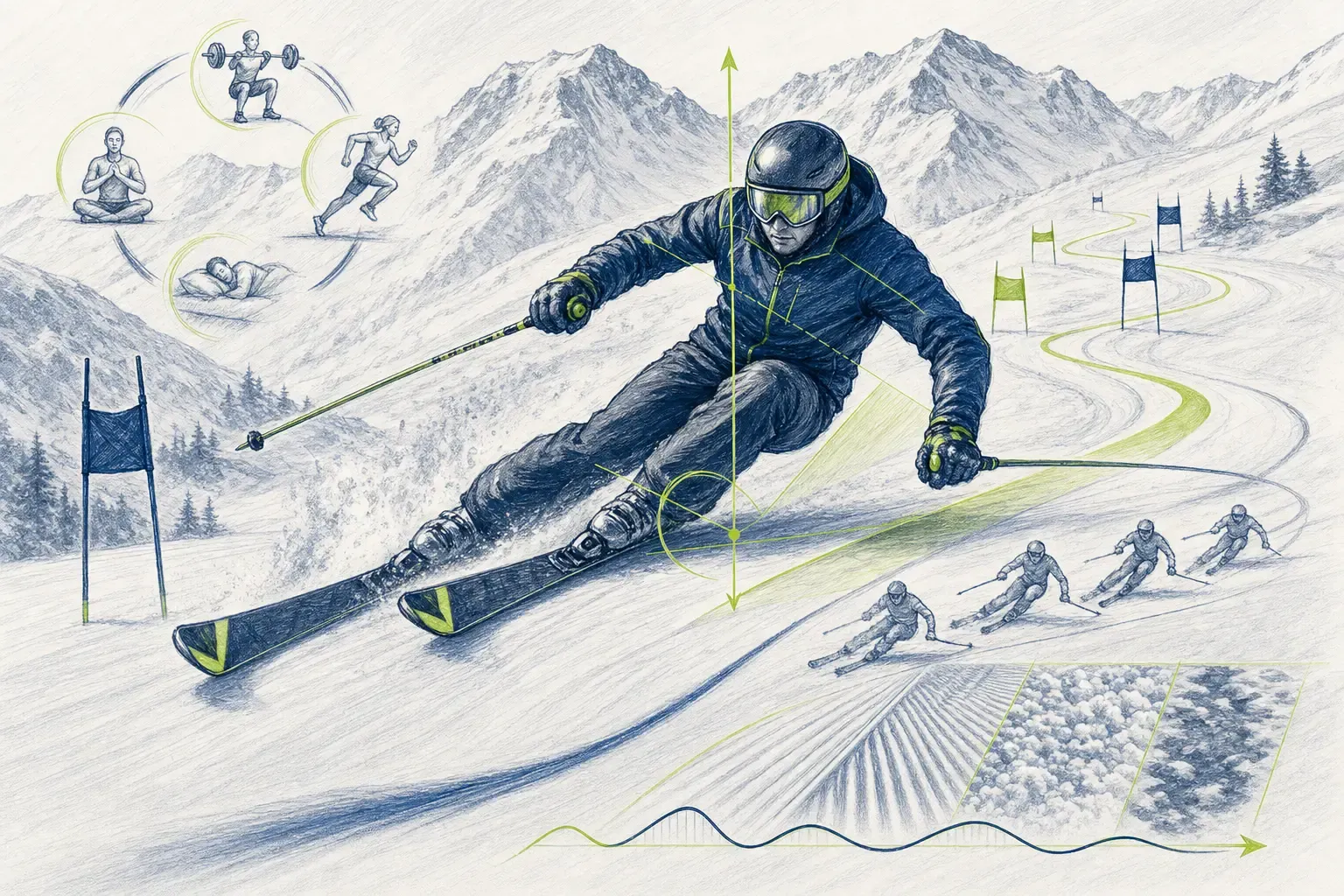
Ski Training is a planned process through which a skier develops movement skills, technique, tactical decision-making, fitness, mental resilience, and independence. It takes place on snow and off snow, and includes appropriate load, rest, evaluation, and a gradual increase in difficulty.
The sheer number of days on snow, kilometers skied, or runs through gates does not yet determine training quality. What matters is what the skier is learning, under what conditions, with what level of fatigue, and whether the acquired skill can also be used on different terrain, at a different rhythm, or in a different turn shape. Official development systems from U.S. Ski & Snowboard and Alpine Canada therefore view skier preparation as a long-term process and emphasize fundamental skiing skills, age-appropriate development, and a gradual transition to specialized performance.
What Training Includes
Technical Preparation
Its goal is purposeful control of skis and balance. This includes working on stance, edging, pressure, rotation, transition between turns, and adapting movement to speed, snow, and terrain. Technique is not developed only through isolated drills. It also needs plenty of quality free skiing, different turn radii, changes of rhythm, terrain waves, and varied snow conditions.
In children’s training, the skill base should be broad. U.S. Ski & Snowboard explicitly emphasizes free skiing, basic skills, and age-appropriate tasks or courses. Narrowing training too early to repeated runs in one discipline may bring short-term results, but it does not create an all-round skier.
Tactical Preparation
Tactics means choosing the line, timing the turn, reacting to the terrain, rhythm, and gate spacing. A child does not learn it by memorizing one “correct” line, but by solving age-appropriate tasks. The coach can change distances, direction, slope angle, or gate type so that a clear movement problem emerges.
Gate training is therefore not just about timing. Gates can highlight rhythm, precision, earlier turn setup, or the ability to adapt. The stopwatch only matters when the coach evaluates the final time together with technique, conditions, and the goal of the run.
Fitness and General Movement Preparation
Alpine skiing combines high technical demands with the action of significant internal and external forces. Fitness preparation therefore develops strength, speed, coordination, balance, mobility, endurance, and the ability to handle repeated load, according to age and level. It should not be a punishment or thoughtless copying of adult racers’ training.
For younger children, varied movement has great value: running, jumping, climbing, gymnastics tasks, ball games, skating, or cycling. Strength exercises are chosen according to technical readiness and carried out under qualified supervision. A universal plan based on chronological age is not enough.
Mental Preparation and Sports Habits
Training gradually develops focus, courage appropriate to the situation, coping with mistakes, communication, responsibility for equipment, and the ability to accept feedback. For children, it is important that the result of one race does not define their value or their place in the group. Long-term development also includes the joy of skiing, self-confidence, and a willingness to learn.
A child is not a miniature adult racer
A proven principle of long-term development Training is adapted to the athlete’s developmental stage. Children of the same calendar age can differ greatly in physical growth, maturation, experience, and ability to process instructions. Growth and maturation affect how well they handle training and races, so development should not be assessed only by immediate results.
For a younger or less experienced skier, shorter and easy-to-understand tasks, frequent changes of activity, and safe terrain are appropriate. An older and technically more advanced racer can work in longer blocks, with more precise tactical instructions and an individual plan. The move between levels should be determined not only by age, but also by readiness, experience, and quality of execution.
Official development models give approximate training and competition volumes for each stage. They describe them as a framework that must, however, be adapted to the specific skier, conditions, goals, and the club’s possibilities. They are not a universal rule for the number of days on snow for every child.
Load, recovery, and safety
A training effect comes from alternating load and recovery. The overall load also includes school, travel, lack of sleep, cold, stress, or several sports activities in one day. Fatigue may show up as a loss of precision, slower reactions, worse balance, or reduced concentration.
In everyday training practice the coach adjusts the number of runs, the difficulty of the course, the terrain, or the goal of the session based on these signs. Continuing at any cost is not a sign of good training. Pain, signs of injury, or health problems belong in the hands of a medical professional; neither the coach nor this glossary can replace a proper medical examination.
Training and race rules
It is necessary to distinguish rule and training method. Races are governed by the current rules of the relevant organization, the race regulations, and the decisions of the responsible officials. A training course may be intentionally simpler, shorter, or methodically adjusted, as long as it serves the safe practice of a specific skill.
When preparing for a competition, however, the coach must know the valid rules of the discipline, the course requirements, and the equipment requirements. As of 2. September 2026, FIS listed the International Competition Rules edition from 6. July 2026 among the current alpine skiing documents. Before a specific race, always check the current FIS rules as well as the national and competition regulations.
Typical mistakes and misunderstandings
- confusing quality training with the highest possible number of runs or gates,
- copying an adult racer’s program regardless of the child’s development,
- too many technical instructions in one run,
- judging learning only by time or placing,
- neglecting free skiing and all-round development,
- increasing difficulty before the movement is stable in easier conditions,
- ignoring fatigue, cold, fear, or a drop in concentration,
- the same expectations for all children in one age group.
The coach’s perspective
A good training session has a clear but appropriate goal. The coach chooses the terrain and exercises according to the group’s abilities, watches the children’s reactions, and adjusts the task as needed. Feedback should be brief, specific, and focused on what the skier can influence on the next run.
The long-term goal is not a child who can follow one learned instruction, but a skier who can ski safely, understand the situation, adapt, and want to keep improving.
Sources and further reading
- FIS – Alpine Skiing Documents and current International Competition Rules
- U.S. Ski & Snowboard – Training Systems
- U.S. Ski & Snowboard – Alpine Training System
- U.S. Ski & Snowboard – 2021/2022 Alpine Guide
- Alpine Canada – Planning for Performance
- Alpine Canada – Growth and Maturation
- Alpine Canada – Physical Fitness
- Alpine Canada – LTAD Reference Materials