What concentration is
Concentration is the practical ability to direct attention: to pick out the essential stimulus, stay with it for as long as the task requires, shift attention at the right moment, and return to the task after being distracted. So it is not only about focusing on one thing for a long time.
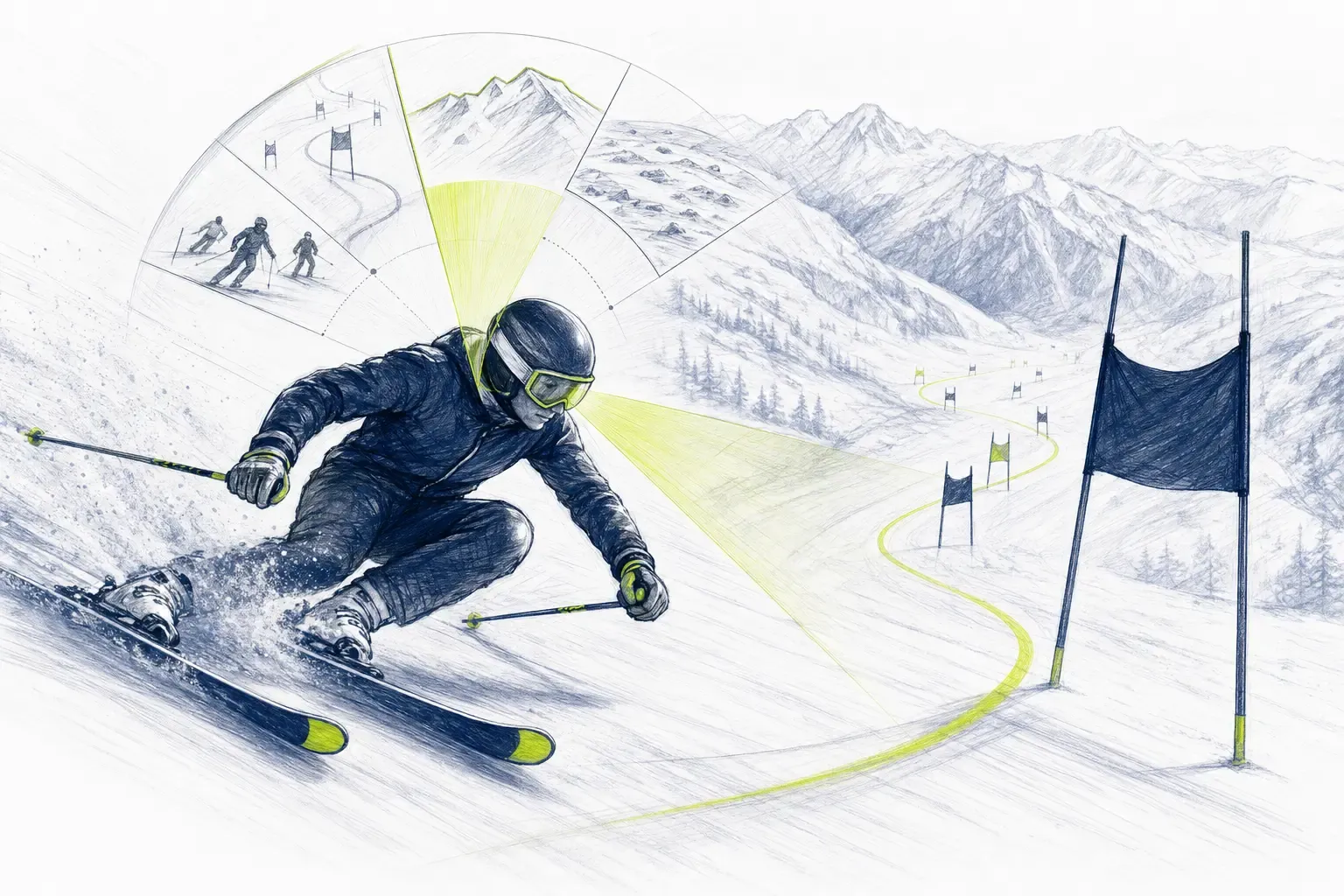
In alpine skiing, the important information changes quickly. The skier watches the direction of travel, the slope profile, the snow surface, the next gates, or the other people on the slope. At the same time, they carry out learned movements. Good concentration means that their attention is directed mainly toward the information that is useful at that moment for safe and effective skiing.
Concentration is not the same as stiffness, holding your breath, or a tense effort not to make a mistake. Too much control of every small movement can disrupt smooth coordination, especially when the skill has already been learned.
Internal and external focus of attention
When learning movement, two often studied ways of focusing attention are distinguished:
- internal focus is directed at the body itself or its movement, for example at the position of the knees or hands,
- external focus is directed at the effect of the movement or at the environment, for example at the track of the skis, the direction of the turn, or the space the skier wants to continue into.
Research on motor learning in many sports often finds an advantage of external focus, including in children. However, children’s studies use different tasks and age groups, and the quality of the evidence is not the same in all areas. The results therefore cannot be turned into a rule that an internal cue is always wrong.[1][2][5][6]
A review article on coaching cues points out that internal cues can be useful when deliberately changing a specific position or movement, while external focus more often supports overall coordination and the outcome of the movement.[4] In ski practice, it therefore depends on the child’s level, the goal of the exercise, and whether the coach is currently explaining a new element, correcting a specific mistake, or asking for smooth skiing.
Concentration in children
A child’s ability to work with attention develops over time. A coach should therefore not treat every distraction as disobedience or a lack of effort. The instruction must match the child’s age, experience, understanding, and the difficulty of the environment.
Good training practice usually includes:
- one main task instead of a list of multiple corrections,
- a short, specific, and age-appropriate instruction,
- a clear demonstration, a line in the snow, a colored spot, or another visible cue,
- alternating a focused task with freer skiing or play,
- the question of what the child should focus on during the next run,
- the opportunity for a more experienced young skier to have a say in when they want feedback.
Research in children suggests possible benefits of visual cues and feedback provided at the moment the athlete asks for it. However, the authors of the systematic review formulate these recommendations cautiously because of the variability and limited methodological quality of the available studies.[2] There is therefore no universal number of minutes that a child of a certain age should be able to concentrate without a break.
Concentration in ski racing
In races, the focus of attention changes according to the phase of performance. During the course inspection, the racer builds an image of the line, rhythm, terrain changes, and challenging sections. Before the start, they need to limit distracting stimuli and remember only the most important plan. During the run, attention shifts to the next gates, direction, and current conditions.
A simple pre-start routine is considered a useful tool in training practice. It may include checking readiness, one or two key points of the run, a brief calming moment, and a clear signal to begin the performance. Its exact form is individual and is not a race rule. For a child, it should be short, understandable, and practiced in training, not introduced for the first time just before an important start.
After a mistake, the ability to restore attention is crucial. Thinking about a gate already passed takes attention away from the next section. The coach can practice a simple return cue, for example a short word connected with the next task. The goal is not to deny the mistake, but to postpone evaluating it until after the run.
Typical mistakes and misunderstandings
- Too many instructions at once: the child has to choose between several physical, technical, and tactical tasks.
- An unclear instruction focus: does not say what the athlete should direct attention to.
- Focusing on what not to do: the instruction do not think about the mistake can repeatedly bring attention back to the mistake. It is more useful to name the desired task.
- Following the result during the run: thoughts about time, placing, or the expectations of those around distract attention from the current course.
- Confusing a technical error with lack of attention: the athlete may understand the task and focus on it, but may still not have the necessary movement skill.
- Rigid self-monitoring: constantly thinking about every part of the body can disrupt automated movement.
The coach's view
A coach does not develop concentration only by urging, but above all by organizing the task well. They should be able to say which stimulus is currently decisive and why. Instead of the general stay focused, they can assign observe the point where the turn starts, watch the next gate, or compare your line with the marked line.
After the run, it is appropriate to first find out what the athlete was watching and what they felt, and only then add evaluation. That way the coach can distinguish misunderstanding of the instruction, inappropriate focus of attention, and insufficiently learned technique. Gradually, more demanding terrain, a variable rhythm, or mild distractions can be added. However, safety, appropriate speed, and mastering the basic task take priority over mental strain.
Available research supports the importance of attention, motivation, and an appropriate degree of autonomy in motor learning.[3] Most of the cited studies, however, were not conducted directly in alpine skiing. Transferring their results to ski training is therefore a training application by experts, not proof that one type of instruction will work equally well for every child and in every ski situation.
Sources and further reading
- Eguia, Ng, Wong: Attentional Focus Strategies for Promoting Children's Motor Learning – scoping review
- van der Veer et al.: How can instructions and feedback with external focus be shaped to enhance motor learning in children?
- Lewthwaite, Wulf: Optimizing motivation and attention for motor performance and learning
- Werner, Federolf: Focus of Attention in Coach Instructions for Technique Training in Sports
- Brocken, Kal, van der Kamp: Focus of Attention in Children's Motor Learning – age and working memory
- Perreault, French: Differences in children's thinking and learning during attentional focus instruction
- Starzak et al.: Attentional focus strategies in racket sports – systematic review