What Safety on the Slope Means
Safety on the Slope is the ability to ski in control, anticipate the movement of others, and follow trail rules, the operator’s instructions, and the training organization. It does not mean removing every risk. It means reducing it appropriately through sound decisions, technique, terrain choice, and equipment.
It is based on the FIS Code of Conduct, Slovak law, local operating rules, and resort signage. The FIS rules are a generally recognized code, but they do not replace legal regulations or the specific rules of a given area, training slope, or competition.[1][2][6]
Basic Riding Rules
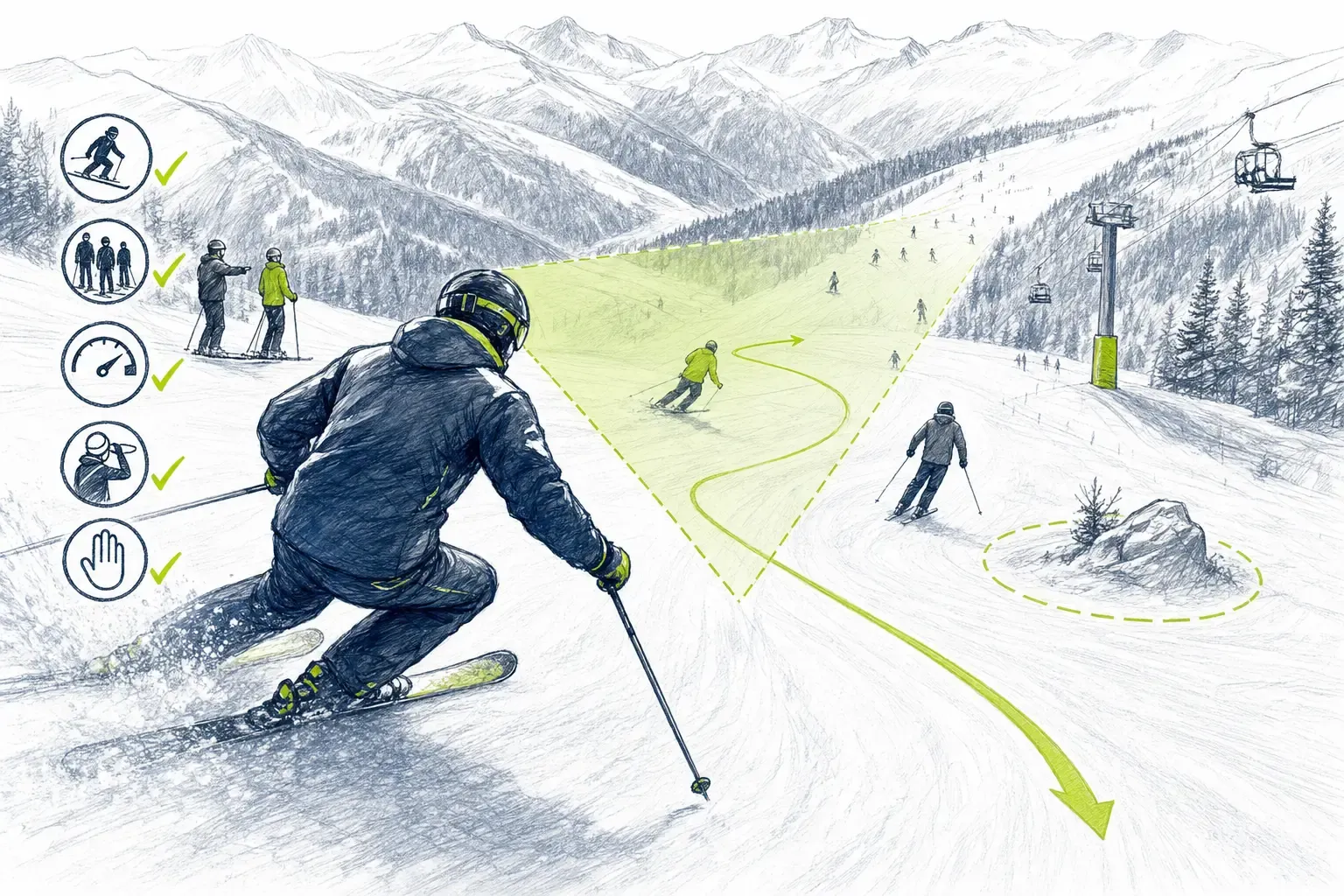
A skier must ride in a way that does not endanger others. Speed and style must be adapted to their ability, the terrain, snow conditions, visibility, and traffic density. It is not enough to know how to turn: a skier must be able to slow down, stop, or safely avoid an obstacle within the space they can see.[1][2]
The following principles apply in particular when moving on a trail:
- The skier lower on the slope has priority. A skier coming from behind must choose a line that does not endanger others.
- Check the slope before setting off. This applies when entering the trail, after stopping, and when crossing the slope.
- Overtaking is allowed only with enough distance. The skier being passed must have room to change direction naturally.
- Stop in a visible place. Narrow sections, terrain breaks, the area right under a crest, and the middle of a busy trail are not suitable.
- Walking belongs at the edge of the trail. Skis, poles, or other equipment must not create an obstacle.
- Signs and closures are binding. Do not enter a closed trail or a closed area.
- Secure equipment against sliding away on its own. Working ski brakes or another designated system prevent equipment from sliding away uncontrollably.[1][3]
A skier who skis technically well but too fast for the traffic or visibility is not skiing safely. Safe speed is therefore not a single number; it changes depending on the situation.
Children on the slope
In Slovakia, a skier or snowboarder younger than 15 years old must wear a properly fastened protective helmet on a ski slope.[2] In club practice, a helmet should be a given for the whole children’s group. It must fit properly and be used according to the manufacturer’s instructions. However, a helmet does not replace speed control, keeping distance, or choosing the right slope.
Younger children need simple organization. The coach chooses the stopping point, sets the order in which they ski, and gives short instructions appropriate to their age. A child should not start skiing just because the child ahead has moved off; they wait for the agreed signal. The spacing must allow safe stopping even if a member of the group falls.
Training practice: in group skiing, it works well to set a clear start and finish point, stop at the edge of a preselected clear section, and regularly check the number of children. This is not a separate FIS rule, but an organizational procedure that reduces chaos in the group.
The terrain must suit the weakest member of the group. A child who can make turns on an empty gentle slope may still not react safely in traffic, on ice, or in poor visibility. Fatigue, cold, and a drop in attention are a reason for a break or for ending the skiing, not for one last fast run.[4]
Chairlifts, tows, and snowpark
Before getting on, the child should know where to wait, when to load, and what to do if the loading fails. If help is needed, ask the lift operator. Staff instructions and the local rules of the transport facility take priority over improvisation by a parent or group.[3]
A snowpark is not a regular piste. Before using a feature, the skier should inspect it, check the landing area, and not move on to a more difficult feature without mastering the easier movements. They respect the local order, signals, and the clear landing area. FIS emphasizes progression in learning, terrain inspection, planning, and proper use of protective equipment in snowparks.[5]
What to do in case of a fall or injury
In a normal fall, the skier should, if possible, clear the runout as soon as possible and check whether the child can stand up safely. If an injury is suspected, avoid unnecessary handling. The spot must remain visible to approaching skiers, and the resort staff or mountain rescue should be called according to local instructions.
Slovak law requires a person on a ski slope to provide assistance according to their abilities and possibilities, report the accident to the operator without delay, and remain at the scene until help arrives. FIS also requires assistance in case of an accident and identification of those involved, including witnesses.[1][2]
Race and coaching perspective
On a public slope, the priority remains the safety of others, even when the group is training sports technique. The coach must not place the exercise in an unclear or overly crowded area. Speed drills and gate skiing belong on a suitably secured and organized course.
In races and organized training, the general principles are supplemented by the current rules of the discipline, the organizer’s instructions, and local safety measures. Requirements for the course and protective gear should therefore not be transferred between disciplines or set according to outdated experience.[6]
The most common misunderstanding is the belief that good technique automatically means safe skiing. The coach also watches decision-making: where the child looks, where they stop, whether they keep distance, and whether they can reduce speed in time. Safe habits should be part of every exercise, not just the introductory briefing.
Sources and further reading
- [1] FIS – Code of Conduct for Skiers and Snowboarders
- [2] Slov-Lex – Act No. 544/2002 Coll., current version as of 1 January 2026
- [3] National Ski Areas Association – Your Responsibility Code
- [4] National Ski Areas Association – Skiing & Snowboarding Tips
- [5] FIS – Guidelines: Snowpark Code of Conduct
- [6] FIS – General Regulations and official document library