What a ski helmet is
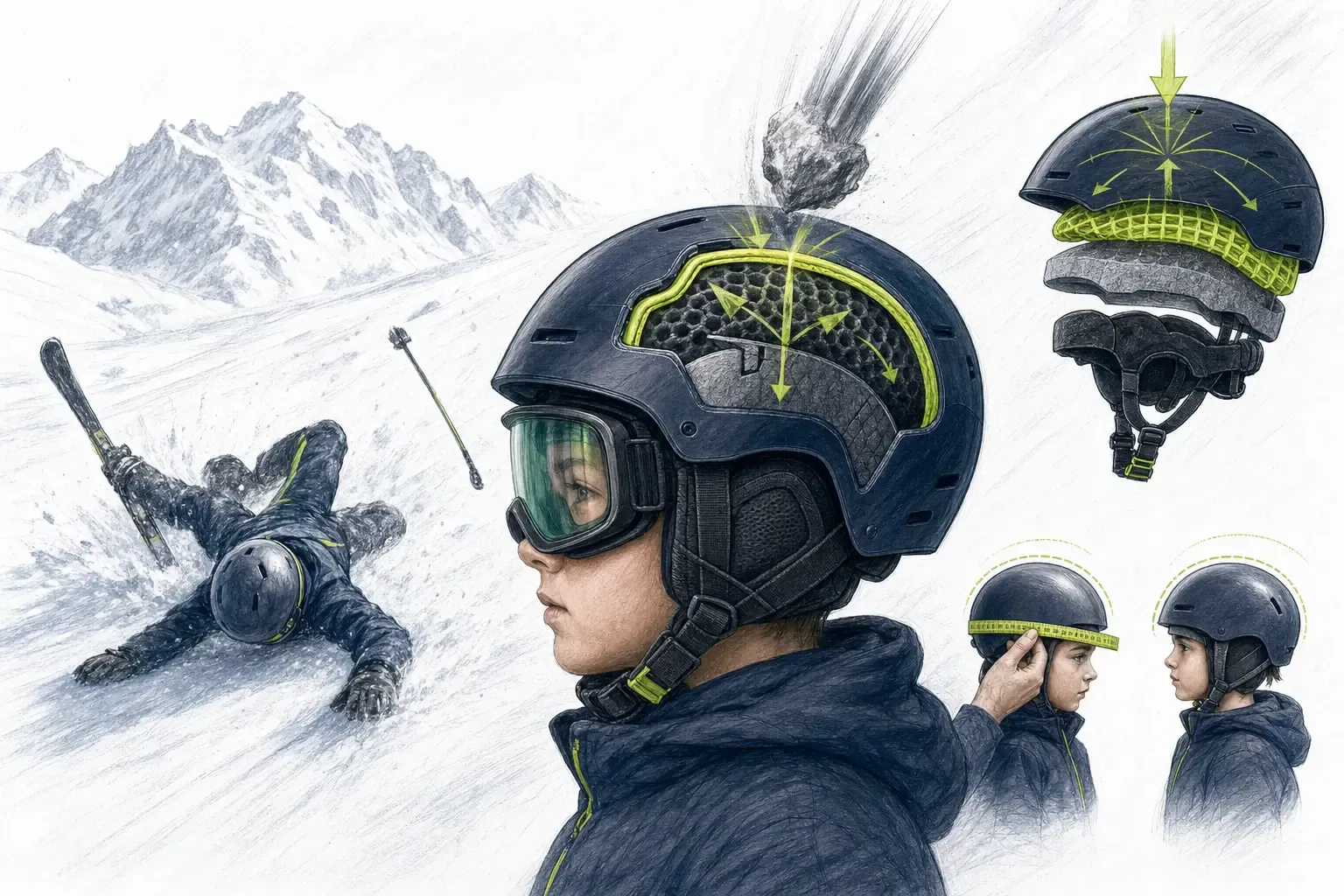
A ski helmet is a protective device whose task is to absorb part of the energy acting on the head in the event of an impact. It usually consists of an outer shell, an inner shock-absorbing layer, a fastening system, and a chin strap. It is not a bulletproof shield: it cannot prevent every injury and does not rule out concussion, facial injury, or injury to the cervical spine.
Systematic reviews of studies have shown that wearing a helmet while skiing and snowboarding reduces the risk of head injury. A meta-analysis that also included children likewise found no evidence that a helmet increases the risk of neck injury. That is a proven protective effect, not a guarantee of a safe outcome in every fall.
How the helmet should fit
The correct size is not determined only by age. Head circumference is the starting point, but the deciding factor is trying on a specific model according to the manufacturer’s instructions. Two children with the same head circumference may need different helmet shapes.
In a practical check, the helmet should:
- sit straight, not pushed back with the forehead exposed,
- fit snugly all around without painful pressure,
- stay stable with gentle head movement,
- have the strap fastened and properly tightened,
- work with goggles without a noticeable gap and without pushing each other out of place,
- allow the child to hear instructions normally and perceive the surroundings.
A helmet that is too large may shift in a fall. A helmet that is too small causes pressure, pain, and reluctance to wear it properly. Buying a helmet for a child “to grow into” is therefore not a good training practice. A thick hat should not be added under the helmet on one’s own if the manufacturer did not account for it in the fit; it can change the helmet’s position and stability.
A younger child usually cannot reliably judge the size or tighten the strap correctly. The check should therefore be done by a parent or coach, ideally before every entry onto the slope. The helmet should be fastened already during warm-up runs and ski transfers, not only during timed training runs.
Helmet condition and handling
Before use, check the shell, inner shock-absorbing layer, buckles, straps, and adjustment mechanism. After a strong impact, follow the manufacturer’s instructions and do not use the helmet just because there is no visible crack on the surface. The inner part may have been damaged without an obvious external mark.
With a used helmet, the problem may be an unknown impact history, improper storage, or a missing manual. Lifespan cannot be determined by one universal number of years for all products. The manufacturer’s instructions, the helmet’s condition, and the way it is used are decisive. Chemicals, solvents, unsuitable adhesives, drilling, or unapproved modifications may damage the material or change the helmet’s properties.
Children’s and training context
A helmet does not replace instruction in speed control, safe stopping, choosing a line, and respecting other skiers. A coach sees it as one layer of protection together with suitable terrain, group organization, sensible speed, and the child’s technical readiness.
After a head impact, whether training can continue is not judged by whether the helmet stayed intact. Even a skier wearing a helmet can suffer a concussion; a study of young skiers and snowboarders with head injuries did not show that wearing a helmet alone ruled out concussion. If a head injury is suspected, the club’s or resort’s health and emergency protocol is followed, and the child does not return to the slope based only on how they feel.
Helmets in competitive skiing
In races, it is not enough that a product looks like a race helmet or is commonly sold for skiing. FIS issues seasonal specifications for competition equipment and distinguishes helmet requirements by discipline. For the 2026/27 season, a separate document valid from July 2026 is published.
Before the start, the coach or the person responsible for equipment must check the current FIS rules, the national federation rules, and the regulations of the specific race. The required certification and helmet markings for the given discipline are checked in particular. Older specifications cannot be automatically considered valid for the current season.
FIS also points out that a helmet must be used in accordance with the manufacturer’s instructions and does not provide absolute protection against the consequences of an accident. A recreational helmet therefore may not meet race requirements, even if it is suitable for regular skiing.
Typical mistakes
- helmet pushed back and forehead exposed,
- strap unfastened or loose,
- size chosen only by age,
- helmet bought with a large allowance for growth,
- unsuitable combination of helmet and goggles,
- continued use after a hard impact without checking the manufacturer’s instructions,
- the assumption that a helmet allows you to ski faster or more recklessly,
- using a recreational model in races without checking the rules.
From a coach’s point of view, the best helmet is the one intended for the activity, fits the child properly, is always fastened, and does not lead to a false sense of invincibility.
Sources and further reading
- FIS – Specifications for Alpine Competition Equipment 2026/27, document valid from July 2026
- FIS – Alpine Skiing Documents
- FIS – Specifications for Alpine Competition Equipment 2025/2026
- Russell et al. – The effect of helmets on the risk of head and neck injuries among skiers and snowboarders: a meta-analysis
- Cusimano and Kwok – The effectiveness of helmet wear in skiers and snowboarders: a systematic review
- Haider et al. – An evidence-based review: efficacy of safety helmets in recreational skiers and snowboarders
- Canadian Paediatric Society – Skiing and snowboarding injury prevention
- Maat et al. – The spectrum of pediatric injuries sustained in snow sports
- Concussion Among Youth Skiers and Snowboarders – National Trauma Data Bank review