Warm-up is a planned transition from rest or normal daily activity to skiing load. Its purpose is to prepare the musculoskeletal system, coordination, attention, and ski-specific movements without fatiguing the athlete before training or the start.
Warm-up is often incorrectly equated only with stretching. In sports practice, it is a broader whole: gradual activation, mobility needed for the given activity, balance and coordination tasks, appropriate strength or jumping movements, and finally preparation directly on skis.
What we know about warm-up
Research in youth sport mainly supports regular multicomponent warm-up, which combines coordination, balance, strength, movement control, and sport-specific tasks. A systematic review of 15 studies in children and adolescents found a lower rate of sports injuries with such programs. However, this result cannot be seen as a guarantee of individual protection, nor can it be unreservedly transferred to alpine skiing.
The benefit also depends on regularity and proper execution. A newer systematic review of neuromuscular warm-ups in youth sport identifies adherence to the program, available methodological materials, and coach support as important factors.
Findings from handball and children’s football showed that structured programs focused on balance, strength, change of direction, and controlled landings can reduce the occurrence of some injuries. However, these are findings from other sports, not a direct prescription for young skiers.
The importance of quality movement preparation is also highlighted by FIS data: in tracked elite alpine skiing, the knee was among the most frequently injured areas. Warm-up alone cannot eliminate the risks of speed, falls, fatigue, the course, or unsuitable equipment, but it is one of the modifiable parts of an athlete’s preparation. FIS has included the development of recommendations for warm-up and cool-down after exertion among the topics of its injury prevention program.
What warm-up for a skier can look like
The following breakdown presents training practice, not a single FIS rule. The coach determines the specific exercises, their number, and their difficulty based on age, experience, health status, surface, weather, and the planned training session.
1. Overall activation Walking, light jogging, small side steps, arm work, or a simple movement game gradually prepare the child for the next tasks. In cold weather, it is not suitable to start with sudden sprints or maximum jumps.
2. Active mobility Controlled movements of the ankles, knees, hips, trunk, and shoulders are performed within a range that the child can safely control. Long passive holding in an end range is not a full replacement for active warm-up.
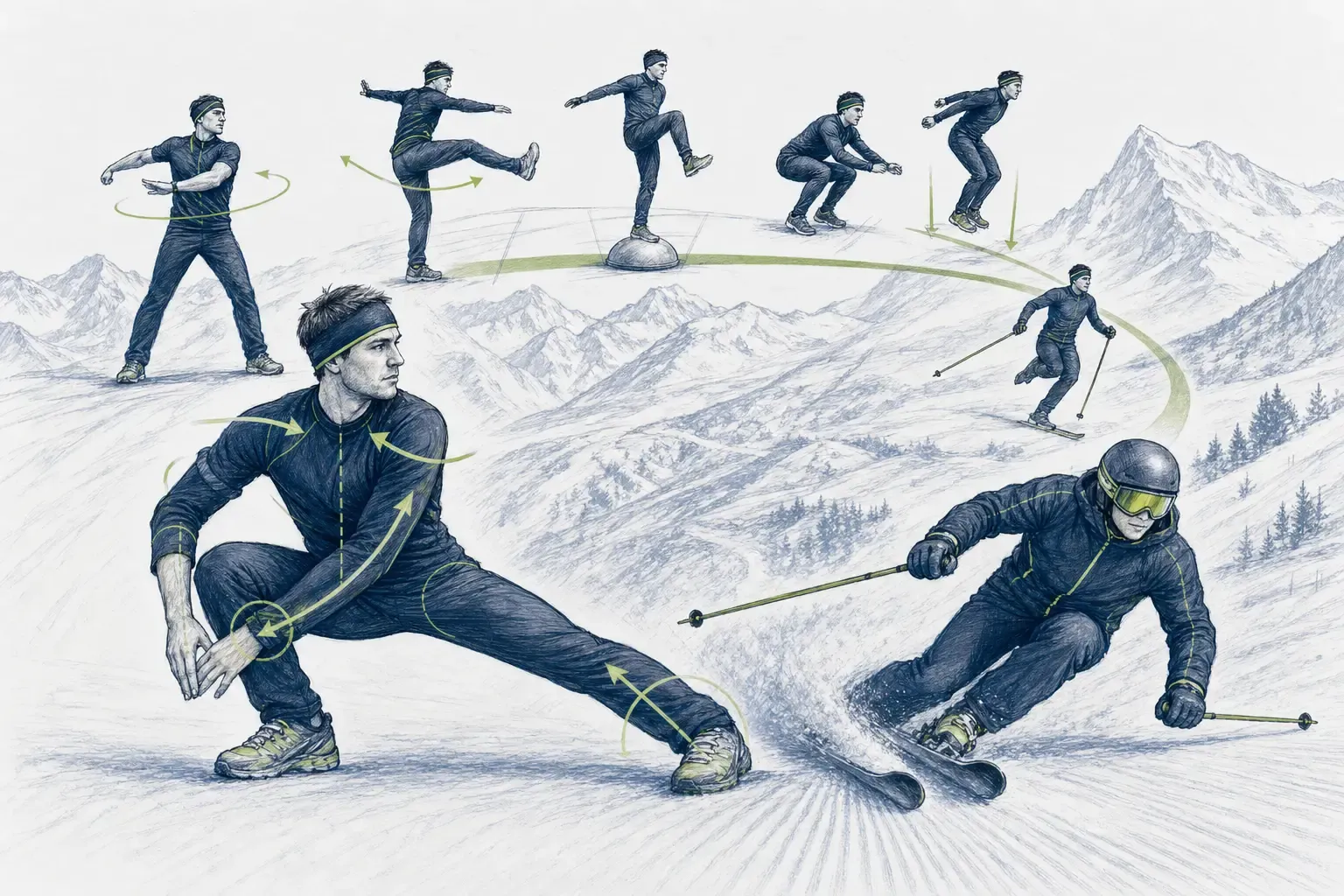
3. Balance and movement control You can use a stable one-leg stand, a suitable squat, weight shifting, side steps, or a controlled landing. Hops and more demanding balance tasks make sense only when they match the child’s level and the surface is not slippery or uneven.
4. Ski-specific preparation The coach can include the basic skiing stance, work with the ankles and knees, movement of the center of gravity, trunk stabilization, and imitation of the rhythm of turns. The goal is not to practice complex technique without skis, but to remind athletes of the movement tasks of the next training session.
5. Gradual warm-up on snow The first runs are usually technically easier and with some reserve in speed. Only then does the pace, slope steepness, edging intensity, or course difficulty increase. A dry-land warm-up therefore does not replace an appropriate warm-up on skis.
Children's warm-up
Younger children usually respond better to short, easy-to-understand tasks and movement games than to a long series of isolated exercises. The coach should demonstrate the movement, use simple instructions, and monitor the quality of execution. Chronological age alone is not enough: children of the same age can differ significantly in motor level, physical development, and experience on snow.
A warm-up must not be used to “work off” pain or a fresh injury. In case of pain, unusual movement restriction, or return after an injury, the procedure is determined by a healthcare professional in cooperation with the coach. Extra attention is also needed when moving in ski boots, with poles, and on icy ground.
Race context
Before a race, warm-up should prepare the athlete, not exhaust them. The content can reflect the discipline: slalom requires readiness for quick changes of rhythm, while longer and faster disciplines place different demands on stability and concentration. However, there is no universal recipe.
Waiting at the start, traveling by chairlift, or bad weather can weaken the effect of the previous activation. Training practice therefore includes keeping warm and, when possible, a short re-activation before the start. Race day is not suitable for trying new or overly demanding exercises.
Typical mistakes
- the warm-up consists of only a few static positions,
- it starts with explosive movements without gradual activation,
- the program is the same for a small child and a teenage racer,
- the exercises are so demanding that they worsen technique or tire the athlete,
- the warm-up ends too long before the run and is followed by a long wait,
- the first run on snow is done immediately at full speed,
- the coach prioritizes the number of repetitions over precision and safety of movement.
From the coach’s point of view, a good warm-up is short, purposeful, gradual, and linked to the training content. Its quality does not lie in the number of exercises, but in whether the child appears focused after it ends, moves in a controlled way, and is ready to start skiing safely.
Sources and further reading
- Ding et al. – Effectiveness of Warm-Up Intervention Programs to Prevent Sports Injuries among Children and Adolescents: A Systematic Review and Meta-Analysis
- Lutz et al. – Best practices for the dissemination and implementation of neuromuscular training injury prevention warm-ups in youth team sport
- Herman et al. – The effectiveness of neuromuscular warm-up strategies for preventing lower limb injuries during sports participation
- Olsen et al. – Exercises to prevent lower limb injuries in youth sports: cluster randomised controlled trial
- Rössler et al. – A Multinational Cluster Randomised Controlled Trial to Assess the Efficacy of 11+ Kids
- FIS Injury Surveillance System 2006–2019
- FIS Injury Prevention and Health Protection – Five-Year Plan 2025–2030