Definition
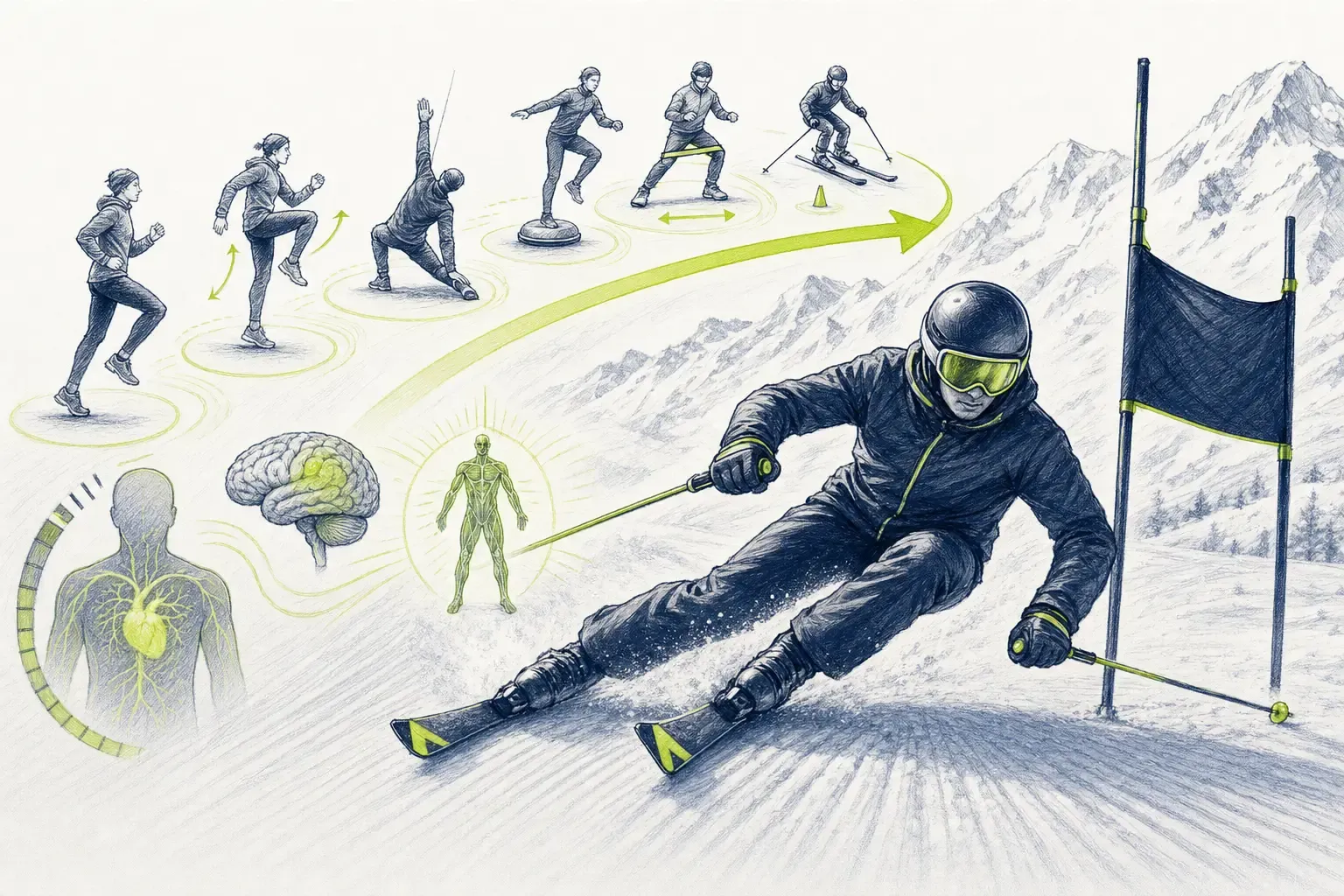
Activation in training practice is a targeted part of the warm-up that prepares the neuromuscular system, stability, coordination, body position awareness, and attention for the skiing that follows. It is not a separate FIS rule or a precisely prescribed set of exercises. The consensus of the International Ski and Snowboard Federation includes muscle activation among the goals of the warm-up, along with raising heart rate, blood flow, and body temperature, mobility, proprioception, and stability.
Activation therefore forms one part of broader preparation. Warm-up includes all physical and mental activities before training or competition; activation focuses mainly on readiness to perform a specific movement quickly, accurately, and under control.
What it looks like in skiing
Suitable preparation progresses from simple movement to ski-specific tasks. First it can include light movement that raises body temperature, then dynamic mobility, stabilization and coordination tasks, and finally short movements similar to what a skier does on the slope. The FIS consensus recommends thinking about cardiovascular, movement, metabolic, and motor readiness; in racing skiing, depending on conditions, this also includes warm-up runs on snow.
Examples from training practice are short jumps with controlled landing, changes of direction, balance tasks, squats and lunges within a suitable range, trunk movements, reaction games, or imitation of a skiing stance. On snow, activation can continue with progressive free runs, changes in rhythm, and simple technical tasks. This is not a mandatory list: the choice depends on age, experience, discipline, temperature, surface, and the skier’s current condition.
Systematic reviews from youth sport show that programs combining strength, balance, coordination, agility, and movement control can support motor skills and some indicators of performance. However, the results cannot automatically be turned into one universal activation routine for all children, nor transferred without adjustment from other sports to alpine skiing.
Activation in children
In younger children it should be short, easy to understand, and often led in the form of a game. More important than a large number of repetitions is the quality of the basic movements: soft and stable landing, maintaining balance, spatial orientation, and responding to a simple cue. As age and training experience increase, more precise tasks can be included according to the discipline and expected riding intensity.
The scope should not be determined only by calendar age. Children of the same age can differ in physical development, coordination, experience, and response to load. Research on integrated neuromuscular training supports age-appropriate development of movement abilities, but also points to differences between programs and the outcomes being monitored.
Competition importance
Before the start, activation should prepare the racer without unnecessary fatigue. The coach can use short dynamic movements, reaction cues, and a mental reminder of the task. If a longer wait follows the warm-up, a short reactivation is usually added close to the start. This is a training procedure, not an FIS rule.
Activation does not replace course inspection, technical preparation, rest, clothing appropriate for the weather, or sensible energy management. Preventive neuromuscular warm-ups in youth sport can reduce the occurrence of some lower-limb injuries, but the evidence comes mainly from team sports. It therefore cannot be claimed that short activation alone will prevent an injury in skiing.
Common mistakes
- activation is confused with a few random exercises or just stretching,
- the intensity is so high that the child arrives at the slope tired,
- complex tasks are used that the skier is not yet technically able to perform,
- all members of the group receive the same set regardless of age and level,
- long explanations lead to getting cold and losing attention,
- activation exercises are considered a substitute for skiing technique or long-term fitness training.
Coach’s view
Good activation is not judged by whether the child “feels the burn in their muscles.” The coach watches whether the skier moves more confidently, responds to instructions, controls body alignment and landings, and is ready to increase intensity. An exercise should be simplified or ended if there is pain, dizziness, unusual fatigue, or loss of movement control. Activation is meant to prepare the skier for performance, not exhaust them before the first run.
Sources and further reading
- International Ski and Snowboard Federation consensus statement on warm-up and cool-down in competitive alpine and freestyle skiers and snowboarders
- Effectiveness of Warm-Up Intervention Programs to Prevent Sports Injuries among Children and Adolescents: A Systematic Review and Meta-Analysis
- Neuromuscular Training and Motor Control in Youth Athletes: A Meta-Analysis
- The efficacy of neuromuscular training, with minimal or no equipment, on performance of youth athletes: A systematic review with meta-analysis
- The effectiveness of neuromuscular warm-up strategies for preventing lower limb injuries during sports participation: a systematic review
- Effects of school-based neuromuscular training on fundamental movement skills and physical fitness in children: a systematic review
- The Road to Designing Integrated Neuromuscular Training Programs for Children and Adolescents: A Systematic Review and Meta-Analysis
- Best practices for the dissemination and implementation of neuromuscular training injury prevention warm-ups in youth team sport: a systematic review