What is strength
In sports training, strength is the ability of the neuromuscular system to create muscle tension and work against external resistance. It is not just about performance in the gym. Strength always also depends on body position, joint angles, movement speed, coordination, fatigue, and the way the muscles work.
For a skier, these forms of strength are especially important:
- maximum strength – the greatest force the athlete can produce in a specific task,
- fast and explosive strength – the ability to produce the required force in a very short time,
- strength endurance – the ability to repeatedly or for a longer time maintain strength performance without a significant decline in movement quality,
- eccentric strength – the ability to control load as the muscle lengthens, for example when absorbing an uneven surface or resisting external forces in a turn,
- isometric strength – creating muscle tension without a significant change in muscle length, which is used for example when stabilizing the trunk.
Strength and power are not exactly the same terms. Power also includes the speed of performing a movement. A child may be relatively strong but may not be able to produce strength quickly enough or time it correctly.
Importance in skiing
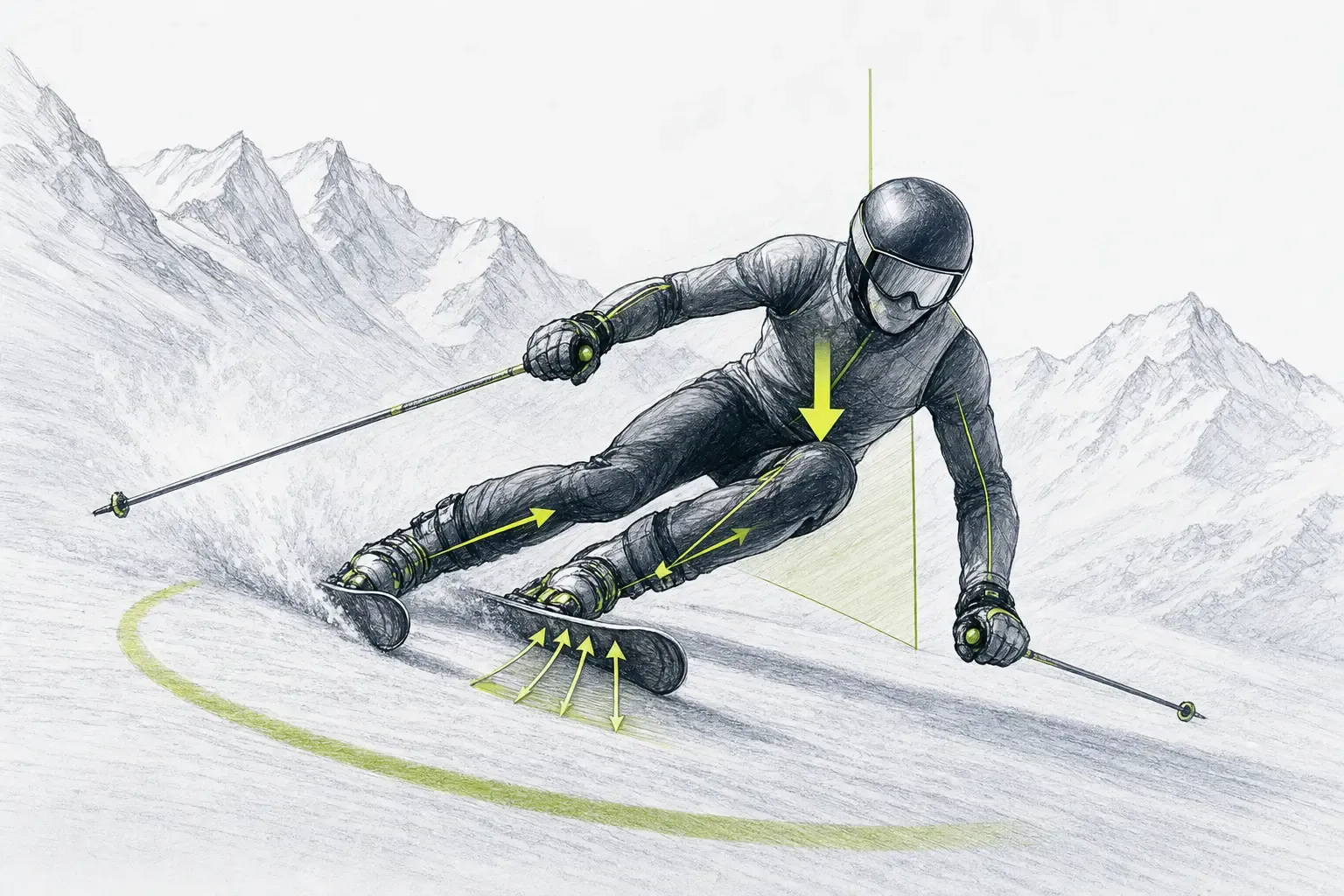
In alpine skiing, changing external forces act on the body. The skier must regulate pressure on the skis, maintain a functional position of the lower limbs and trunk, handle transitions between turns, and react to terrain. Expert overviews therefore include the strength of the lower limbs, hip area, and trunk among the essential fitness prerequisites, as well as explosiveness, balance, coordination, mobility, and endurance.
Strength helps the skier:
- maintain a stable yet mobile stance,
- control loading on the outside ski,
- resist unwanted deviation of the knee, hip, or torso,
- smoothly absorb and release pressure,
- dampen bumps and impacts,
- maintain technique quality even as fatigue builds,
- create an effective push-off at the start.
But greater strength does not automatically mean better technique or a faster run through the course. If a skier cannot time their strength well, moves stiffly, or uses an unsuitable movement pattern, fitness alone will not solve the problem.
Strength in children and young skiers
Expert opinions support appropriate and professionally supervised resistance training for children and adolescents. The conditions are suitable exercise selection, mastered technique, gradual increases in difficulty, a safe environment, and supervision by a qualified person. Calendar age alone is not enough to determine training load. Biological maturation, movement experience, ability to focus on instructions, health status, and previous training are also important.
In younger children, strength development can take the form of games, obstacle courses, climbing, hangs, supports, squats, carrying light objects, jumps, and controlled landings. The goal is mainly all-round development, proper movement habits, and appropriate control of one’s own body. Visible muscle growth is not the only or main indicator of improvement; better coordination and movement control play a significant role.
As experience increases, external resistance can also be used, such as rubber bands, medicine balls, machines, or free weights. Their inclusion is not decided by the effort to lift heavy loads as soon as possible, but by the athlete’s readiness to perform the exercise technically correctly and repeatedly.
WHO recommends that children and adolescents aged 5 to 17 years include muscle- and bone-strengthening activities at least three days a week. This is a general health recommendation, not an individual plan for a skier’s strength preparation.
Competition context
The international FIS consensus recommends developing and assessing strength together with endurance, speed, coordination, and agility, with testing matching the athlete’s age, sex, level, and needs. The result of a single strength test should therefore not be the only criterion for talent or race readiness.
In children, comparing only absolute lifted weight can be distorted by differences in body size and biological maturity. Coaches are also interested in relative strength, movement quality, lower-limb axis control, symmetry, trunk stability, and the ability to maintain technique under repeated load.
Typical mistakes and misconceptions
- Strength is confused with bodybuilding. Resistance training also includes working with your own body weight, jumps, throws, pulls, supports, and braking movement.
- Only the thighs are strengthened. Skiing requires cooperation of the foot, ankle, knee, hip, trunk, and upper body.
- Difficulty is increased before quality. More weight or more repetitions will not replace proper technique.
- Training adult competitors is copied over. The program of an elite skier does not match a child’s needs or recovery.
- Each set is performed to complete exhaustion. Excessive fatigue can worsen motor control and the subsequent ski training.
- Strength is trained without being tied to movement. A skier needs to know how to direct strength, time it, and combine it with balance and mobility.
Coach’s view
The coach does not only watch how much a child can carry or how many repetitions they can manage. More important is whether they keep control of the torso, knees, and feet during the exercise, whether they can safely brake the movement, and whether they maintain technique even with appropriate fatigue. Strength training is planned to support learning ski technique, not to leave the child exhausted for the slopes.
Load is increased gradually and individually. Pain, swelling, a marked loss of control, or long-term overload are not a normal training goal and require stopping the exercise and professional assessment. With health limitations, the decision belongs to cooperation between the coach, parent, and a qualified healthcare professional.
Sources and further reading
- International Ski and Snowboard Federation (FIS) consensus statement on training and testing in competitive alpine and freestyle skiers and snowboarders
- The Training of Olympic Alpine Ski Racers
- Position statement on youth resistance training: the 2014 International Consensus
- Youth resistance training: updated position statement paper from the National Strength and Conditioning Association
- WHO Guidelines on Physical Activity and Sedentary Behaviour
- Trunk Strength Characteristics of Elite Alpine Skiers – a Comparison with Physically Active Controls
- A Classification of Fitness Components in Elite Alpine Skiers: A Cluster Analysis