What a training run is
Training run is one intentional descent by a skier on a defined section of the slope or a marked course. It is part of training and has a pre-set task, for example arc control, balance on the outside ski, edge work, rhythm, line choice, or handling a specific gate combination.
It does not have to be timed and it does not have to go through gates. A free run on the slope can also be a training run if it has a clear purpose and the coach can evaluate it properly. Repeated descents without a defined task do not yet create quality training.
How a training run works
In practice, it is usually preceded by a short explanation of the task, or a demonstration. The skier then performs the task and the coach watches how well it is completed. Feedback may follow immediately, after a few runs, or using video footage. There is no need to correct everything at once; especially for a child, one clear main message is easier to process.
Run quality cannot be judged only by time. A coach can watch, for example:
- whether the skier maintained balance and speed control,
- where the turn began and ended,
- how they reacted to a change in rhythm or slope,
- whether they chose an appropriate line,
- whether they could repeat the same task,
- whether they skied safely in view of their abilities and the conditions.
Timekeeping is mainly useful for tactical and race-related tasks. But if every run is timed, a child may start to favor immediate speed over correct movement execution.
Children's context
For young skiers, the difficulty of a training run is adapted not only to age group, but also to technical level, experience, motor development, fatigue, and current conditions. Recognized long-term skier development systems emphasize age-appropriate training and a broad base of ski skills before too-early specialization on results.
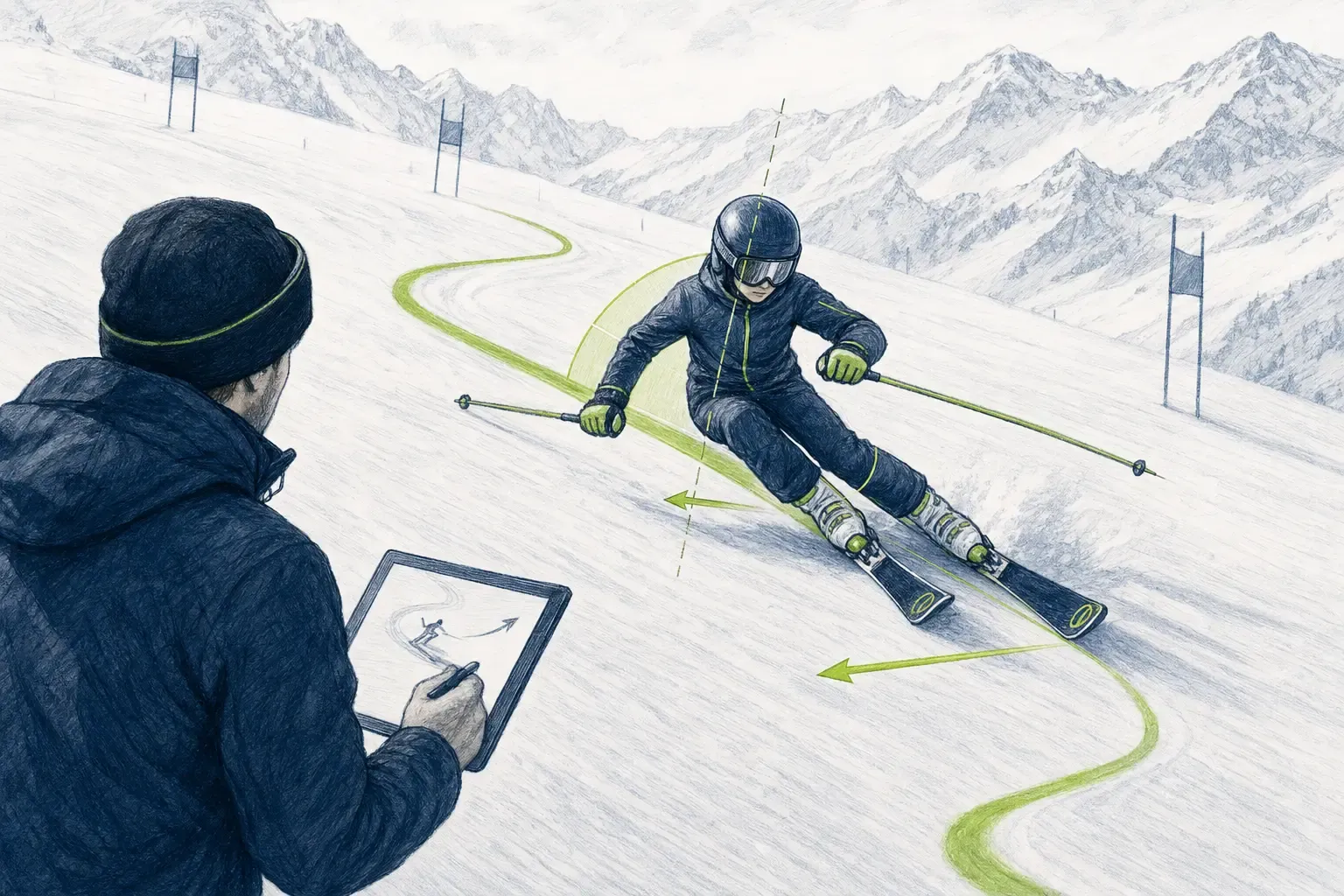
For a beginner, the goal may be a controlled stop or linking turns. An advanced racer may work on rhythm in slalom, passing a vertical section, or choosing a line in giant slalom. The same course therefore does not have to mean the same task for all children.
In organized gate training, the start method, spacing between skiers, place for a safe stop, and procedure after a fall must be clear. The coach also takes into account traffic on the slope, visibility, surface, course condition, and the group's fatigue. The number of runs is not more important than safety or quality of execution.
Training run and races
A training run must not be confused with course inspection nor with race run. Course inspection serves to familiarize athletes with the course setting and conditions according to the event rules. A race run is a judged competitive performance.
A special meaning applies to the term official downhill training. In FIS competitions, it refers to the formally organized part of the event with a start list, time schedule, and training results. Such official training must not be confused with a regular club run on a slalom or giant slalom training course. Specific duties and procedures are always governed by the current FIS rules and the event regulations.
Typical mistakes and the coach’s view
A common mistake is the demand to ski every run flat out. Maximum speed can be a separate task, but it is not a universal sign of good training. Other mistakes include too many instructions at once, an overly difficult course, judging only by time, and continuing with low-quality runs when significantly tired.
From the coach’s point of view, a good training run should answer a simple question: What should the skier learn or verify in this run? The task must be clear, safe, and appropriate. Success is not only a faster time, but also a better decision, more precise movement, greater stability, or the ability to repeat the correct solution in the next run.
Sources and further reading
- FIS – Alpine Skiing Documents and current competition rules
- FIS – World Championships Saalbach 2025, official downhill training
- U.S. Ski & Snowboard – Training Systems
- U.S. Ski & Snowboard – Alpine Training System
- U.S. Ski & Snowboard – 2025 Alpine Guide
- U.S. Ski & Snowboard – Level 100 Alpine Manual
- U.S. Ski & Snowboard – Alpine Ski Fundamentals Instructor Manual