Race Run is a timed descent on a marked ski course. The final time counts only when the racer completes the start, course, gates, and finish in a way that complies with the rules of the specific discipline and competition. The term is also used in training, where it can mean the full run of the course at race pace and with timing.
The exact conditions for a valid run, passing gates, the start, the finish, a re-run, or disqualification are not left to the coach’s discretion. In competitions, they are governed by the current FIS international rules, the relevant national regulations, and jury decisions.
What determines the quality of a run
Line
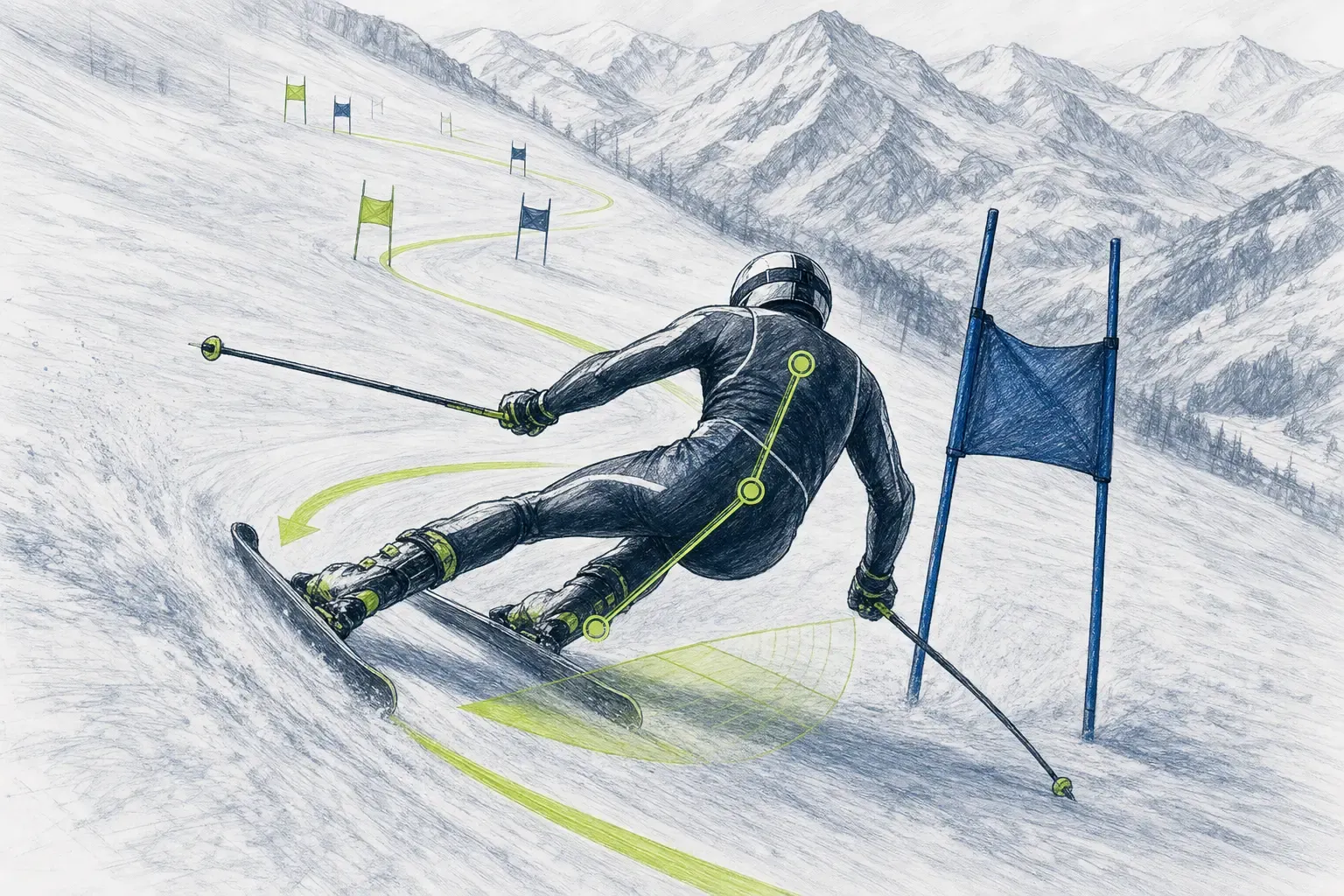
The line is the path along which the skis and the skier’s center of mass move in relation to the gates, the slope, and the shape of the hill. There is no single universal line that works on every course. The racer looks for a compromise between path length, turn radius, the ability to keep speed, and preparation for the next gate.
The shortest or seemingly most direct line is not necessarily the fastest. If it requires hard braking, too small a turn radius, or a late correction under the gate, the loss of energy may be greater than the saved distance. Biomechanical analysis of race runs therefore looks not only at the ski track, but also at changes in mechanical energy throughout the course.
Timing and turn shape
A ski turn can be simplified into initiation and steering. In race skiing, it is important that the change of direction develops in the right space and at the right time, not only as an emergency reaction at the gate. The gate defines the required passage, but it is not automatically the place where the turn begins or ends.
The load on the skis changes during the turn. An effective run therefore does not mean applying the greatest possible pressure at any time, but creating and releasing forces at the right phase. Research in giant slalom shows a connection between performance and the course of reaction forces and the speed of their changes, not a simple instruction to “push as hard as possible.” At the same time, the exact movement pattern changes depending on the discipline, terrain, snow, speed, and the skier’s abilities.
Speed regulation
The goal is not to be as fast as possible at every moment, but to complete the entire course in the shortest valid time. A skier must be able to create speed, maintain it, and deliberately regulate it. Too much approach speed into a difficult combination can lead to a delayed turn, a skid, an invalid run, or a fall.
The demands differ by discipline. Slalom emphasizes quick linking of turns and a precise rhythm, giant slalom focuses on line and forces in a larger space. In speed disciplines, gliding, aerodynamic position, terrain transitions, and anticipation become more important at significantly higher speeds.
Adapting to the course
Race skiing begins even before the start with a course inspection. The skier notices gate spacing and offsets, changes in rhythm, slope angle, terrain breaks, surface quality, and the places where the next turn needs to be prepared. But the plan must be adjusted while skiing. The snow can become rutted, and the actual run may not exactly match the inspection.
The course setting affects speed, loading, and the racer’s movement options. Simply increasing the lateral offset of the gates therefore does not automatically mean a safer or slower run; it can prolong the action of forces and create more demanding balance situations.
Race run for children
For a young skier, race skiing should not be the first or only form of training. It assumes adequate control of basic skiing skills: balance, edging, turning the skis, pressure regulation, and movement coordination. The SkillsQuest methodology of US Ski & Snowboard therefore bases youth development on learning and ongoing assessment of fundamental skills according to the athlete’s stage of development.
Training practice: children usually progress from free skiing and movement tasks through corridors, markers, and shorter sections to a continuous gate course. The timing of this progression depends on age, experience, motor development, conditions, and the coach’s assessment. It is not appropriate to mechanically copy the technique, course, or training volume of adult racers.
Measured time is useful feedback, but with children it must not be the only criterion. A faster run can also come from risky or accidental skiing that the skier cannot repeat. The coach therefore also watches stability, direction control, the point where the turn begins, response to changes in rhythm, and the ability to finish several runs at a comparable level of quality.
Gate training belongs on a designated and organizationally secured section under the guidance of a qualified coach. Fatigue, an unsuitable course, and loss of control increase the risk of mistakes and injuries; competitive alpine skiing is associated mainly with significant stress on the lower limbs and the risk of knee injury.
Typical mistakes and misunderstandings
- "The shortest line is always the fastest." An overly direct line can cause hard braking or a late turn.
- Starting the solution only at the gate. The skier reacts late and makes most of the direction change under the gate.
- Fixating the gaze on one pole. The racer stops reading the continuation of the course and does not prepare for the next combination.
- Maximum effort in every run. Constantly skiing at full speed makes learning harder, reduces the accuracy of feedback, and, when tired, can worsen safety.
- Evaluation based only on time. Time does not show where the loss happened or whether the run was technically repeatable.
- Copying an elite racer. The same visible movement may not be suitable for a child with different strength, height, speed, and equipment.
Coach's view
The coach distinguishes result and execution method. The result is a valid time; the execution method includes the line, rhythm, balance, timing of forces, ski work, and decision-making. In analysis, the coach can combine observation, video, split times, and comparison of repeated runs. Modern biomechanical methods show that technique cannot be reliably reduced to a single body position or one moment of the turn.
A good training task has a specific goal, for example to prepare direction earlier before a change in rhythm or to handle a terrain break more calmly. The instruction “go faster” by itself does not explain what change the young skier should make. Quality race skiing develops gradually: from solid basic skills, correct reading of the course, and the ability to repeatedly choose a solution appropriate to the current situation.
Sources and further reading
- International Ski and Snowboard Federation (FIS): Alpine Documents – current international competition rules ICR and other regulations
- US Ski & Snowboard: Descriptions SkillsQuest Drills – development and assessment of basic youth skiing skills
- Supej M.: Differential specific mechanical energy as a quality parameter in racing alpine skiing
- Vaverka F., Vodickova S., Elfmark M.: Kinetic analysis of ski turns based on measured ground reaction forces
- Kinetic keys to alpine skiing performance: A 3-D analysis of ground reaction forces and torques
- Spörri J. et al.: Course setting and selected biomechanical variables related to injury risk in alpine ski racing
- Müller E., Schwameder H.: Biomechanical aspects of new techniques in alpine skiing and ski-jumping
- Anterior cruciate ligament injury/reinjury in alpine ski racing: a narrative review