What is disqualification
Disqualification, marked in start and result lists by the abbreviation DSQ or DSQ/DQ, means that the competitor’s performance is not recognized because of a rule violation. Depending on the competition format, it may apply to one run or to the overall result. In two-run races, it usually prevents a valid overall ranking. This entry is based on FIS rules available 2. September 2026; however, the version of the rules valid for the specific competition is always decisive.
Disqualification is not the same as:
- DNS – Did Not Start: the competitor did not start,
- DNF – Did Not Finish: started, but did not finish the run,
- NPS – Not Permitted to Start: was not allowed to start,
- DSQ – Disqualified: was disqualified for breaking a rule.
A fall, losing a ski, or slow skiing therefore do not by themselves mean disqualification. The circumstances and the relevant rule decide.
Most common reason: incorrect gate passage
In standard alpine skiing disciplines, a gate is passed correctly when both ski tips and both feet of the competitor pass across the gate line. The position of this line is determined by the discipline and by how the course is set. If a competitor loses a ski without having broken a rule before that, a special rule applies to the remaining ski and both feet.
For children, it is important to understand that the decisive factor is not the pole touch itself. A racer may knock down the gate pole or miss it completely and still pass the gate correctly. On the other hand, passing very close to the pole may look smooth but be invalid if the skis and feet did not cross the prescribed gate line.
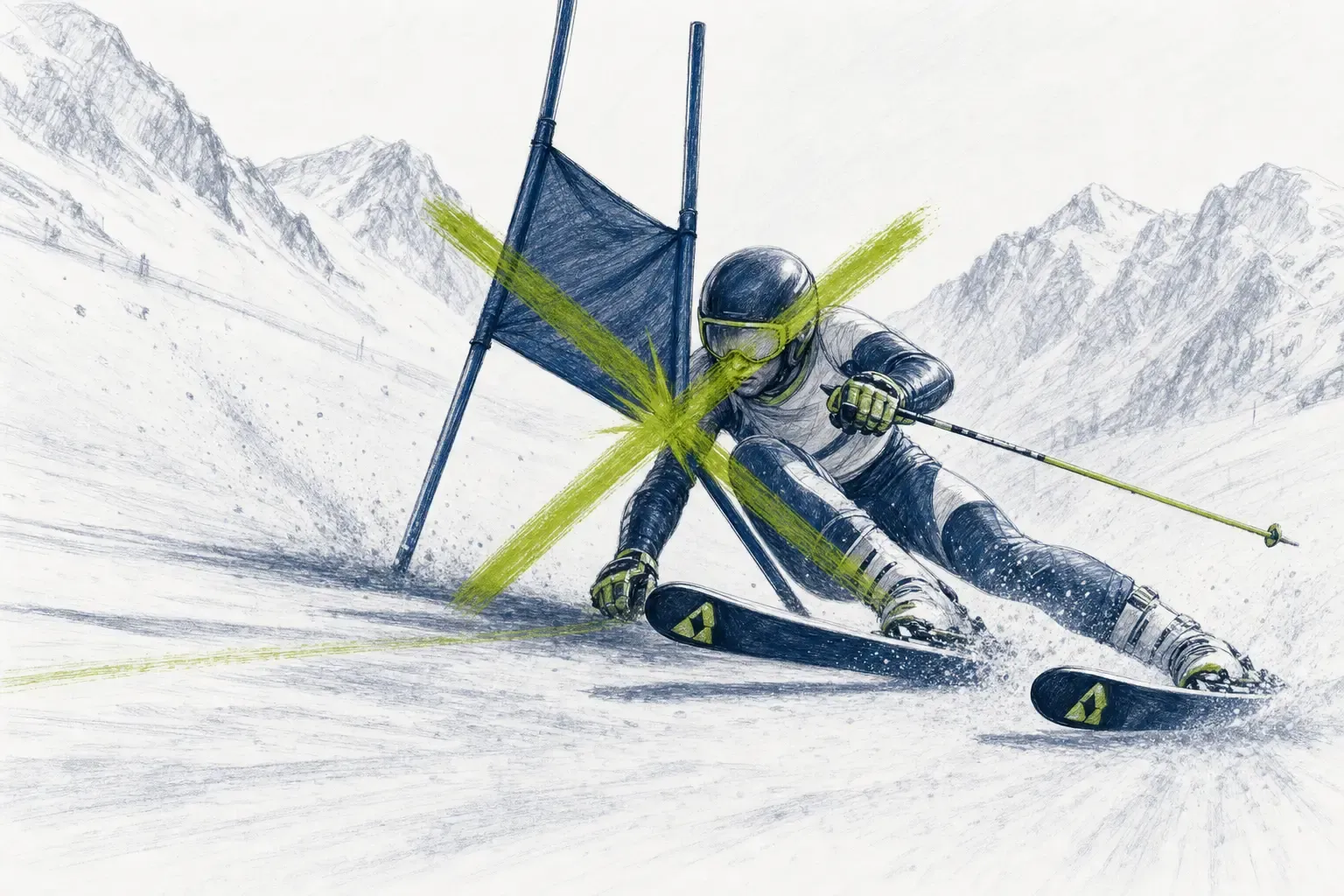
A typical mistake in slalom is a straddle, that is, passing with one ski or one foot on the wrong side of the turning pole. In giant slalom, super-G, and downhill, the more common problem is missing the entire gate or taking the wrong line between its defining poles.
The option to return to a missed gate depends on the discipline, the specific situation, and the valid rules. The correction must not endanger other racers or disrupt the competition. That is why neither “always go back” nor “always continue” is a correct universal rule.
Other possible reasons
Disqualification does not have to be related only to gates. FIS rules also allow penalties for violations of general competition rules, jury instructions, or principles of sportsmanship. Depending on the nature of the case, this may include for example:
- an invalid or false start,
- unauthorized outside help during the run,
- continuing or behaving in a way that endangers safety,
- using non-compliant race equipment,
- violating a binding jury instruction,
- unsportsmanlike conduct.
Not every violation automatically leads to DSQ. The rules also provide for a warning, start prohibition, change of start position, a fine, or other sanctions. In equipment matters, a racer may be barred from starting even before the run; a mismatch found in a later check may have a different procedural consequence. What matters is the specific rule, the level of the competition, the age category, and the moment the issue is discovered.
Requirements for skis, helmets, protectors, suits, and other equipment can change depending on the season and category. FIS sets separate parameters also for U14 and U16, but domestic children's competitions may follow national rules. Equipment should therefore be checked according to the rules of the specific race, not just according to what an older racer or a World Cup athlete uses.
Who decides
The gate judge records and reports situations in their section, but their signal or note is not yet a final result on its own. The competition procedure is handled by the jury, which works with reports from the judges and other admissible materials. Disqualifications are published, and a protest may be filed against the decision in the manner and within the deadline set by the rules. The protest is submitted by an authorized team representative, not by a parent or racer in an informal argument by the course. FIS also uses special forms to record jury decisions and protests.
Video can be a useful piece of evidence, but its admissibility and evidentiary value are assessed by the jury according to the competition rules. At major events, the general ICR may be supplemented by special rules and clarifications for the given format or championship.
Children's and coach's perspective
For a child, DSQ should not mean a “ruined race” or a personal failure. It is a result and rules status. Especially for younger skiers, the cause is often late recognition of the gate, too direct a line, loss of balance, or focusing on the pole instead of the space through which the skis and feet must pass.
Training practice must therefore include:
- an explanation of the gate line directly on the slope,
- runs at low speed and from different angles,
- practice of the start procedure and reactions to the officials’ instructions,
- checking the bib number and equipment before entering the start area,
- a calm review of the situation after the race.
After a disputed run, the coach should first find the gate number and the available facts, check the official notice, and only then consider a protest. The child learns to respect the officials, while also understanding that the rules include a proper procedure for reviewing a disputed decision. The best prevention of disqualification is not to ski cautiously at all costs, but to know the rules and be able to follow them even at race speed.
Sources and further reading
- FIS – Alpine Documents: International Competition Rules, precisions and jury forms
- FIS – Specifications for Alpine Competition Equipment 2026/27
- FIS – Specifications for Alpine Competition Equipment 2025/26, detailed technical wording
- FIS – Precisions and Instructions for Alpine Skiing 2025/26
- FIS – Alpine Skiing Timing and Data Booklets
- FIS – rules and precisions for the World Championships
- U.S. Ski & Snowboard – Alpine Membership Rules and 2026 Alpine Competition Guide
- U.S. Ski & Snowboard – Alpine Rules and Resources