What is a penalty
Penalty is the consequence applied for breaking a competition rule, a jury instruction, or the principles of sportsmanship. In skiing terminology, however, the word also has a second, different meaning: race calculation penalty (race penalty) enters into the calculation of FIS points and does not represent an athlete's offence.
That is why it is not accurate to say automatically that a penalty means “adding seconds.” In alpine skiing, many course mistakes are resolved by disqualification, not by a time penalty. The current rules should always be checked in the relevant edition of the International Competition Rules – ICR and in the entry list for the specific race.
Sanction, disqualification, and non-start clearance
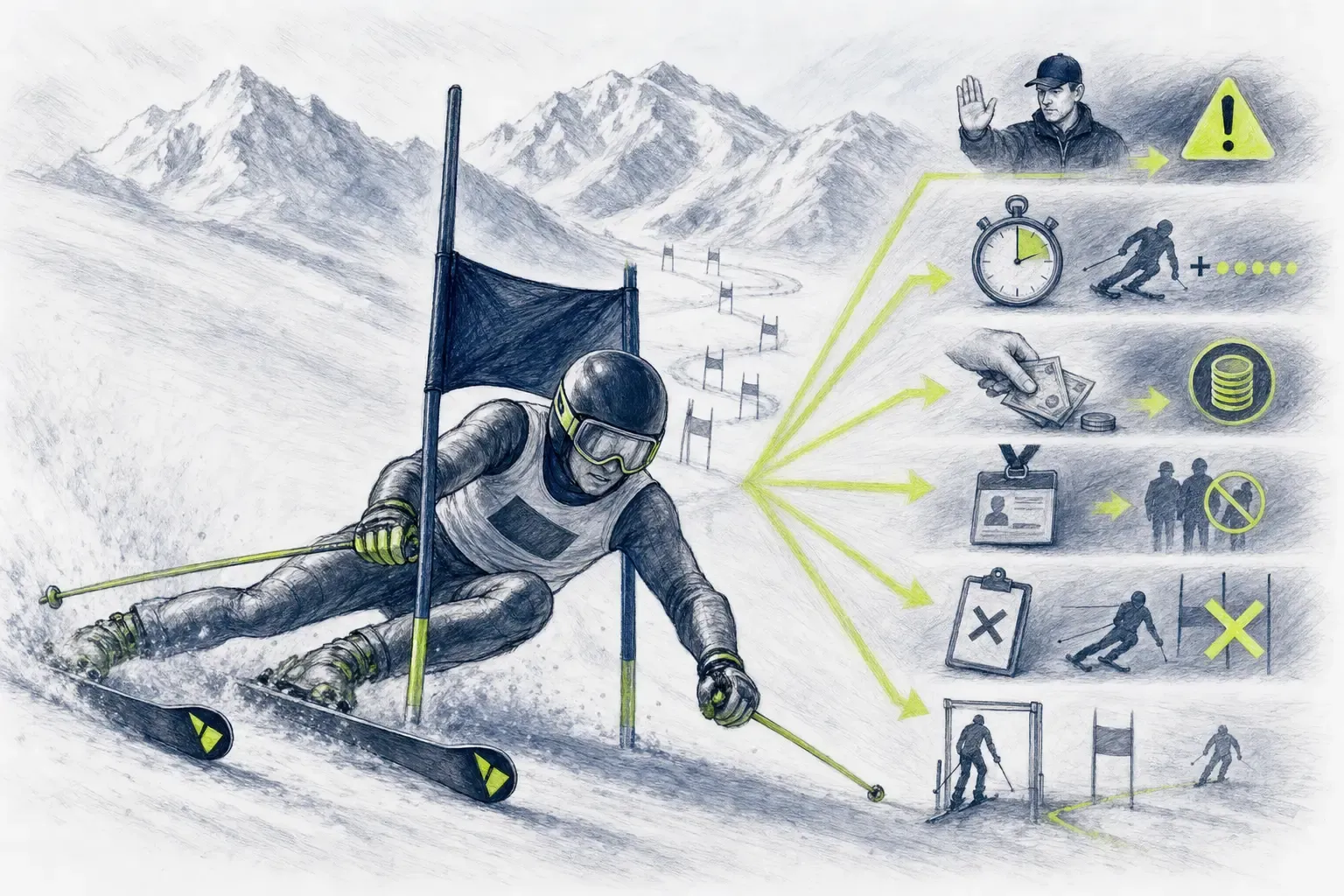
The general FIS sanction framework includes, for example, a warning, a time penalty, a financial fine, a restriction of accreditation, or suspension. For an athlete, the consequence may also be disqualification, a worse start position, or the loss of sporting advantages. Not all of these measures are used in every type of race, and not every violation leads to the same result.
In alpine disciplines, the jury may decide especially in cases of an incorrect gate passage, violation of the start procedure, unauthorized help, failure to respect jury instructions, interference with the course, unsportsmanlike conduct, or equipment not complying with the rules. For equipment, the consequence depends on the type of deficiency and the relevant provision: the athlete may not be allowed to start or may be sanctioned after inspection. Ski dimensions, protective equipment, and other technical requirements are set out in separate FIS specifications valid for the given season and category.
DNS (did not start – did not start) and DNF (did not finish – did not finish) in themselves do not mean a penalty. DSQ means disqualification. The result code must therefore be read precisely and a non-finished run must not be confused with a penalty. The official method of recording results and times is also governed by FIS technical documents for timing and data processing.
The jury makes the decision on a rule violation based on reports from judges, equipment inspection, timing data, or other admissible materials. Any protest may be filed only through the specified procedure and within the set deadline. At major events, the general ICR may be supplemented by special rules and clarifications for the given race.
Penalty in the calculation of FIS points
Term race penalty has a different meaning when it comes to FIS points. It is a mathematically calculated value derived mainly from the point level of the starters and the best-placed racers. It is added to the points for the achieved time difference and helps take the quality of the starting field into account.
Such a penalty is not a punishment, does not increase the measured time, and does not mean a rule violation. The same distinction between a sporting sanction and a points calculation is also important in para alpine skiing, which has its own ICR and its own points rules.
Children's and coaching context
In children's races, the procedure follows the rules of the relevant federation, the age category, and the event regulations. It is not possible to automatically transfer all World Cup or FIS points race provisions to club and youth competitions.
The coach should help the child distinguish three different situations:
- technical mistake – for example, starting a turn too late,
- failure to finish – a fall or leaving the course,
- rule violation – for example, an invalid gate passage.
Disqualification should not be presented as a personal failure or as a punishment from the coach. It is the result of a specific situation under the rules. In training, it makes sense to practice equipment checks, course inspection, start procedure, correct gate passage, and reaction after a mistake. In official races, however, the jury decides; neither the coach nor the parent can change the result by informal agreement.
Sources and further reading
- FIS – Alpine Skiing Documents: ICR, World Cup Rules and rule clarifications 2026/27
- FIS – Event Marketing: Specifications for Alpine Competition Equipment 2026/27
- FIS – Timing & Data: Alpine Skiing Timing Booklet
- FIS – Para Alpine Documents: ICR and Rules of the FIS Points
- FIS – World Championships: rules and special clarifications for major events
- FIS – Snowboard, Freestyle, Freeski and Ski Cross Documents: ICR and common sanctions framework