Definition
Start is the designated place and prescribed procedure by which a skier begins a training or race run. In alpine skiing, it also refers to the short movement phase from preparation in the start area through the push-off to the transition into skiing toward the first gate.
In races, three moments must be distinguished: start signal, the actual start of timing and acceleration on the course. A verbal or sound signal tells the racer to go, but their time is recorded by activating the start gate, usually by swinging away the start wand as the skier passes. The exact technical requirements for main, backup, and manual timing are set by the FIS rules and timing regulations.
Start according to race rules
Rule: The racer must arrive prepared according to the start list and follow the instructions of the starter and the start referee. The method of signaling, the start interval, and the assessment of a late or false start depend on the discipline and the valid event rules. For this reason, a single learned time tolerance cannot be used as a universal rule for slalom, giant slalom, and speed disciplines alike.
As of 2. September 2026, the basic international regulations for alpine disciplines are the FIS ICR rules published on 6. July 2026. These govern the start area, the start ramp, signals, timing, delayed starts, and false starts. At domestic or children's races, the regulations and rules of the relevant national federation also apply; neither coach nor racer may replace them with habits from another event.
The racer starts under their own power. A coach may help with preparation before the run, but may not physically push the racer off at the start itself. Skis, poles, helmet, and other equipment must be ready before taking the start position and, in competition, must comply with the rules of the given age category and event.
In case of a fall, obstacle, or other danger on the course, an authorized official may issue the command Start Stop. The start is then closed immediately and the racer waits for a new signal. The exact radio and organizational procedure is set by the jury and the event rules; the racer and coach must not continue just because an earlier countdown was already heard.
Start technique
Training practice: The goal is not to create the biggest possible movement, but to gain speed without losing balance and without worsening the line into the first gate. An effective start usually has these parts:
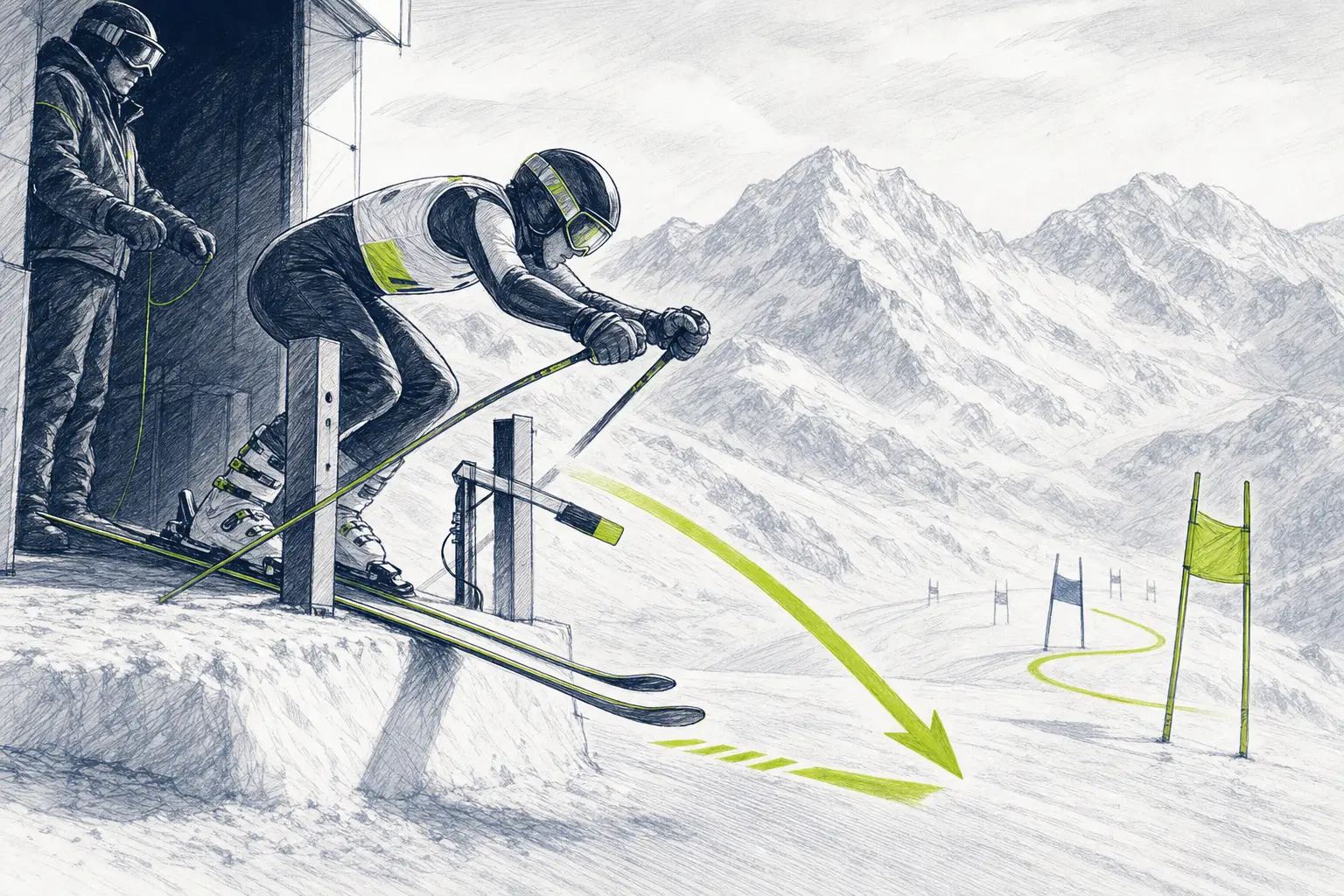
1. Preparation: the skis point into the intended line, the body is stable, and the racer knows where the first gate is. 2. Push-off: dynamic leg work is combined with a purposeful push with the poles. The movement should not pull the skier too far back or bend them at the waist. 3. Acceleration: depending on the slope, space, and discipline, skate pushes, pole work, or an early transition into gliding may follow. 4. Entering the course: the hands return to the skiing position, the gaze points forward, and the skier prepares for the first turn.
In slalom and giant slalom, the first change of direction can come very early. Too many skating steps therefore do not necessarily mean a faster start. In super-G and downhill, there is often more room to accelerate, but the specific profile of the ramp and the position of the first gate always decide. This is a technical choice, not a fixed rule.
Start for children
A younger skier first learns to enter the start area safely, point the skis correctly, take in the starter’s signal, and leave without help from others. Only then does it make sense to increase the strength and speed of the push-off. A child does not yet have to reliably coordinate pole push-off, a skating step, reacting to the signal, and watching the first gate at the same time; the difficulty therefore needs to match their motor skill level, not just their age category.
Suitable practice starts without time pressure. Then come starts on a simple signal, starts toward a clearly marked target, and only then situations similar to races. The countdown should not be used to scare the child or to deliberately throw them off balance. During practice, there must be free space in front of the ramp, and children must not stand in the direction of the skier leaving.
Typical mistakes
- the skis are already pointed away from the proper line at the start,
- the racer watches the start pole instead of the first gate,
- the poles are planted too far apart, too close together, or unevenly,
- after the push-off, the racer stays back and has to find balance again,
- the racer takes more skating steps than the space allows,
- the racer reacts to another person’s movement instead of the official command,
- the racer arrives at the start late or is still adjusting equipment there,
- after the start is closed, the racer does not respect the starter’s instruction.
Coach’s view
The coach evaluates the start together with the first gates, not separately. A quick push-off is of little value if the racer enters the course without control or spoils the first turn. With video, it makes sense to watch the direction of the skis, the position of the center of gravity, the timing of pole work, and the moment of transition from acceleration to race technique.
Instructions should be short and specific, for example the direction of the skis and the gaze toward the first gate. If push-off, arms, torso, reaction, and skating are corrected all at once, the child often loses their own start routine. The purpose of a routine is not to create a ritual at any cost, but to help the skier start the run calmly, safely, and repeatably. The organization of the start and the decision on its validity are ensured by the designated race officials, especially the starter, start referee, and timekeeper.
Sources and further reading
- FIS – Alpine Documents: International Competition Rules, edition 6. July 2026
- FIS – Timing & Data: Alpine Skiing Timing Booklet, June 2026
- FIS – Specifications for Alpine Competition Equipment 2026/27
- U.S. Ski & Snowboard – Alpine Competition Officials Education Resources, season 2026
- U.S. Ski & Snowboard – Alpine Officials
- U.S. Ski & Snowboard – Alpine Officials’ Manual, Rules, Jury & Technical Delegate: Start Stop procedures
- U.S. Ski & Snowboard – Alpine Guide: start referee duties and race organization