What is the start gate
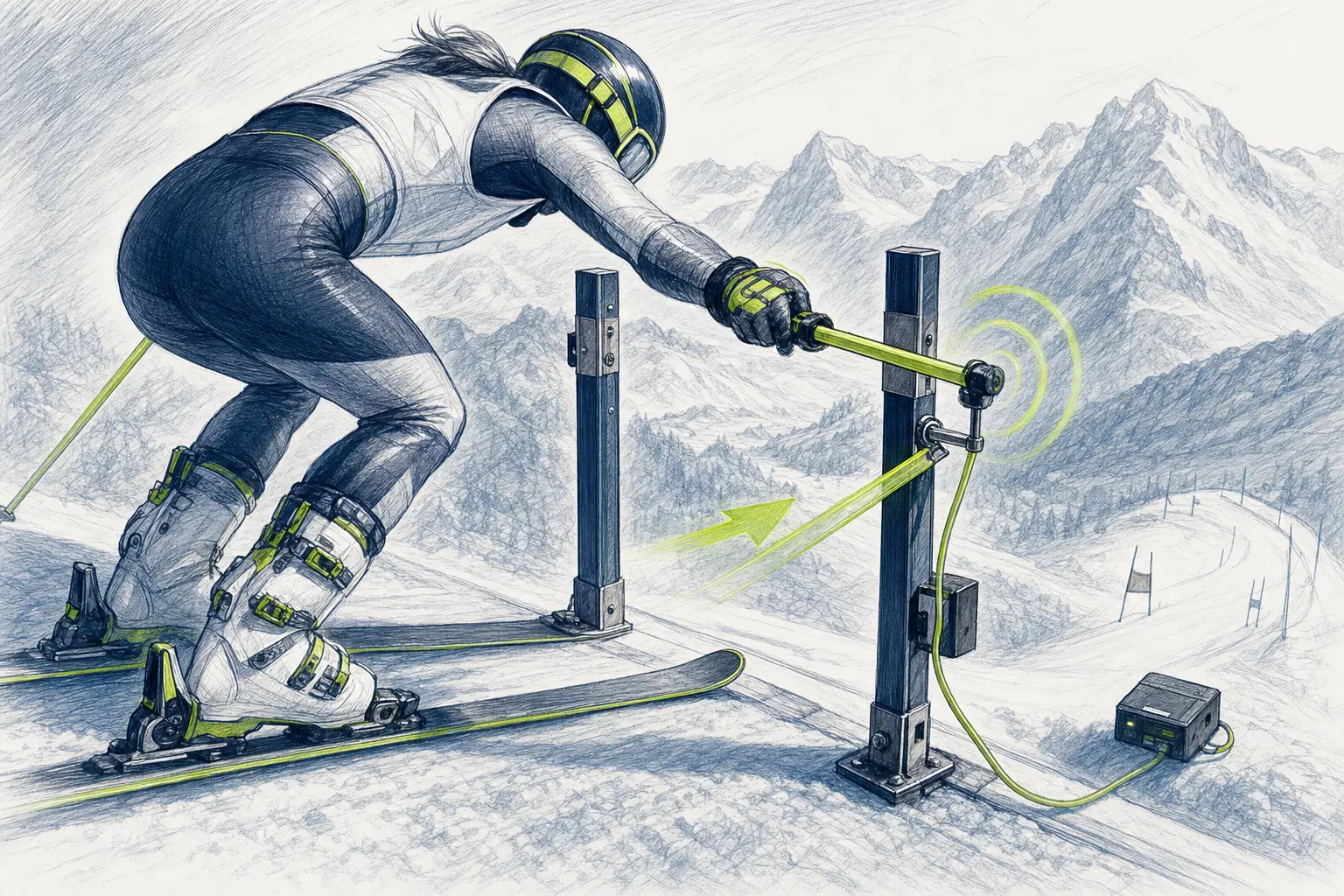
Start gate is a mechanical and electronic device at the start of ski races. Its moving wand, often also referred to by the English term start wand, is connected to the timing system. When the racer opens it during the push-off, the device sends an electric impulse that records the actual start time.
So it is not the first slalom gate on the course or the start house. In parallel disciplines, start gates that open in a controlled way may be used. FIS lists start gates and start doors as separate categories of timing equipment.
Start gate and timing
At races included in the FIS calendar, only homologated timing equipment may be used. The current FIS list states the manufacturer, model, and homologation number of the equipment.
The start gate must provide separate, electronically isolated contacts for the main timing system A and the backup system B. Opening the same wand thus creates a start impulse for both systems. In addition, electronic timing is supplemented by independent manual timing.
If the start gate needs to be replaced during one run, the technical rules require the same device to be placed in the same position. The gate is set up, tested, and connected by a qualified timekeeper or an authorized organizer; the racer or coach should not change its position on their own.
Starter’s signal and actual start
The starter’s verbal or sound signal and the moment timing begins are not always the same. The signal allows the racer to start, but their electronic time begins only when the start wand opens. At the same time, the racer must follow the starting procedure and the time window for the given discipline.
In downhill, super-G, and giant slalom, a set start interval and countdown are used. At FIS events at higher levels, a start timing system with a sound countdown is prescribed. In slalom, after the start is allowed, the starter gives the warning “Ready” and a few seconds later the command “Go”; according to the rules, the racer should start within about ten seconds.
The exact procedure at children’s, club, or national races may be supplemented by the competition rules of the organizer or the national federation. A child should therefore listen to the starter and not rely only on the procedure known from training.
Importance in children’s training
A start is not just a forceful push-off. It is a short coordination task in which a young skier combines reacting to the command, using the poles, moving the center of mass forward, and smoothly transitioning into the first turns.
In training practice, the progression goes from a simple push-off on a gentle and safe section to starting onto the course. For younger children, it is more important to master a stable stance and a clear reaction to the command than to imitate the aggressive start of an adult racer. The number of skating steps, the strength of the push, and the moment of moving into a downhill stance depend on the slope, surface, discipline, and the child’s motor skills.
The coach mainly watches whether the skier:
- stands balanced and does not lean on the start wand,
- has the poles ready for a symmetrical and safe push-off,
- responds only to a valid command,
- moves the hips forward together with the torso and does not stay “sitting” back,
- quickly regains stability after the push-off,
- focuses attention on the approach and the first gate, not on the mechanism under the feet.
Typical mistakes and misunderstandings
A common mistake is pressing or opening the wand too early while adjusting the stance. Another problem is a sudden movement of the arms without shifting the hips, planting the poles too far away, an uneven push-off, or immediately taking a low stance before balance has been established.
The child should also not start based on the racer in front of them or on a sound from the course. The decisive factor is the starter’s command addressed directly to them. If they have a problem with the gate, equipment, or start readiness, they should stay in place and alert the starter or coach.
From a coach’s point of view, a quality start is one that can be repeated, matches the child’s age, and leads into a controlled approach to the first gate. A small time advantage from a strong push-off is meaningless if the skier then loses direction, balance, or course rhythm.
Sources and further reading
- FIS – Alpine Skiing Documents: International Competition Rules 2026/27
- FIS – Timing & Data: Alpine Skiing Timing Booklet, version 2.67, June 2026
- FIS – Homologated Timing Equipment: Start Gate
- FIS – Alpine Timing Booklet, version 2.63
- U.S. Ski & Snowboard – 2026 Alpine Competition Guide
- U.S. Ski & Snowboard – Alpine Competition Officials Education Resources