What is a start interval
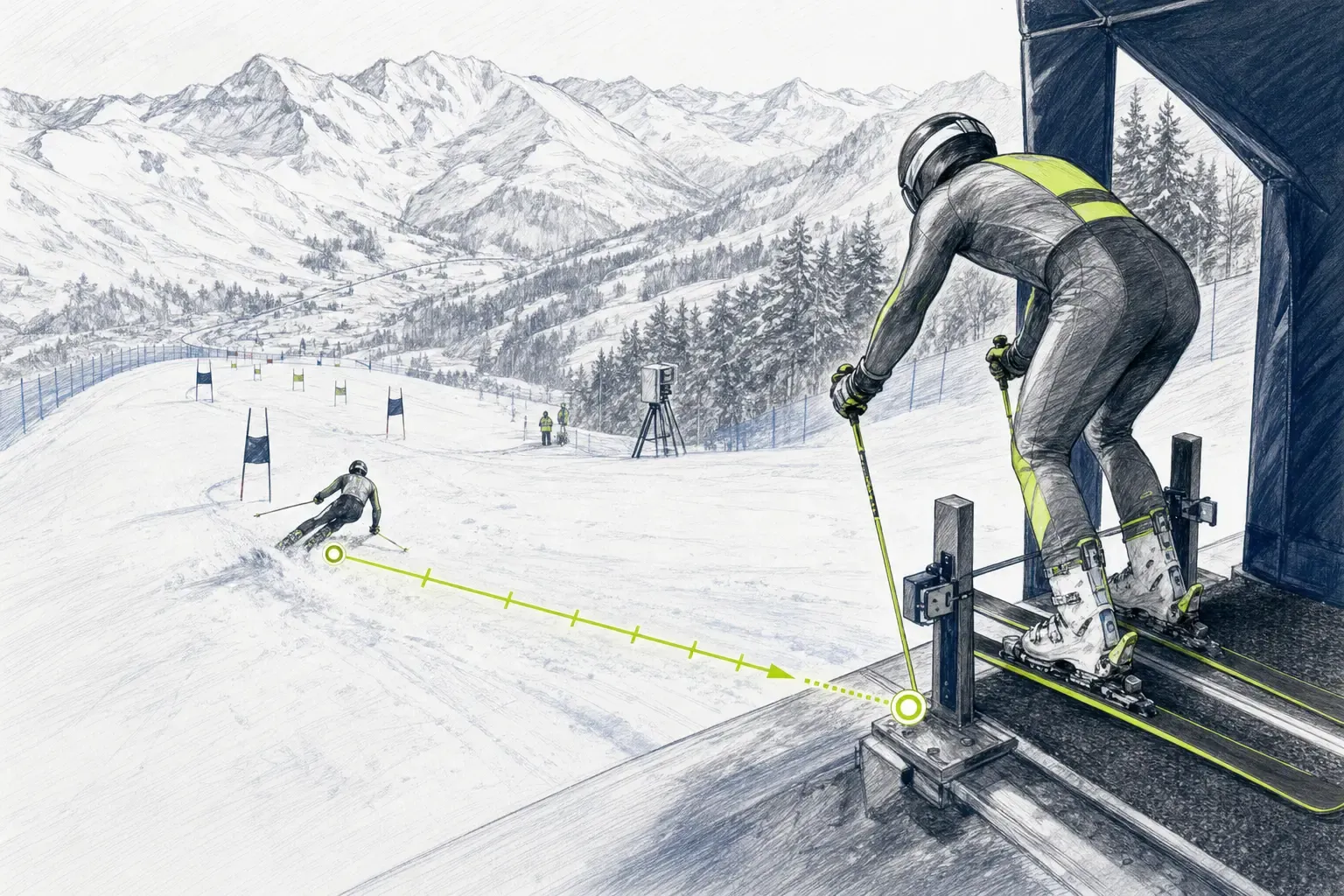
Start interval is the planned time gap between the starts of two consecutive racers or forerunners. It is counted from one skier’s start to the next skier’s start, not from when they cross the finish line.
The interval allows organizers to manage the movement of racers on the course. It must leave enough space for safe skiing, timing, course marshals’ work, and any course preparation. Its length depends on the discipline, the course’s length and clarity, weather, visibility, snow conditions, timing capabilities, and the level of the competition.
Regular and irregular interval
FIS regulates start intervals in article 622 of the international alpine skiing rules. It mainly distinguishes between regular and irregular intervals.
For a regular, that is fixed, interval the next racer is normally sent onto the course after a predetermined number of seconds. This method is used mainly in downhill, super-G, and giant slalom. The general rule uses a 60-second interval, but the jury may set a different value depending on the conditions. If shortened, the interval in downhill and super-G must not be shorter than 40 seconds, and in giant slalom not shorter than 30 seconds. Special rules of a specific competition may further adjust the start organization.
For an irregular or variable interval each racer does not get a start at exactly the same time gap. The starter gives the next start according to the timing and race organization instructions. A typical example is slalom, where several skiers may be on the course at the same time, as long as they do not endanger or hinder one another.
A separate organizational procedure is waiting until the previous racer crosses the finish line. It is sometimes referred to as the finish interval (finish interval). It is not an automatic requirement in every discipline.
The interval is not a start window
The start interval is often confused with the start signal. However, these are two different things:
- start interval defines the gap between two racers,
- start signal and start window determine when a particular racer may or must leave the start.
A skier should therefore not estimate their start based on the movement of the previous competitor. They follow the starter’s instructions and the official signal. If the start is stopped, the original interval rhythm no longer applies and the racer waits for a new instruction.
Meaning in children’s races
In children’s races, the same basic principle applies: the next child may set off only after the starter’s permission. The specific interval is determined by the race organization and the jury according to the rules and the conditions on the course. There is no single universal value suitable for every children’s category and every slope.
With younger or less experienced skiers, larger differences in speed, unpredictable stopping or falling, and slower clearing of the course must be expected. The planned timetable must therefore never take priority over safety. If a racer remains in an unclear or dangerous place, the start must be stopped regardless of the originally set interval.
In training, the start interval is not a fixed competition standard. The coach chooses it according to age, the group’s level, the type of exercise, visibility on the course, and safe places to stop. A shorter interval can speed up the organization of training, but it increases the risk of catching up to a slower skier. With children, the coach or an authorized person should have control over every departure from the start.
Typical misunderstandings
- A shorter interval does not automatically mean better-organized races.
- The start interval is not the time gap in the results.
- A racer does not always have to wait until their predecessor crosses the finish line.
- The value stated in the program may change for safety or organizational reasons.
- Television breaks, course preparation, and the “stop start” instruction interrupt the normal sequence of starts.
Coach’s view
A young racer should know their approximate start position, but just before the run they should mainly watch the starter. The coach’s task is to prepare the child in time, check that the equipment is fastened, and at the same time not let them start just because, according to their own counting, the expected interval has already passed. The official start procedure, not the racer’s, parent’s, or coach’s stopwatch, decides when they are sent onto the course.
Sources and further reading
- FIS – Rules for the Alpine FIS World Cup 2023/24
- FIS – International Competition Rules Masters Alpine Skiing, Spring 2024
- U.S. Ski & Snowboard – 2026 Alpine Competition Guide
- U.S. Ski & Snowboard – Alpine Competition Officials Education Resources 2025–26
- U.S. Ski & Snowboard – Alpine Officials’ Manual: Rules, Jury and Technical Delegate
- Alpine Canada – Level 2 Alpine Officials Manual