What Is the Finish Area
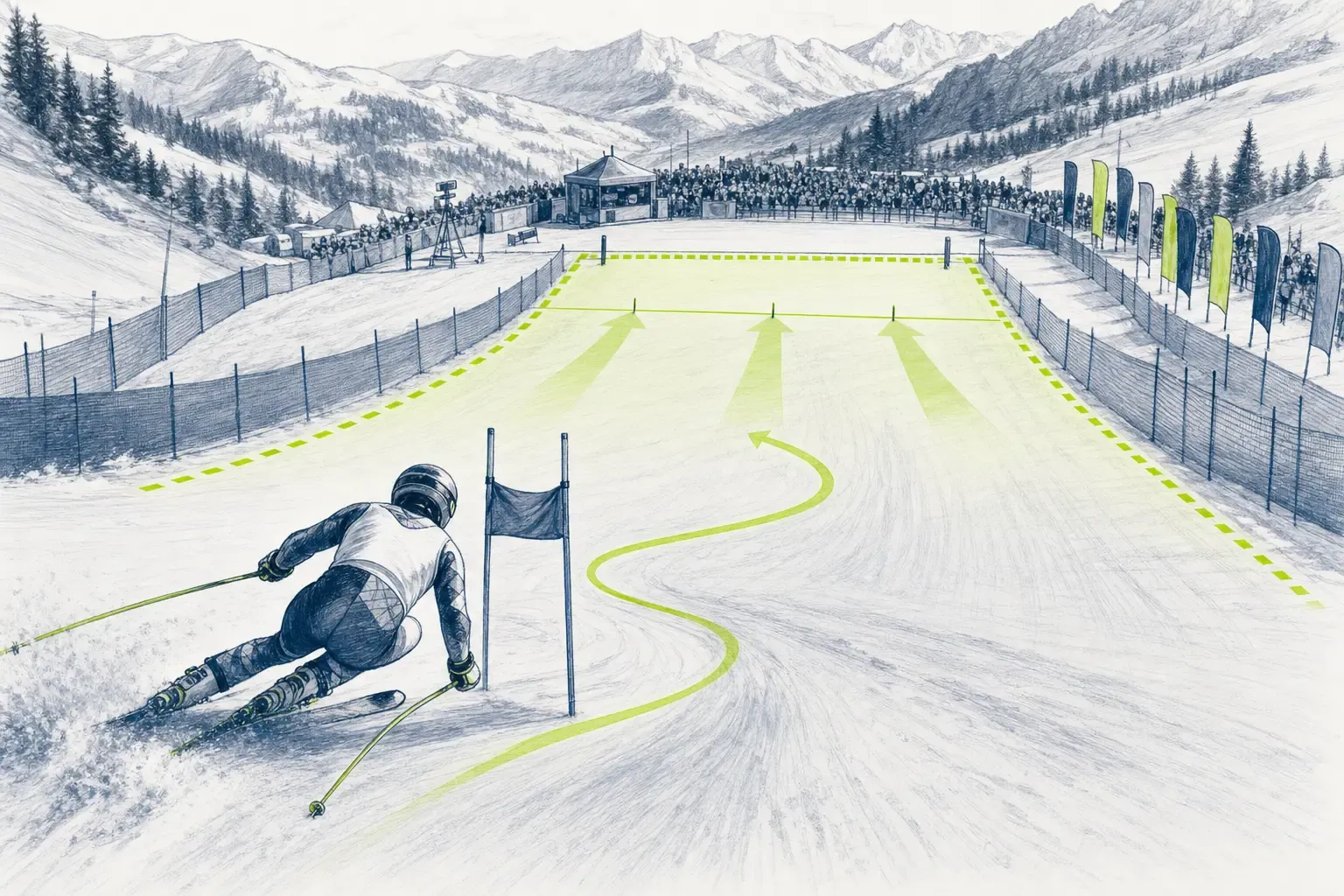
Finish Area (in English, finish area) is the marked, controlled, and secured part of the ski course around and beyond the finish line. It includes the timing location, enough room to slow down, and a designated exit from the course. Its purpose is to let the racer complete the run in a natural line and then stop safely without suddenly avoiding people, equipment, or fixed obstacles.
The finish area should not be confused with the finish line. The finish line is the exact boundary where time is recorded. The finish area is a broader safety and organizational zone.
Requirements for Races
According to alpine competition rules, the finish should be clearly visible to an approaching racer. The run-out area should be wide, smoothly sloped, and prepared so that a skier can safely reduce speed there. The course setter should place the final gates so that the racer passes through the finish along a natural line that matches the terrain.
The finish area is fenced off, and unauthorized persons must not enter it. Posts, timing equipment, advertising structures, and other elements must be placed or protected so that they do not pose an unreasonable risk. The racer should leave the area through the designated exit and with the equipment used during the run.
The finish line is marked by two vertical posts or banners and a horizontal colored marking on the snow. FIS rules set a standard minimum finish width of 15 meters for downhill and super-G, and 10 meters for slalom and giant slalom. In exceptional cases, the jury may reduce this distance for technical or terrain reasons. At children's and national events, the relevant competition rules, event regulations, and jury instructions must always be respected.
How to Pass Through the Finish Correctly
The racer should cross the finish line:
- on both skis,
- on one ski,
- or on both feet, if they fell between the last gate and the finish line.
In the last case, the time is recorded at the moment when any part of the body activates the timing system. A valid result still requires the course to be completed correctly, including the last gate.
A common misunderstanding is the idea that the run ends at the last gate. The racer must continue all the way to the finish line. Braking too early, standing up too soon, or veering away from the natural line can worsen the time and, at high speed, also stability. However, after crossing the line, there must be enough room to slow down in a controlled way.
Children and Training Practice
In children’s training, the finish area serves primarily an educational and safety purpose. The youngest skiers tend to think of the colored line or the last gate as the place where they must stop immediately. The coach therefore teaches them a simple sequence: pass through the finish, keep going in balance, and brake only in the run-out area.
The length of the training run-out is not determined by one universal distance. It must match the speed, slope, snow quality, discipline, the children’s abilities, and the possibilities for safe fencing. Parents, waiting children, or stored skis must not stand behind the finish. A racer who has already completed the run-out should be able to leave the area in the designated direction without delay.
For beginners, a calm passage in a stable stance is more important than imitating an aggressive racing finish. Only more experienced young racers learn to hold a purposeful stance and speed across the finish line without losing control of the subsequent run-out.
Coach’s view
During the inspection, the coach checks not only the last gates, but also the line through the finish, the run-out surface, the braking area, timekeeping protection, and the way children leave the area. The coach clearly defines where waiting is allowed and who may enter the finish area. A safe finish is not a place for gathering the team, but an active part of the course where skiers are still moving at high speed.
Sources and further reading
- U.S. Ski & Snowboard – 2026 Alpine Competition Guide
- U.S. Ski & Snowboard – 2025–26 Alpine Precisions
- U.S. Ski & Snowboard – Alpine Competition Officials Education Resources
- U.S. Ski & Snowboard – Alpine Course Setting Specs
- U.S. Ski & Snowboard – Rules & Equipment: Alpine
- FIS – Rules for the Alpine FIS World Cup, edition 2024/25
- FIS – Cortina ready for Olympic and Paralympic challenge