What is the finish line
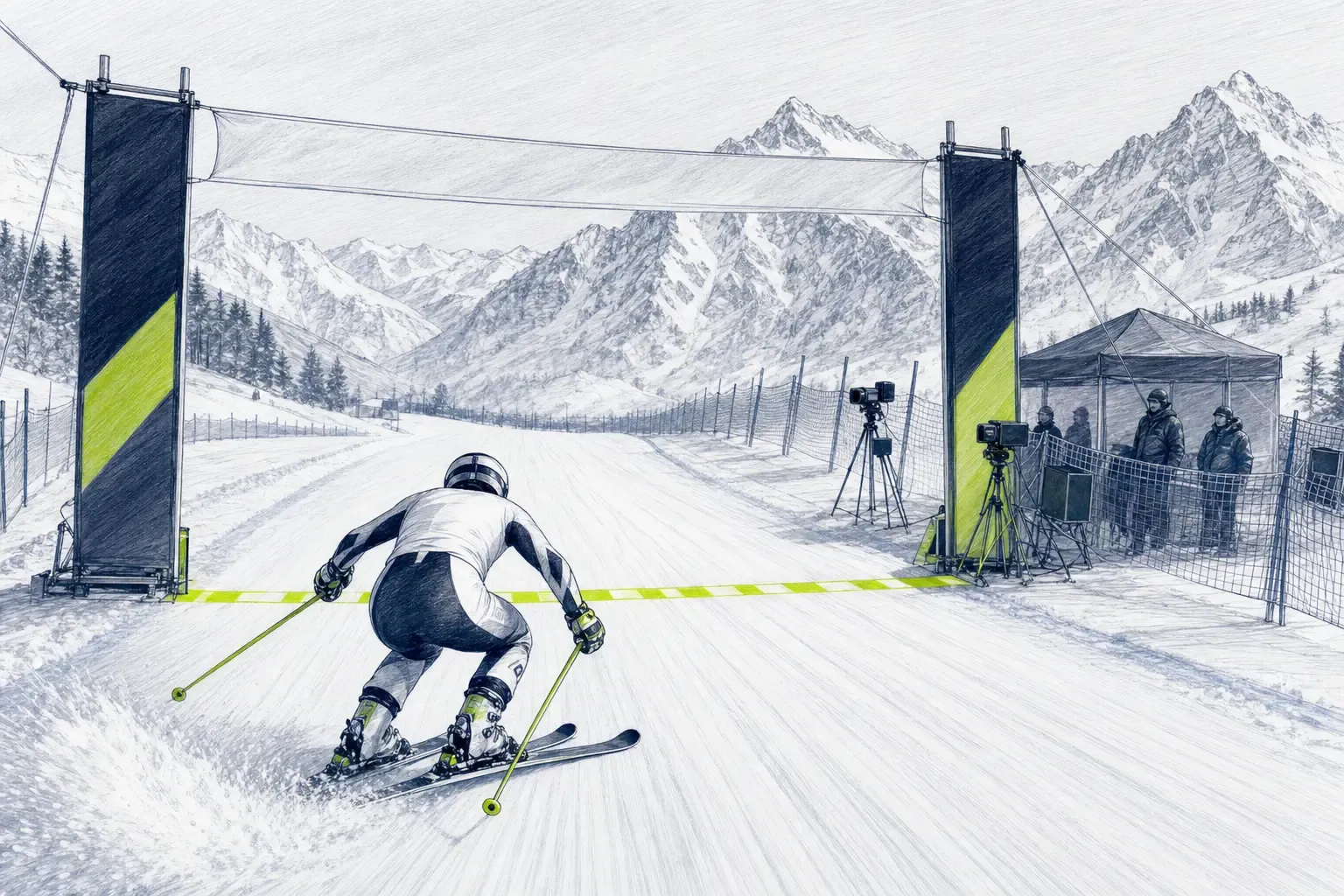
Finish line is the precisely defined boundary at the end of the race course. It is located between two finish poles or vertical banners, which may be connected by a horizontal finish banner. On the snow, the line should be clearly marked. Its position must match the electronic timing equipment.
The finish line and finish area are not the same. The line is the boundary where the time is recorded. The finish area also includes the safe glide-out beyond it, timing equipment, safety nets, space for officials, and the designated exit.
How is the finish line crossed correctly
According to alpine skiing rules, the racer must cross the finish line:
- on both skis,
- on one ski, or
- on both feet without skis, if they fell in the section between the last gate and the finish line.
In the third case, the time is recorded at the moment any part of the body breaks the timing beam. This rule is an exception for a fall just before the finish, not a general permission to complete the course without skis.
It is important to distinguish between triggering the timing system and a valid finish. The photocell may first be interrupted by a hand, pole, or another part of the body, but the racer must also meet the rules for crossing the finish. Compliance is monitored by the finish referee or finish controller, who watches the area from the last gate, the manner of crossing, and the order of arriving racers.
After finishing, the racer should leave the finish area through the designated exit and with the equipment used during the run. They should not return across the finish line or remain standing in the path of the next racer.
Timing and safety
In races, the finish time is measured by an automatic timing system connected to photocells. FIS technical regulations предусматривают separate and backup timing systems. The finish photocells and their support elements must be positioned so they match the marked line, do not endanger the racer, and reliably capture the crossing. Exact requirements are set by the current FIS manual for timing and homologated equipment.
The finish should be clearly visible to the approaching skier. The run-out area must be wide enough, prepared, and laid out so that the racer can gradually slow down after crossing the line. Finish structures are protected with appropriate safety measures, and access by unauthorized persons to the area is restricted.
Finish line in children's skiing
For a child, the most important simple rule is: the run ends only after the finish line, not at the last gate. A young skier should cross the finish in a stable stance, continue straight into the open run-out, and brake only there, where there is enough space to do so.
Especially beginners may be tempted by the banner to slam on the brakes just before the finish, put their skis sideways, or start looking around. Such a reaction reduces stability and can endanger both the racer and the people at the finish. Children are therefore also not encouraged to throw the torso or arms markedly forward in an effort to trigger the photo cell a fraction earlier. In training practice, the priority is a smooth, balanced, and safe passage.
Typical mistakes
- slowing down before the finish line,
- mistaking the last gate for the end of the course,
- sudden braking directly on the line,
- passing outside the space between the finish markers,
- stopping in the run-out lane of another racer,
- unfastening skis or turning back against the direction of travel in the finish area.
Coach's view
During the course inspection, the coach should point out the last gate, the approach line into the finish, the actual position of the line, and the place where it is safe to slow down. With younger children, it is advisable to practice the whole sequence as one movement: last gate – look ahead – cross the line – controlled run-out.
The coach's job is not to teach the child an impressive “throwing themselves” into the finish, but to preserve active skiing until after the line. If a fall, ski loss, or unusual passage occurs, the validity of the result is decided by the judges and jury according to the rules in force for the given competition.
Sources and further reading
- FIS – Alpine Skiing Documents and ICR rules
- FIS – Timing & Data, current timing manuals
- FIS – Alpine Timing Booklet, version 2.65
- U.S. Ski & Snowboard – 2026 Alpine Competition Guide
- U.S. Ski & Snowboard – 2026 Alpine Competition Guide, PDF
- U.S. Ski & Snowboard – Alpine Competition Officials Education Resources
- U.S. Ski & Snowboard – Alpine Guide, provisions on the finish and finish line