What is Super-G
Super-G (SG), or super giant slalom, is a speed discipline of alpine skiing. The racer completes one timed run, and the result is decided by the time achieved, while correctly passing all gates. In course character, it sits between downhill and giant slalom: it is faster and more open than giant slalom, but usually more technical and more gate-bound than downhill.
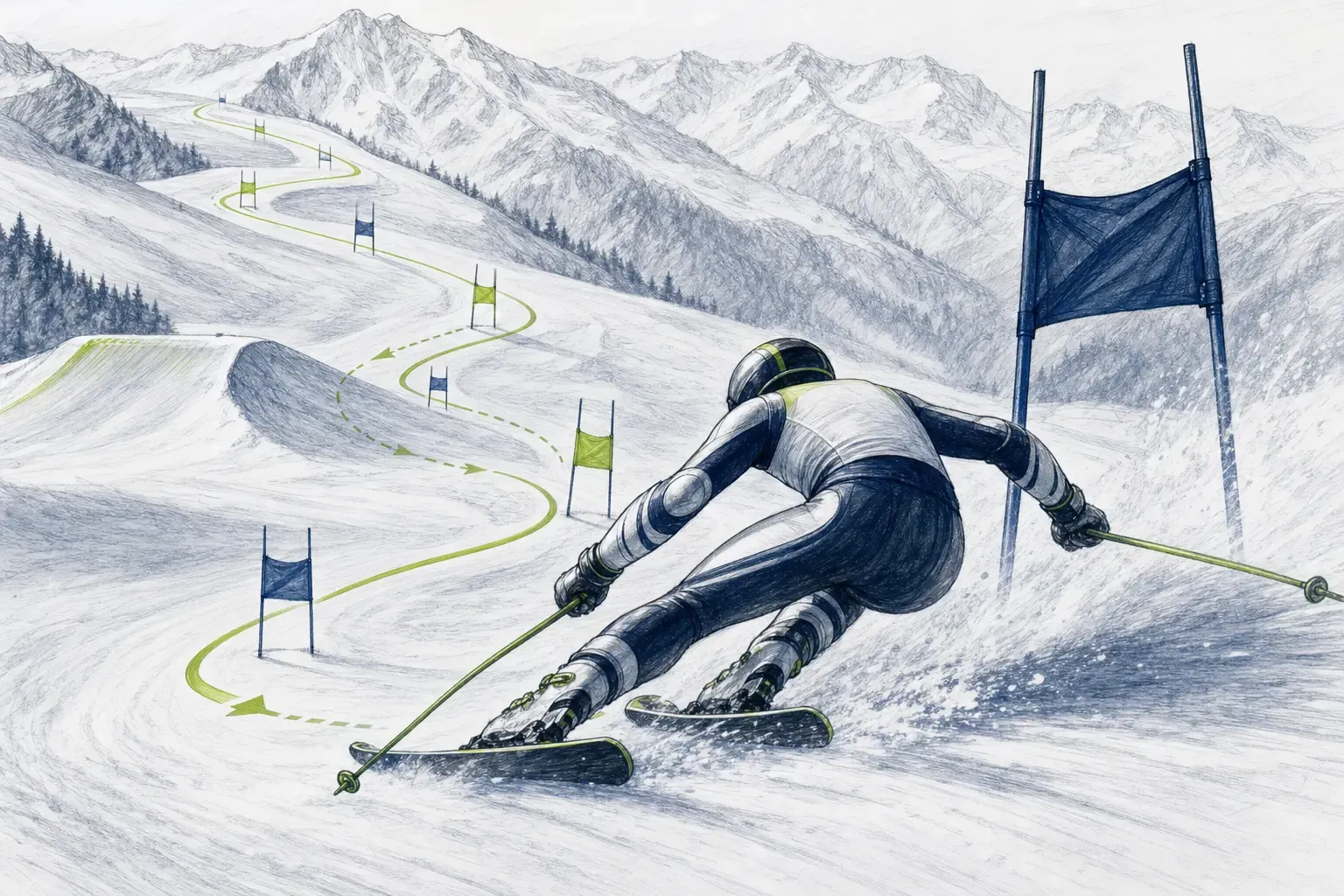
A Super-G course includes long and medium-length turns, changes in pitch, terrain rolls, and, depending on the slope, jumps as well. The course setter must leave the racer the option to choose their own line; the course should not be set only straight down the fall line.
Basic FIS rules
According to FIS rules, Super-G is run in one run. Unlike downhill, it is not preceded by mandatory timed training runs on the race course. That makes the official course inspection, which takes place in the manner set by the jury, even more important.
Gates are marked alternately with red and blue panels. Their layout must create turns of different lengths and respect the terrain, safety requirements, and the prescribed relationship between vertical drop and the number of changes of direction. For a valid result, the racer must pass every gate correctly; any violations are judged by the jury according to the FIS International Competition Rules.
At top-level FIS events, the prescribed course vertical drop is 400 to 600 meters for women and 400 to 650 meters for men. Different parameters may apply for lower levels, special categories, and youth. It is therefore not possible to transfer World Cup course dimensions to children's races.
A slope intended for international competitions must have the appropriate homologation. In this process, FIS assesses the course's geometry, profile, and safety conditions. The homologation certificate for speed disciplines is valid for a maximum of five years. Time is measured with approved electronic timing according to the current FIS timing rules.
Technique and tactics
In Super-G, it is not enough just to take an aerodynamic downhill stance and let the skis accelerate. The racer must constantly balance three demands:
- maintain the highest possible speed,
- take the correct line,
- stay stable through changes in slope, surface, and load.
The shortest line is not always the fastest. A line that is too direct can lead to abrupt edge setting, skidding, or a late exit that ruins the next turns. A smoother line that allows early steering of the skis and gradual pressure build-up is often better.
The turn does not have to be purely carved in every situation. On a steep or very fast section, the racer may deliberately use controlled ski steering. The key is whether the chosen method preserves control and speed for the next part of the course.
The aerodynamic stance is especially important on flat and easier sections. If it is too low or too rigid, it limits visibility, leg movement, and the ability to react to the terrain. The racer therefore moves smoothly between the downhill stance and an active position in the turn.
Super-G in children's skiing
Super-G should not be introduced based only on a child’s age or courage. What matters is the level of skiing skills, motor development, experience on varied terrain, and the ability to consciously control speed.
Before systematic SG training, a young skier should be able to handle especially:
- stable parallel turns on different slopes,
- a long turn with smooth pressure on the outside ski,
- changes in radius and direction without panicked braking,
- running over terrain rollers and small jumps in balance,
- a safe downhill stance and a return to an active position,
- looking ahead and remembering a simple line.
Training practice: Children usually get to know Super-G elements gradually. It starts with free skiing in long turns, drills in corridors, riding over terrain features, and speed control. Only then come shorter open courses, individual sections, and practice of starts or gliding. Speed is increased together with technical confidence, not as a substitute for it.
The exact ski length, radius, course, and training load cannot be determined universally. The rules of the age category, body parameters, the child’s abilities, conditions, and the judgment of a qualified coach are decisive.
Equipment and safety
Racing equipment must comply with the current rules of the relevant category. FIS issues separate specifications every year for skis, helmets, protectors, and other equipment. Super-G skis in adult categories are longer, more stable, and have a larger sidecut radius than giant slalom skis; exact dimensions depend on gender and competition level.
For SG, a helmet designed for speed disciplines and meeting the required standard is used. FIS allows soft ear protectors only in slalom, not in Super-G. The use of a back protector or other protective equipment is governed by the event rules and the national federation. Bindings must be set by a professional technician according to the skier, boots, and conditions; arbitrarily increasing the release force is not a safety solution.
Speed training belongs on a closed, secured, and inspected course. The coach must take into account snow conditions, visibility, wind, safety nets, the stopping area, and the movement of other people.
Typical mistakes and misconceptions
- Super-G is just a faster giant slalom. In reality, it places higher demands on terrain reading, anticipation, and aerodynamics.
- The most direct line is automatically the fastest. Too direct an approach often causes a late and sharp turn.
- A good SG turn must always be perfectly carved. The way the skis are guided is adapted to the slope, speed, snow, and the next gate.
- A brave child is ready for speed training. Courage does not replace technical stability, orientation, or the ability to regulate speed.
- A low downhill stance is the goal of the entire run. It is useful only where it does not disturb balance, visibility, or turn preparation.
Coach’s view
In Super-G, the result is often decided already during inspection. The racer looks not only at individual gates, but also at terrain edges, changes in slope, compressions, shadows, snow quality, and the space needed for the next turn. The coach helps choose the main reference points and a simple run plan that the child can remember.
The goal of children’s training should not be maximum speed at any cost. What matters is teaching a young skier to ski smoothly, look ahead, understand the consequences of their line, and keep enough reserve for a safe response. Speed should be the result of good technique and decision-making.
Sources and further reading
- FIS – Alpine Skiing Documents: International Competition Rules 2026/27
- FIS – Specifications for Alpine Competition Equipment 2026/27
- FIS – What is homologation, and why is it important?
- FIS – Alpine Skiing Broadcaster Manual: Super-G format
- FIS – Timing and Data Documents
- FIS – Alpine Course Homologation Database
- FIS – Official Super-G race record, Panorama 2026