What is passing through a gate
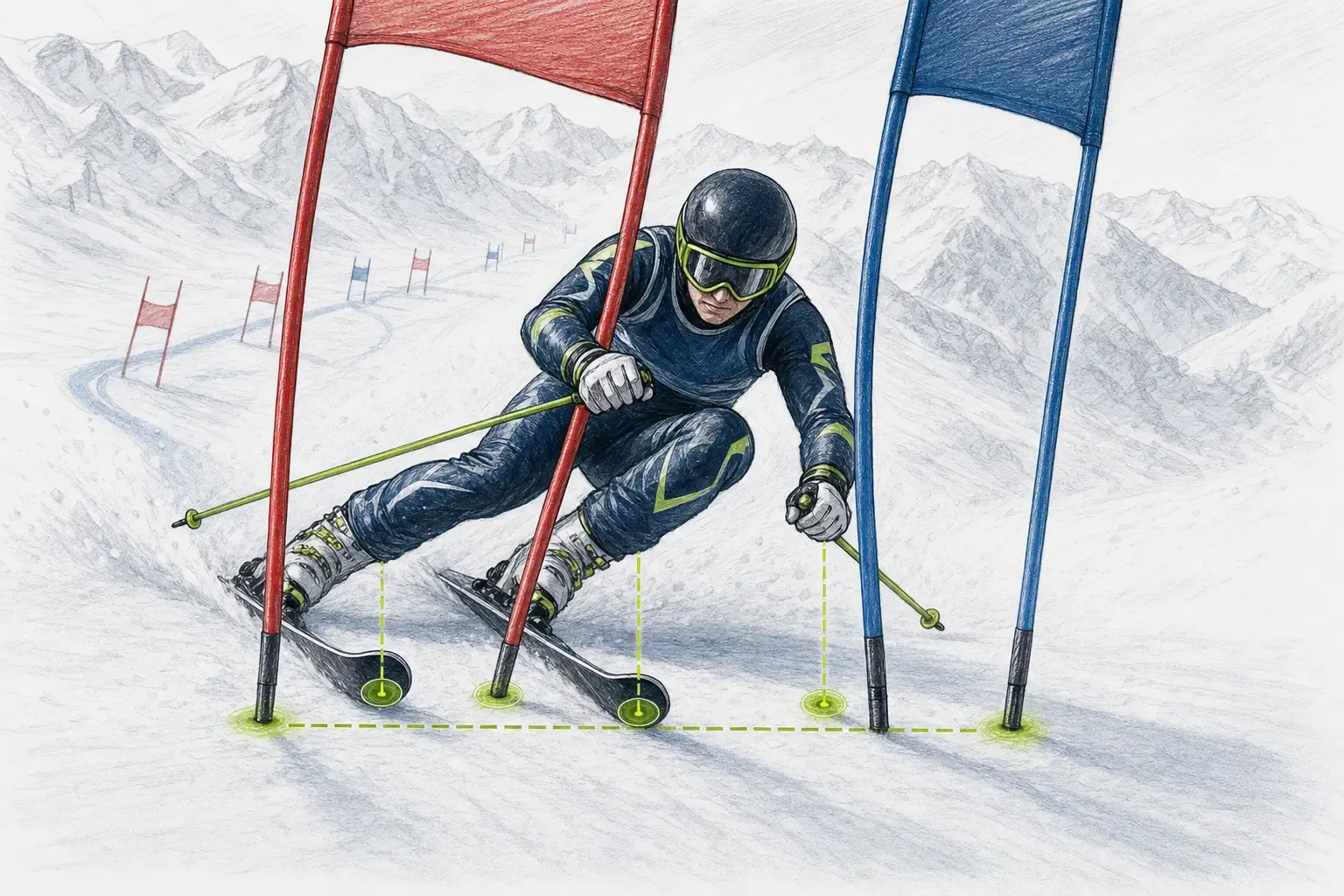
Passing through a gate means the racer passing through or around the turning pole in the manner set by the rules of the given discipline. According to the current FIS rules for alpine skiing, issued on 6. July 2026, a gate is passed correctly when both ski tips and both feet of the racer cross the gate line. The decisive provisions are set out in Article 661.4 of the FIS ICR.
The rule does not require the whole body, both full skis, or poles to pass between the poles. Therefore, a mere touch of the pole, knocking it down, or dislodging it from the snow is not yet a fault. However, it is also not enough for only the torso to pass on the correct side if one ski tip or foot remains on the wrong side.
Gate line
The gate line is the imaginary shortest line connecting the relevant poles at snow level. Its position depends on the discipline and the type of gate:
- in downhill, super-G and giant slalom it is the shortest line connecting the two inside, that is, turning poles of the gate;
- in classic two-pole slalom it runs between the turning pole and the outer pole of the same color;
- in single-pole slalom without an outer pole, the passage around the turning pole and crossing of the imaginary line between consecutive turning poles are judged according to the normal racing line.
If a racer knocks down or pulls out a pole before completing the passage, the gate line does not move with the pole. It is judged according to its original position, which should be marked on the snow.
Going around the pole
The best-known mistake is going around the turning pole – often also referred to by the English term straddle. It occurs when the turning pole remains between the racer’s skis or feet, so that both ski tips and both feet do not pass on the required side of the gate line.
Crossing can happen without a fall or a significant impact. In fast slalom, it may be only a very small deviation of one ski. What matters is not the force of the contact, but the geometry of the passage through the gate.
If a racer loses one ski without having made a gate error before that, the rule counts the passage of the remaining ski tip and both feet across the gate line. However, losing a ski because of crossing does not cancel the error that has already been made.
Single-pole slalom
In single-pole slalom, only the turning pole is used at the regular open gates. The outer poles remain, for example, at the first and last gate and in combinations where they are needed to define the course clearly.
Where there is no outer pole, both ski tips and both feet must pass around the turning pole on the same, correct side and the racer must follow the normal slalom line. So the simplified claim does not apply that with one pole it is enough to get to the next gate in any way.
Error and the possibility of returning
An incorrectly passed and uncorrected gate is grounds for disqualification in a race. Whether a return is possible depends on the discipline and the situation.
In slalom, after an error the racer may return above the incorrectly passed gate and complete it correctly, provided this does not interfere with the next racer and the next racer has not yet passed them. The return must comply with the passage rules; it is not enough to merely touch the pole or go around it from any side.
In downhill, super-G and giant slalom, after a complete stop, the FIS rules do not allow continuing back or farther along the course. A child should therefore not be taught that returning to a missed gate is a universal solution in all disciplines. At club and national events, the rules of the specific competition and the jury’s instructions must also be respected.
What matters for children
A beginner often thinks of a gate as a place to hit with the shoulder or hand. It is better first to understand wherever the course leads and from which side the turning pole must be passed. Contact with the pole is not a condition for a correct or fast passage.
In training practice, the difficulty is increased gradually according to the skier’s level, balance, spatial awareness and ability to anticipate the next gates. For less experienced children, the correct line, rhythm, stable stance and safe speed control take priority over aggressive blocking of the poles. The coach may use short poles or brushes as a teaching aid, not as a different passing rule.
Coach’s view
When evaluating a passage, the coach watches three different things:
1. rule correctness – whether both ski tips and both feet met the passage requirement; 2. technical solution – balance, turn timing, pressure into the skis and the way of releasing after the gate; 3. tactical line — where the skier began the turn and whether they prepared space for the next gate or combination.
So a passage can be valid under the rules, but technically slow or unstable. On the other hand, a very tight and fast line has no value if it leads to straddling the pole. In a disputed run during a race, the relevant judges and jury decide according to the rules and available evidence; the coach’s opinion or the racer’s own opinion does not replace the official decision.
Sources and further reading
- FIS – Alpine Skiing Documents: International Competition Rules (ICR), edition 6. 7. 2026
- U.S. Ski & Snowboard – 2026 Alpine Competition Guide
- U.S. Ski & Snowboard – 2026 Alpine Competition Guide, full PDF
- U.S. Ski & Snowboard – Alpine Competition Officials Education Resources, Gate Judge
- U.S. Ski & Snowboard – Alpine Gate Judge resources
- FIS – Para Alpine Skiing Rules and Regulations 2025/2026, correct passage of gates