Who is the course setter
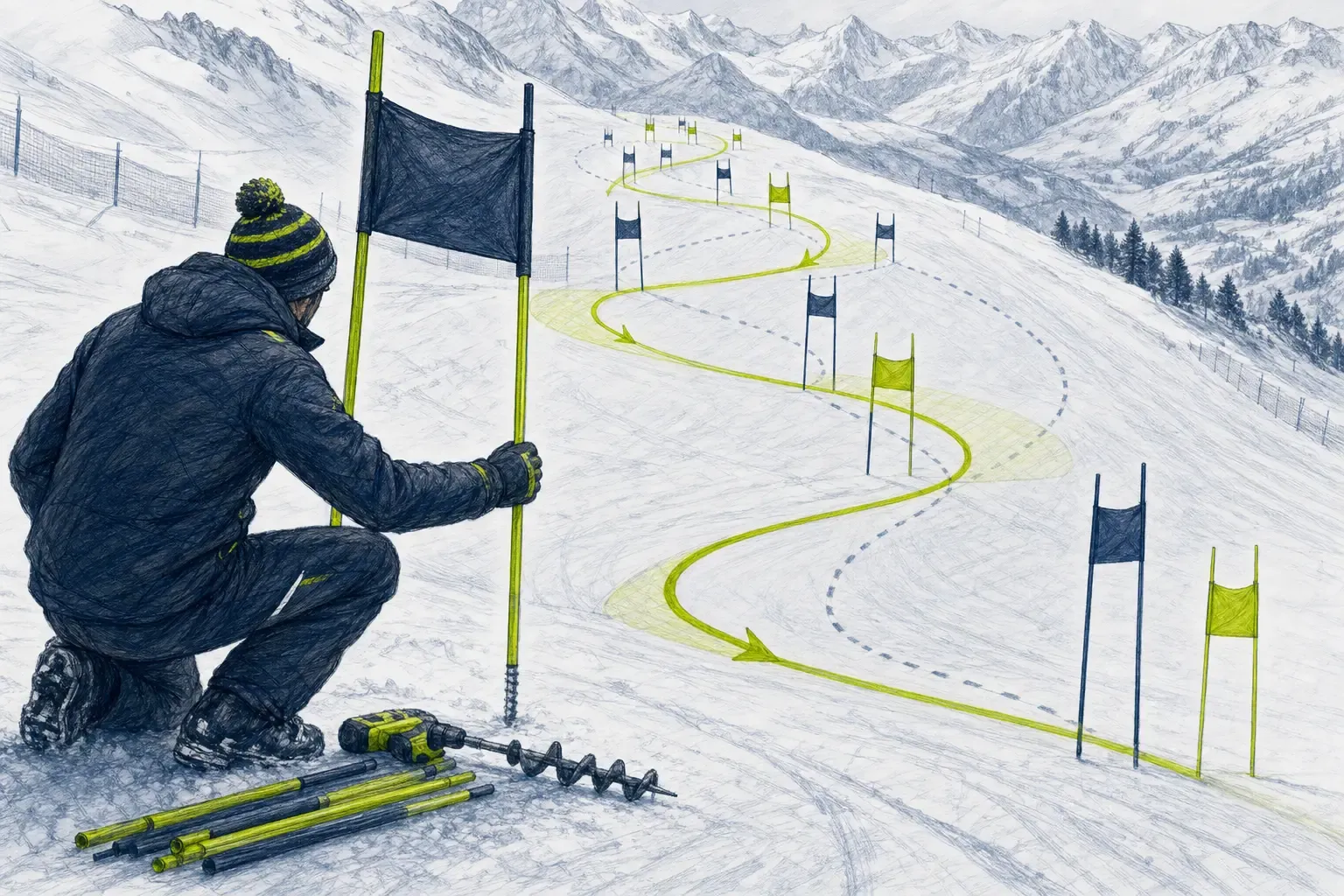
Course Setter (eng. course setter) is the person who creates the race or training line by placing gates. In doing so, they determine the sequence of turns, changes of rhythm and direction, the space for ski handling, and the places where the racer speeds up or must control speed.
At official races, it is not just a coach with a drill and poles. The setter is appointed according to the rules of the event and works under the supervision of the jury. They must follow the current regulations for the given discipline, age category and level of competition. The rules define, for example, the permitted distances between gates, the number or extent of direction changes, required combinations, vertical drop and other course parameters.
The course setter must not be confused with the course chief. The course chief is mainly responsible for preparing the slope, work crews and technical course support. The setter designs and physically marks the race line. Approval of the course and decisions related to fairness or safety are the responsibility of the jury within the scope set by the rules.
What the setter must take into account
A good course does not come from placing gates at regular intervals with one set spacing. The setter first reads the terrain: slope, changes in steepness, width of the slope, side tilt, snow quality, visibility, safety nets, fixed obstacles and space for a safe stop. The line must match the real possibilities of the slope and must not lead racers in an unsuitable direction or at excessive speed toward a risky place.
The character of the set also depends on the discipline:
- slalom uses short turns, open and closed gates, and prescribed types of combinations,
- giant slalom requires flowing turns with a larger radius and suitable use of the slope's width and terrain features,
- super-G and downhill place exceptional emphasis on speed control, the line taken over terrain breaks, jumps and safety sections,
- parallel disciplines require comparable neighboring courses and compliance with their set geometry.
After the course is set, the jury checks it. It may require a gate to be moved, added or removed if the line does not match the rules, the sporting level of the event, or the safety conditions. The setter is therefore not the only or final decision-making authority.
Course setter in children's races
A children's course should not be just a scaled-down copy of an adult course. It must respect the rules of the age category, the children's body size, their motor development, technical level, and ability to recognize the next task in time. The specific limits may vary by discipline, age, and the rules of the national federation, so it is not possible to automatically transfer the dimensions from international adult races.
For younger or less experienced skiers, a clearly readable line is especially important. A child should have enough time to prepare for the next turn and understand where the course continues. A sudden change of rhythm behind a crest, a sharp break on an icy section, or a combination set just before a terrain change may be formally measurable, but unsuitable for the given group.
An appropriate children's course can develop:
- starting the turn in time,
- skiing along the chosen line,
- balance when the slope changes,
- adapting the turn radius,
- looking ahead and orienting between the gates,
- controlling speed without unnecessary braking.
That does not mean every course must be easy or completely regular. An appropriate change of rhythm teaches the skier to adapt their technique. However, the difficulty should be based on the age and level of the start field, not on the setter's attempt to trap the racers.
Race course and training setup
In races, the course setter is bound by competition rules and jury decisions. In training, the coach has more freedom, because they can set short methodological sections, corridors, turns with a changing radius, or another deliberate task. Such a setup does not have to imitate the full race format, but it must remain safe and understandable.
The coach should be able to name what a particular course is meant to develop. Otherwise, training can easily turn into repeated runs through randomly placed gates. For children, it is suitable to change the setup gradually and watch whether the skiers understand the task. The same course can be an appropriate challenge for one group and confusing or too fast for another.
Typical misunderstandings
"The best course is the hardest possible one." Difficulty by itself is not a sign of quality. The course should test skiing skills appropriate to the discipline and category, not create traps.
"The best course is a regular one with the same spacing." Terrain changes, so the same geometry may not create the same rhythm. The setter adapts gate spacing and offset to the slope within the rules.
"The setter is responsible for the entire safety of the race." Course setting strongly affects speed and direction of skiing, but safety is the result of the work of several roles: the organizer, course chief, jury, technical delegate, safety staff, and others.
"The course can be adjusted freely during the race." Changes after the course has been approved or opened fall under the jury's control and must preserve the fairness of the competition. The setter does not make them on their own.
Coach’s perspective
A skilled course setter can anticipate how skiers will react several gates ahead. They watch not only where the next turn is, but also what speed and position the racer will carry into the next section. For children, a good course is one that leads them toward the correct solution, allows performance levels to be distinguished, and at the same time does not create unnecessary risk. After training or races, it makes sense to evaluate whether the athletes understood the intended task, where the rhythm broke down, and whether the problem came from the skiers’ technique, the course design, or the conditions on the slope.
Sources and further reading
- FIS – Alpine Skiing Documents: current ICR, technical officials’ rules and course-setter documents
- FIS – International Competition Rules for Alpine Skiing, edition 1. July 2025
- U.S. Ski & Snowboard – 2026 Alpine Course Setting Specifications
- U.S. Ski & Snowboard – Alpine Course Setting Specifications
- U.S. Ski & Snowboard – Alpine Competition Officials Education Resources
- U.S. Ski & Snowboard – Alpine Equipment and Course Setting
- U.S. Ski & Snowboard – Alpine Guide 2021, course-setting rules and principles