What is downhill DH
Downhill (in English downhill, abbreviation DH) is the speed discipline of alpine skiing. In standard FIS races, the time from one competition run decides the result; the racer with the fastest valid time wins.
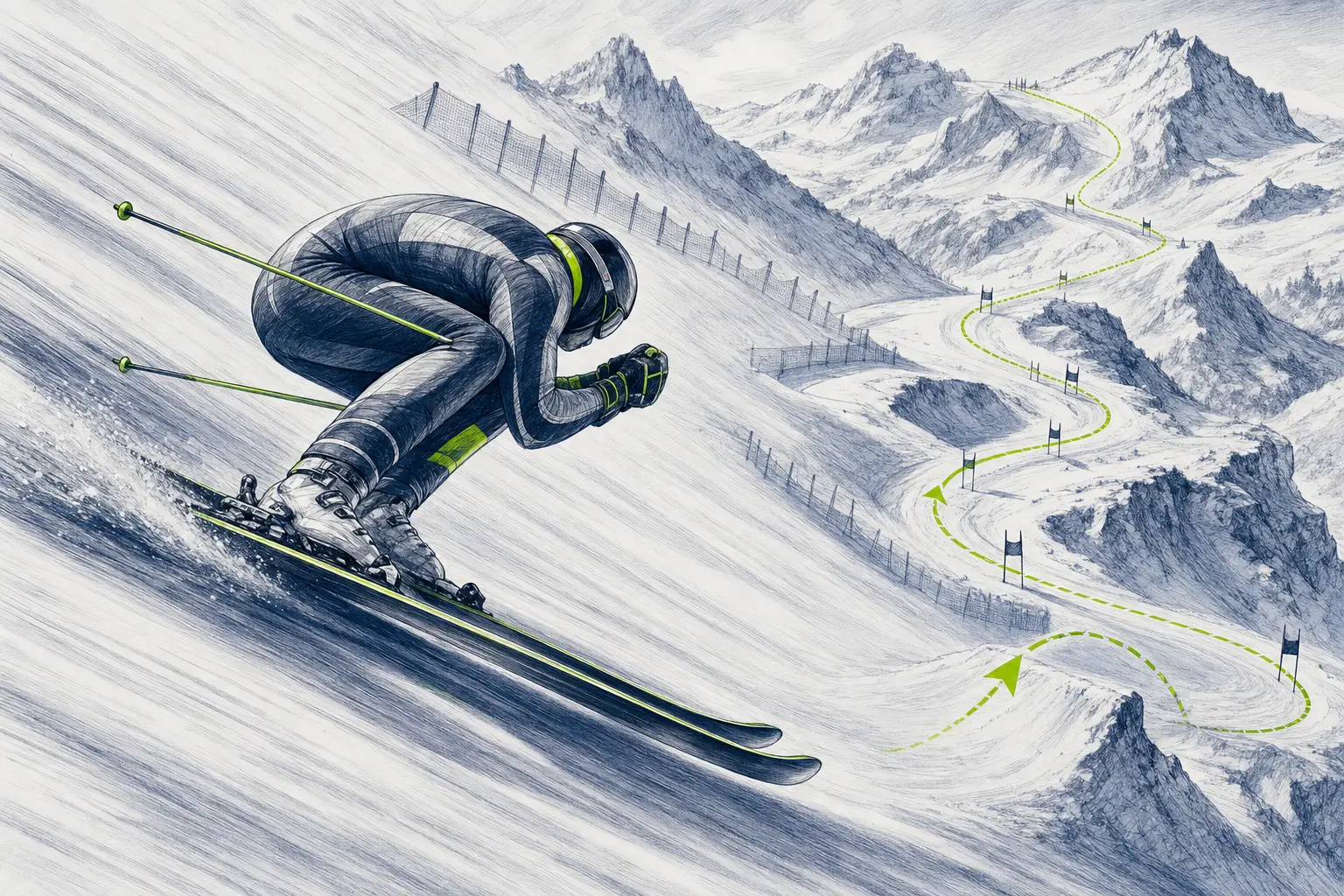
The course runs over varied terrain and can include long turns, traverses, steep sections, terrain changes, compressions, jumps, and passages where an aerodynamic stance and as little drag as possible are important. Downhill therefore cannot be reduced to the simple task of “going as fast as possible”.
FIS characterizes downhill through six components: technique, courage, speed, risk, physical condition, and judgement. The last word is important – the racer must adapt speed and the chosen line to their abilities, the conditions, and the specific point on the course.
Course, gates, and race format
FIS rule: An international downhill race may take place only on a course homologated for the relevant discipline and level of competition. Homologation is a professional assessment of the geometry, terrain, organization, and safety conditions of the course.
The gates in downhill define the corridor and the intended racing line. According to FIS rules, they must be at least eight meters wide. The course should usually be approximately 30 meters wide, but the homologation inspector may approve a different width depending on the line and the character of the terrain. On the outside of turns and near dangerous obstacles, fall zones and safety nets, fencing, mats, or other safety elements are planned.
The course must not be set up so that every section is skied at full speed without control. The course builder must pay special attention to regulating speed before edges, jumps, and terrain changes.
Downhill is preceded by a course inspection and an official timed training run. The conditions for taking part in training and the eligibility to start in the race are determined by the current FIS rules and jury decisions. A training run is not just a warm-up: the racer checks the line, approach speed, jump length, visibility of terrain changes, and the places where they must change stance or turn timing.
Downhill technique
A downhill racer needs a stable yet flexible stance. They must be able to keep the skis in contact with the snow, control pressure, absorb bumps, and still keep the chosen line. The aerodynamic downhill stance is especially important on flat and gliding sections; it is not suitable where it limits balance, visibility, or the ability to react.
The key abilities include:
- skiing large turns at high speed,
- reading the terrain early and looking far enough ahead,
- smooth transitions between the turn and the gliding stance,
- absorbing compressions and terrain irregularities,
- controlled takeoff, flight, and landing in jumps,
- choosing a line with speed in mind on the exit,
- the ability to repeat the planned run even under race pressure.
The shortest geometric line does not have to be the fastest. An overly direct approach can cause hard braking, loss of support, or a late turn. A successful line combines the right distance, smoothness, force control, and good exit speed.
Downhill in children's skiing
A full downhill event is not just a scaled-down giant slalom or ordinary fast skiing down the piste. It requires a specific course, safety measures, equipment, organization, and experienced coaching supervision. The availability of the discipline for individual youth categories is determined by the rules of the relevant federation and the specific race regulations.
Training practice: For children, the development of speed skills should progress from quality free skiing, balance, edge control, and pressure management to working with terrain, glide, big turns, and appropriate jumps. Exercises and courses must match the age, physical development, experience, and current conditions. Long-term athlete development methods emphasize age-appropriate courses, plenty of free skiing, and a gradual expansion of skills instead of early specialization.
A child's readiness cannot be judged only by courage or by results in technical disciplines. The coach watches whether the young skier controls speed steadily, understands instructions, can read the terrain, and maintains technical control even in a more demanding situation. Speed training is not organized among the public on an open piste.
Equipment and safety
Downhill skis are longer in a race context and have a larger sidecut radius than skis for technical disciplines. Exact dimensions and other requirements vary according to gender, age category, and competition level, and the FIS may change them between seasons. The current technical rules are therefore decisive, not an older table or data from another category.
The same applies to the helmet, race suit, and other protective equipment. The bindings must match the ski, the athlete's physical data, the rider's level, and the technical rules; their adjustment belongs to a qualified service technician or mechanic. A higher release value by itself does not mean greater safety.
Protective nets and course homologation do not free the racer from the duty to ski according to their ability. The coach or jury must stop training if visibility, the snow surface, course safety, or the athlete's readiness worsens.
Common misunderstandings
- “Downhill” is not a general term for skiing down a slope. In competitive skiing, it refers to the specific DH discipline.
- Courage does not mean ignoring risk. A good downhill skier plans speed and can adapt it to the situation.
- An aerodynamic stance is not the goal of the whole run. It is used only where it does not limit control and technique.
- Training time is not the only information. Differences can come from the line, the wind, the surface, a mistake on the jump, or a different race plan.
- Adult downhill gear is not automatically suitable for a child. An unsuitable length, stiffness, or binding setting can reduce both control and safety.
From a coach’s point of view, a quality downhill run is the result of technique and judgment built up step by step. Speed should come as a result of precision, flow, and a well-mastered terrain, not as a substitute for these skills.
Sources and further reading
- FIS – Alpine Skiing Documents: current ICR, World Cup rules, safety and homologation documents
- FIS – International Competition Rules for Alpine Skiing, edition 2025, chapter Downhill
- FIS – Specifications for Alpine Competition Equipment 2026/27, document available in the FIS library
- FIS – Alpine Skiing and Para Alpine Skiing Timing Booklet, timing documents
- FIS – What is homologation in Alpine Skiing, and why is it important?
- U.S. Ski & Snowboard – Alpine Training System
- U.S. Ski & Snowboard – Athlete Performance Profile and developmental framework
- U.S. Ski & Snowboard – Alpine Development Guide