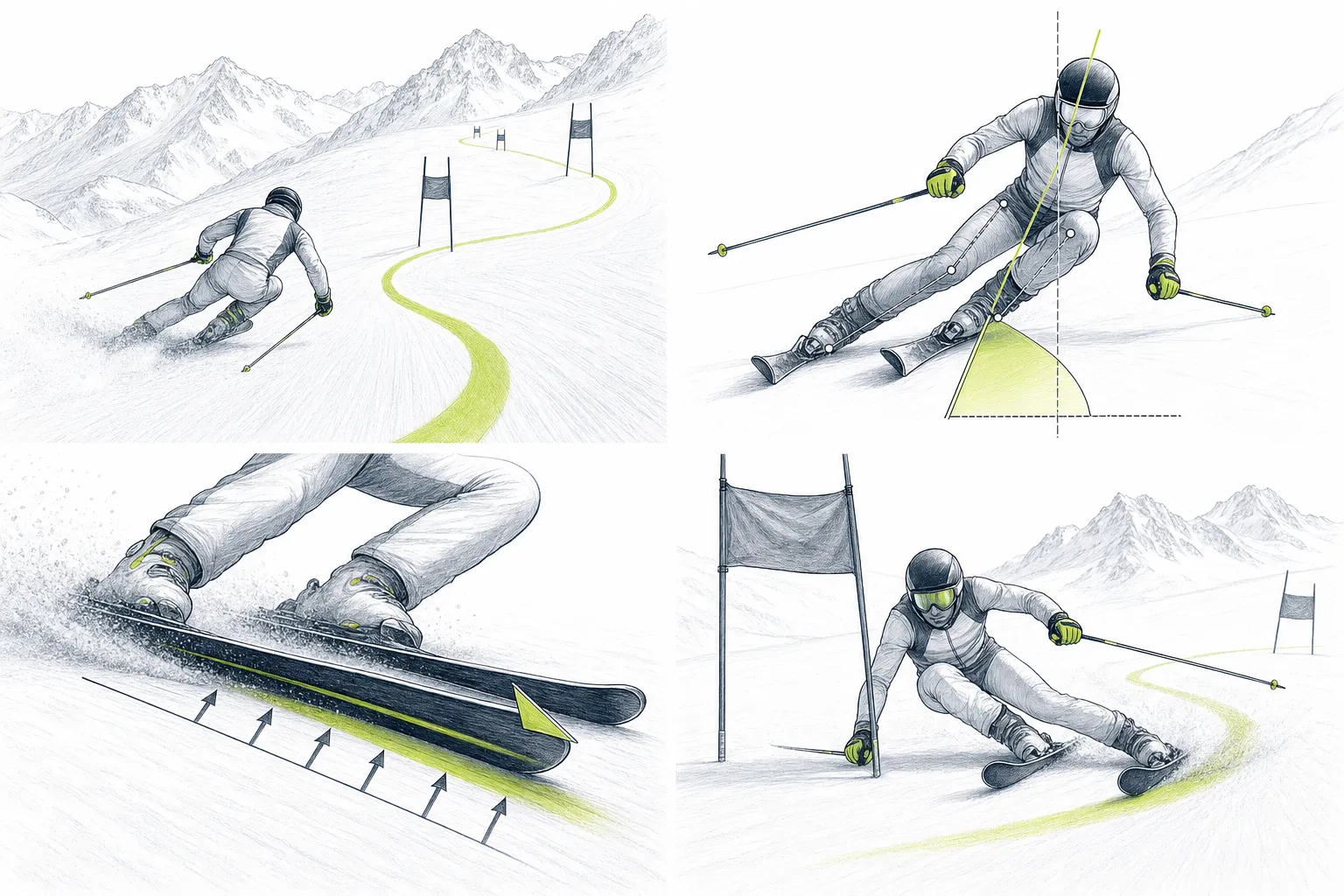
What is giant slalom
Giant slalom, internationally abbreviated as GS from the English giant slalom, is a technical alpine skiing discipline. The gates are set farther apart than in slalom, so the racer makes longer turns and usually reaches higher speed. Compared with super-G, the course is more technical, direction changes are more pronounced, and the speed is usually lower. GS is a separate Olympic and FIS points discipline.
Giant slalom is not just a “big slalom.” It requires a different combination of timing, ski guidance, tactical line choice, and pressure control. The skier must create enough change of direction while not losing more speed than necessary.
What the race course looks like
GS gates consist of poles with colored panels, which alternate in red and blue along the course. The course setter uses the slope, terrain features, and width of the run to test the racers’ technical and tactical readiness. The rhythm does not have to be even: the distance and direction of the next gate can vary, and the course can include more pronounced line changes.
FIS rule: giant slalom is usually decided in two runs in the standard format. The times from successfully completed runs are added together, and the lowest total time wins. The second run is usually set again, and its start order is determined according to the relevant competition rules. The racer must pass each gate correctly; continuing after an uncorrected missed gate leads to disqualification. The exact course parameters, vertical drop, number of direction changes, start order, and possible exceptions are determined by the current edition of the ICR and the rules of the specific competition level. As of 2. September 2026, FIS lists as the current ICR the document published on 6. July 2026.
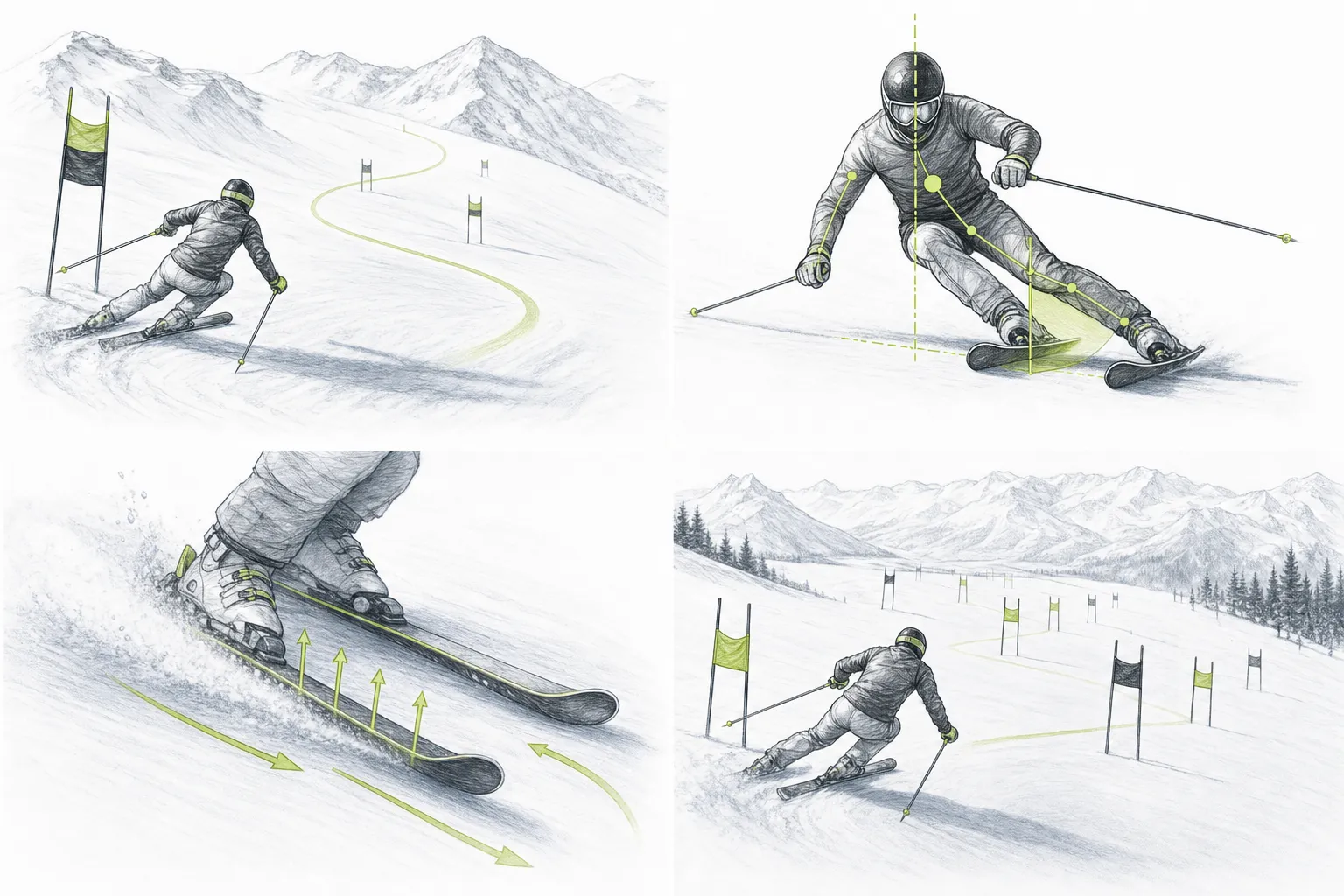
Technique and tactics
A successful GS run comes from combining several skills:
- choosing the line early before the gate,
- smooth transition from one turn to the next,
- appropriate edging of the skis,
- building and releasing pressure in the right part of the turn,
- stable balance over the supporting, mostly outside ski,
- adapting technique to the surface, slope, and shape of the course.
The shortest geometric line is not automatically the fastest. An overly direct approach often forces the skier to brake hard or finish a large part of the turn right under the gate. A slightly rounder but smooth line can be better, because it lets the skis start turning earlier and maintain speed on the exit.
Even race GS is not, under all circumstances, a ride on a clean carved edge. On hard or uneven snow and when rhythm changes are demanding, the skier may deliberately regulate pressure, edge angle, or the amount of skidding. The goal is not “carving at any cost,” but effective control of direction and speed.
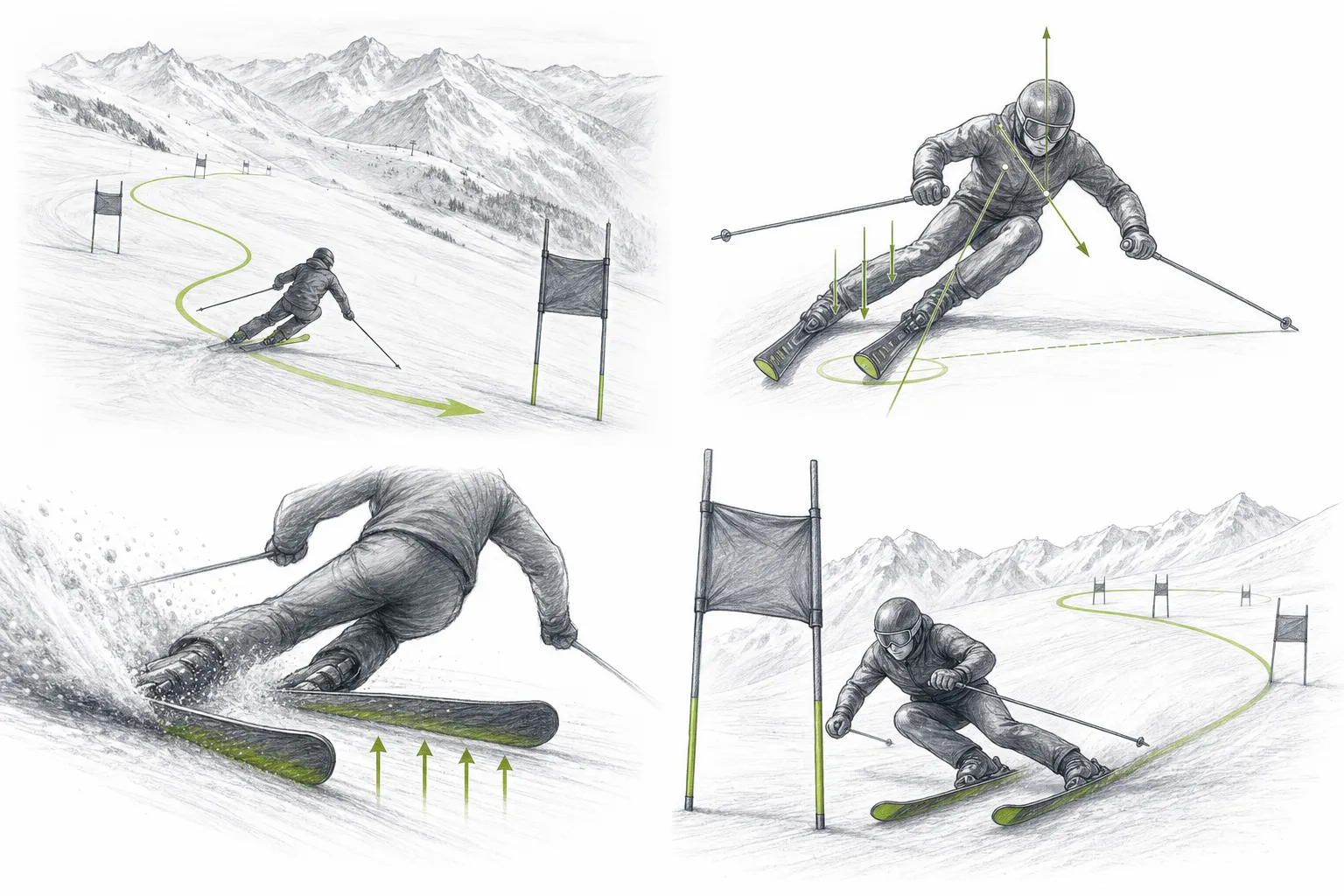
Giant slalom for children
Children’s GS should not be a smaller copy of adult training. The difficulty of the course, speed, length of the section, and the equipment used must match the age, experience, motor development, and current conditions.
Training practice: younger skiers first learn the principles of giant slalom in free skiing, in simple corridors, and on courses marked with brushes or low markers. Only later are full gates, bigger rhythm changes, and more demanding terrain added. It is important to alternate different turn radii and gradients, not to repeat only one course set in the same way.
When working with children, the coach mainly watches whether the skier:
- looks ahead and recognizes the next gate in time,
- can change turn size without panicked braking,
- stays agile and balanced instead of in a static squat,
- finishes the needed change of direction in time,
- can handle the course repeatedly, not just with one randomly successful run.
Speed is added gradually. Time alone is not a sufficient measure of quality in younger children, because it may reward an overly direct and risky run that the skier does not yet control.
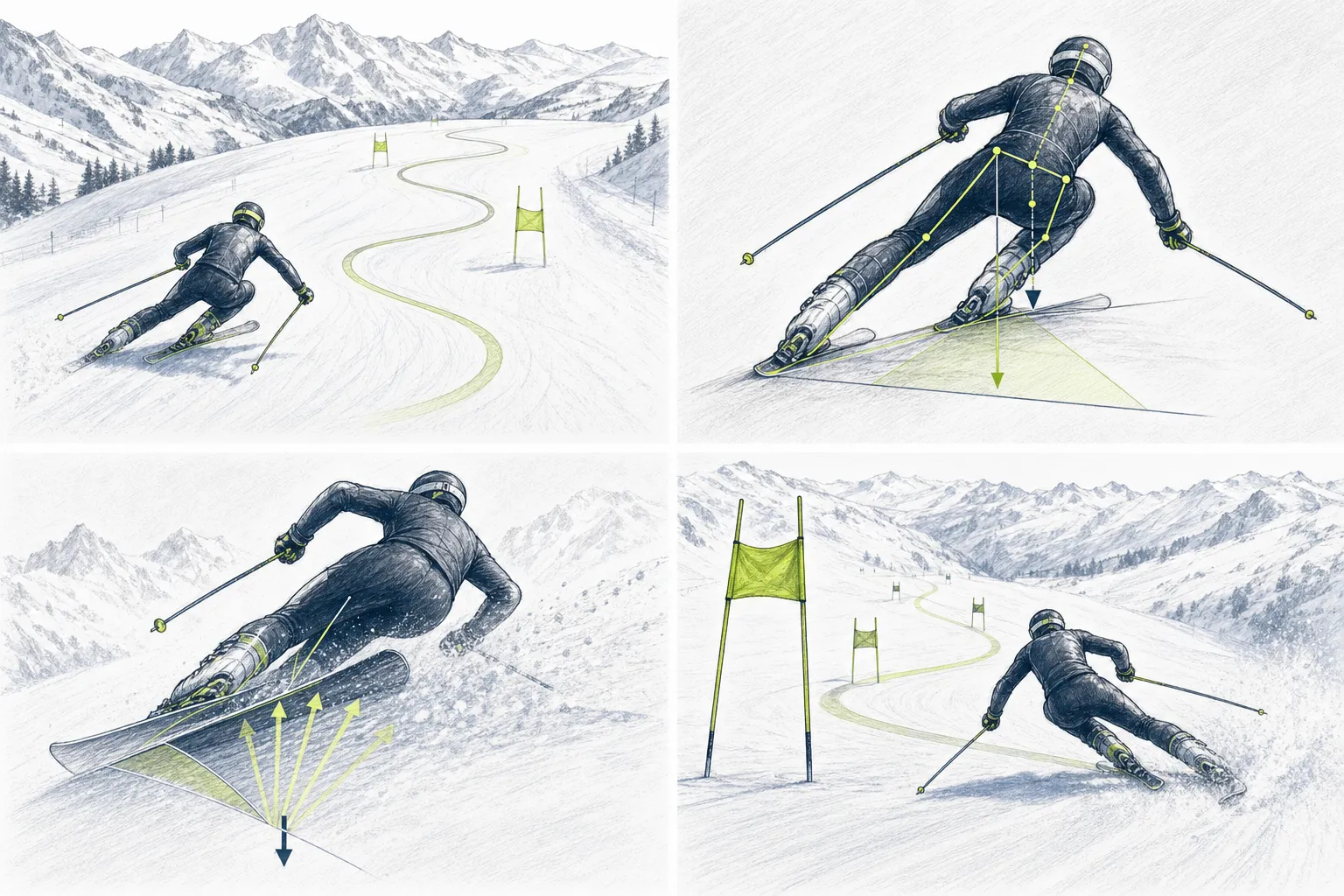
Skis and protective gear
Race GS skis are generally longer than slalom skis and have a larger sidecut radius. They provide stability in a longer turn, but at the same time require appropriate strength, balance, and technique. FIS sets the dimensions of competition skis according to category, gender, and competition level; special provisions also apply to categories U14 and U16. The current FIS specifications for the 2026/27 season are valid from July 2026.
For a child, therefore, the right length or radius cannot be determined only by age or body height. Weight, technical level, physical readiness, the course, and the rules of the specific race also matter. Ski selection and binding setup belong in the hands of the coach and qualified service personnel. In races, a helmet and other equipment in line with the current rules, standards, and manufacturer instructions are used.
Typical mistakes and misconceptions
- The fastest line is always the most direct. An overly direct approach often leads to a late turn and a sharp loss of speed.
- GS is only carving between the gates. The way the skis are guided must adapt to the course and the snow surface.
- A big lean means good technique. Without support, proper timing, and directional control, leaning by itself is more of a risk.
- A stiffer, longer ski makes a child faster. Material that is too demanding can make control harder and reinforce defensive movements.
- GS training means only skiing full gates. The foundation remains quality free skiing, variety of turns, and confidence on different surfaces.
From a coach’s point of view, a good giant slalom is the result of repeatable technique and sound decisions. Time is the final result, but the path to it is shown mainly by line, balance, timing of pressure, and the skier’s ability to react to changes in rhythm without losing control.
Sources and further reading
- FIS – Alpine Skiing Documents: International Competition Rules (ICR), 6. July 2026
- FIS – Specifications for Alpine Competition Equipment 2026/27, valid from July 2026
- FIS – Specifications for Alpine Competition Equipment 2025/26, official technical document
- FIS – Specifications for Alpine Competition Equipment 2025/26, table of categories and disciplines
- U.S. Ski & Snowboard – Alpine Level 300 and GS coach education
- FIS – Olympic Winter Games 2026, Giant Slalom event details
- FIS – Alpine World Cup 2026/27: technical and speed disciplines
- FIS – Alpine Skiing, 3rd FIS Points List 2026/27