What gate spacing is
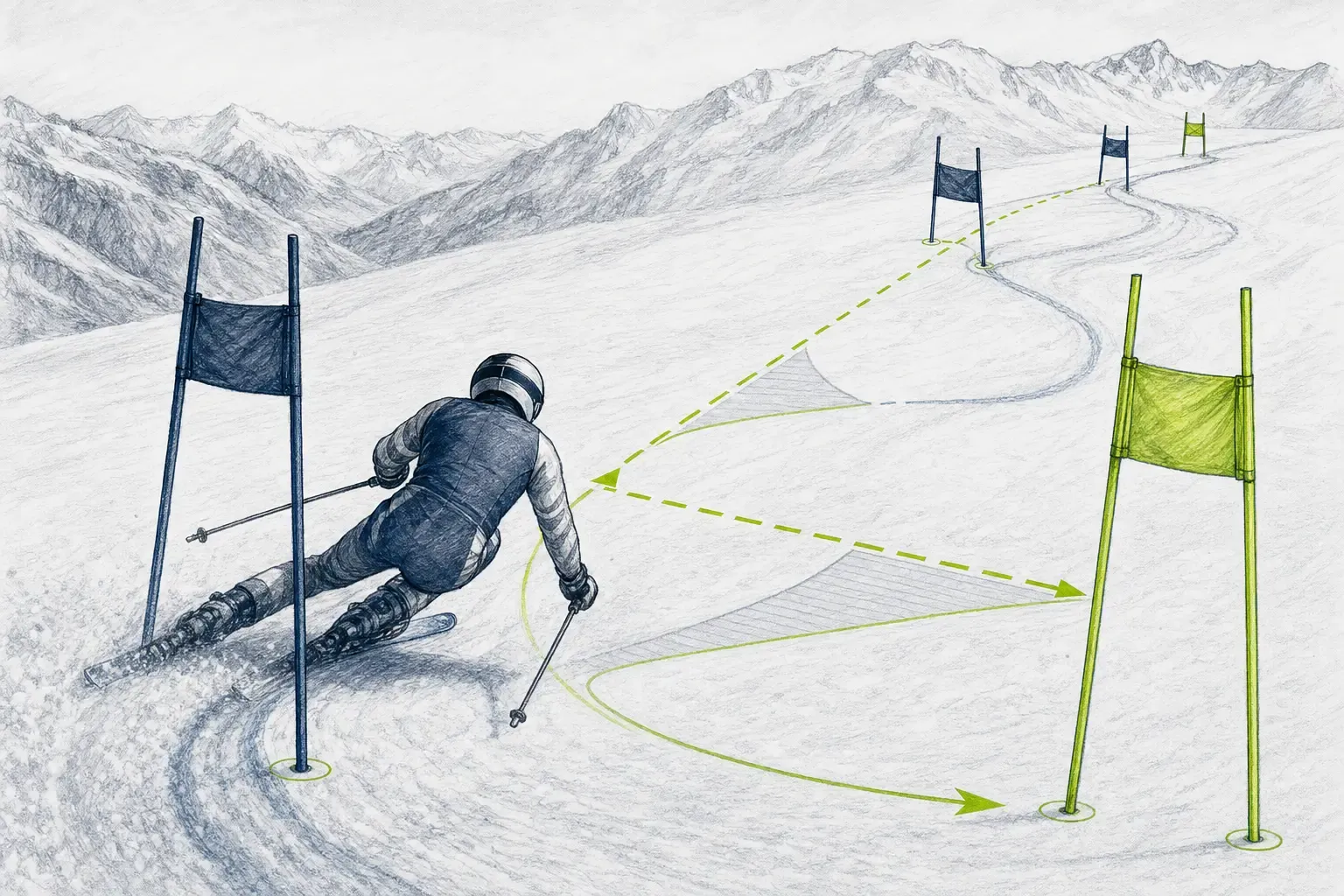
Gate spacing describes the distance between successive gates or their designated poles on a ski course. For an exact definition, the discipline, gate type, and the points between which it is measured must always be stated. FIS mainly uses the distance between turning poles in slalom, while in giant slalom it also sets a minimum distance between the nearest poles of two successive gates.
In everyday coaching language, the term can mean the overall spacing, as well as its two practical components:
- longitudinal spacing, that is, the course shift downhill,
- lateral offset or offset, that is, the sideways shift of the next turning pole.
Two courses with the same spacing between poles do not have to be equally difficult. A larger lateral offset requires a more pronounced change of direction, while a smaller offset creates a more direct and usually faster line.
Spacing is not gate width
A common misunderstanding is to confuse the spacing between gates with the width of one gate. Gate width is the distance between its inner and outer pole. Gate spacing describes the relationship between two successive gates.
It is also necessary to distinguish course elevation change. Elevation change is the difference in height between the start and finish, not the sum of the spaces between gates.
Values in race rules
The current FIS international rules for alpine disciplines were published on the FIS website on 6. July 2026. The numerical limits are assessed according to the specific discipline and category; they are not a universal guide for building a training course.
Slalom
In slalom, the distance between the turning poles of successive open or closed gates ranges from 8 to 13 metres. For the U12, U14 and U16 categories, the upper limit is 12 meters. In delayed turns, the distance between turning poles is 12 to 18 meters, and for the listed youth categories the maximum is 15 meters.
Between gates in vertical combinations and hairpins, the distance may not be less than 0,75 meters; for categories U12 to U16, the rules allow a minimum of 0,50 meters. According to the current wording, the slalom gate itself has a width of 6 to 8 meters. These dimensions are the rule for the competition course, not a recommendation that all training gates should be set at the same limit.
Giant slalom
The giant slalom gate has a width of 4 to 8 meters. The distance between the nearest poles of two consecutive gates may not be less than 10 meters. The course setter works with the terrain and alternates longer, medium and shorter turns; simply meeting the minimum spacing does not yet guarantee a suitable or safe course.
Super-G
In Super-G, open gates have a width of 6 to 8 meters and vertical gates 8 to 12 meters. The distance between the turning poles of consecutive gates must not be less than 25 meters. In this discipline, the position of the gates in relation to terrain changes, jumps, safety nets and the safe racing line is of exceptional importance.
The rules may change, and national regulations may include additions for children’s or regional competitions. Before setting a race course, always check the current ICR edition, the relevant national rules and the race programme.
Practical significance
The spacing and offset of the gates affect how much time a skier has to finish the turn and prepare for the next change of direction. A shorter distance creates a faster rhythm, but is not automatically more difficult. If the gates are close to the fall line, the course can be technically easier and still fast. A greater distance with a pronounced offset may require a longer, more precisely controlled turn.
The difficulty of the resulting task is influenced at the same time by:
- the slope and shape of the hill,
- snow firmness and grip,
- visibility and terrain shape,
- side offset of the gates,
- rhythm changes and inserted combinations,
- the speed the skier carries over from the previous section.
During inspection, the racer therefore learns more than just numbers. They watch the rhythm, where the turn begins, changes in offset and the sections where they must either control speed or, on the contrary, keep it.
Children’s and training context
For children, the spacing of a race course cannot be determined mechanically from age alone. Technical level, physical and motor development, experience with poles, ski length, slope and snow conditions all matter. FIS limits define the competition framework, but they are not an individual training prescription.
At the first exercises, simple, easy-to-read lines and appropriate speed are used. A shorter rhythm, greater offsets and changes in distance are introduced gradually. The coach may use soft poles, brushes or other suitable training aids so that the child can first focus on line choice and orientation in the course, not on contact with a full pole.
An improperly set children’s course may show up as repeated late turns, sudden braking under the gate, loss of balance, or the fact that most of the group cannot hold the intended line. Such a result does not necessarily mean the children did not try hard; it often signals that the spacing, offset or slope does not match the training goal.
Coach’s view
Gate spacing is a tool for creating a specific movement task. The coach should know whether they want to develop rhythm, an early turn initiation, work with the outside ski, a longer turn, or adaptation to a change of line. Only then do they choose the spacing and offset.
A good course is not one where all gates are equally spaced. It is easy to read, appropriate for the group, and allows the training goal to be met without unnecessarily increasing risk. At competitions, designated officials and the jury are responsible for correct course setting and approval according to the rules; a qualified coach with knowledge of the slope and the group’s abilities should set the training course.
Resources and further reading
- FIS – Alpine Skiing Documents: International Competition Rules (ICR), edition 6. 7. 2026
- FIS Council – Minutes Summary, November 2024: changes to alpine skiing rules
- U.S. Ski & Snowboard – 2026 Alpine Competition Guide
- U.S. Ski & Snowboard – Alpine Competition Officials Education Resources
- U.S. Ski & Snowboard – Alpine Points: the significance of rules for course dimensions and construction
- Alpine Canada Alpin – Resources
- Alpine Canada Alpin – National Officials Program, Level 1: gates and course building
- FIS – Rules for the Alpine FIS World Cup 2024/25: course setter assignment and approval