What gate offset is
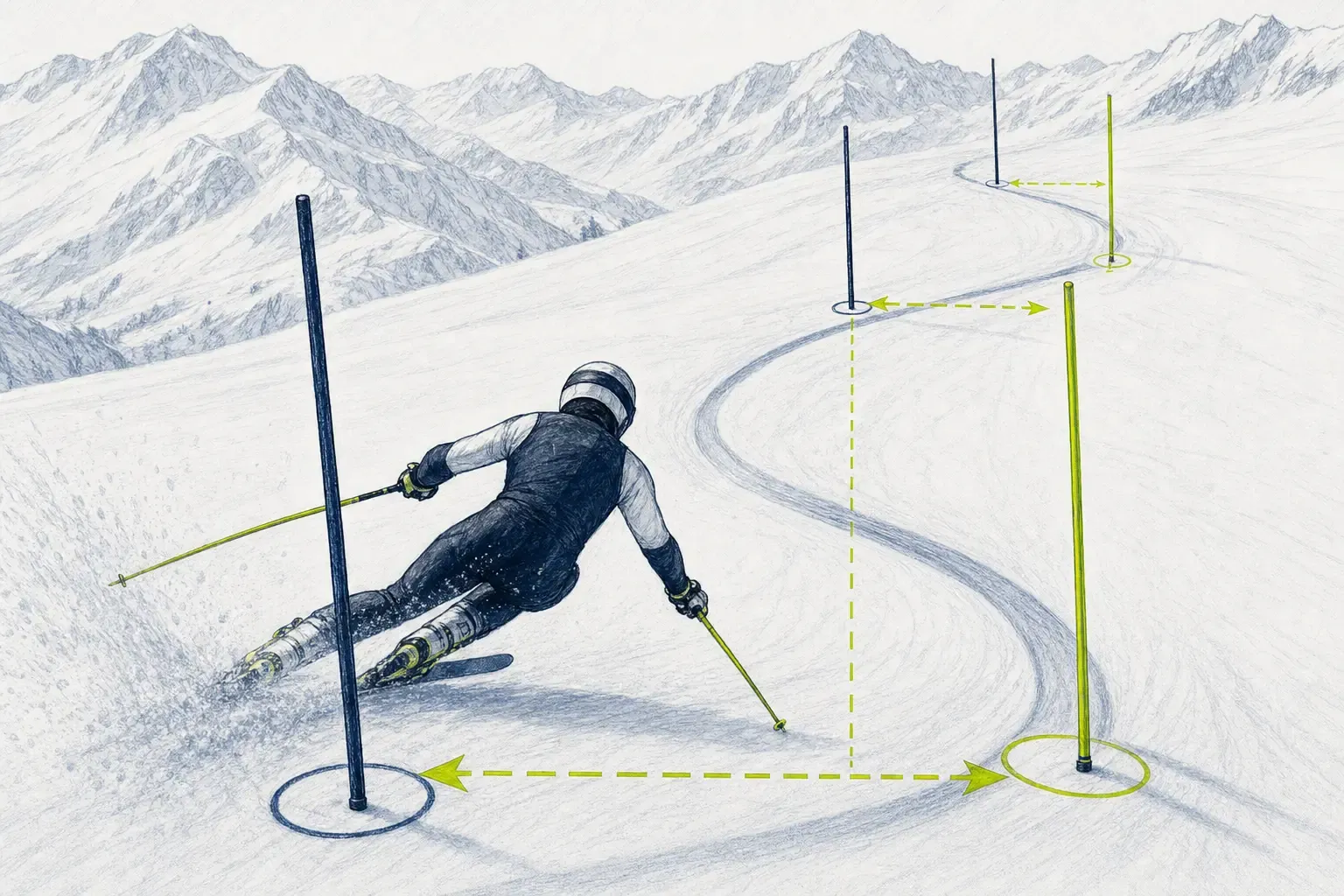
Gate offset (engl. gate offset) is, in coaching and course setting, the lateral shift of the next turning pole or turning gate across the slope relative to the previous one. It is assessed with respect to the fall line, meaning the direction of the greatest slope steepness.
Offset should be distinguished from other course dimensions:
- gate width is the distance between the poles of one gate,
- distance between gates is defined in the rules and technical tables between the relevant poles or turning points,
- vertical distance is the course-setting term for the spacing of gates downhill along the slope,
- offset expresses their lateral shift across the slope.
In a giant slalom or slalom with a single turning pole, the course geometry is assessed according to the turning gates or poles, not the auxiliary outside pole.
How offset changes the skiing task
A larger offset usually sends the course more across the slope. The skier has to change direction more strongly, set up the turn in time, and regulate speed appropriately. A smaller offset creates a straighter line, less time between edge changes, and often higher speed.
That does not mean, however, that a given offset value always has the same effect. The resulting task is determined by the combination of:
- lateral offset,
- distance between turning points,
- slope and terrain variety,
- direction of approach from the previous gate,
- expected speed,
- hardness and shape of the surface.
The same offset can be smooth on a gentle slope, but on a steep section with a short spacing it may require hard braking or a very quick change of direction. Offset is therefore not a separate indicator of difficulty or safety.
Offset in the rules and in races
FIS rules set gate dimensions for each discipline, the allowed or required distances, the number of direction changes, combinations, and general principles for course setting. However, there is no single universal offset value that applies to all disciplines, age categories, and slopes. Course legality and suitability cannot be judged only by lateral offset.
In giant slalom, the course should use the terrain and include a variety of long, medium, and shorter turns. The racer should have space between the gates to choose a line. In slalom, vertical combinations and delayed gates are added to open gates, where the geometry and rhythm are assessed differently.
In official races, the course setter must follow the current version of the FIS rules, the relevant national regulations, and the jury's decisions. A training aid or common club spacing does not replace competition rules.
Children's training
For children, the offset should match their skiing level, ability to perceive space, control speed, and link turns together. The goal is not only for the child to get through the course, but to be able to ski in balance and understand the required turn direction.
Too much offset combined with a short distance or a steep slope often leads to turning late, braking under the gate, and skidding across the slope. A course that is too straight can, on the other hand, increase speed excessively and encourage skiing straight at the pole instead of shaping a turn.
In training practice, it is a good idea to increase the difficulty gradually and keep a clear rhythm for the children. If the coach changes the offset, spacing, pitch, and type of combination all at once, it is hard to tell what caused the technical problem. Simpler sections, shorter courses, and a clearly chosen training task allow children more quality repetitions without universally prescribing one geometry for everyone.
Typical misunderstandings
- “A bigger offset means better training.” Not always. An excessive offset can just trigger defensive skiing and braking.
- “The same offset means the same turn.” This is not true without considering the spacing, terrain, and entry speed.
- “Offset is the distance between gates.” It is only the lateral component of their relative position.
- “The racer should go straight to the pole.” The pole marks the point where the course changes direction, but the final line starts to form before that.
- "When building, it is enough to follow the numbers." Dimensions must be linked to safe use of the terrain, flow, and suitability for the given group.
Coach's view
The coach sees offset as a tool for creating a specific movement task. With a smaller offset, they can develop quick transitions and a direct line; with a larger offset, they can emphasize finishing the turn, directing across the slope, and preparing the next change of direction in time. In every case, they must also work with the spacing and the terrain profile.
When inspecting the course, a racer does not need to calculate the offset in meters. They should recognize where the course opens or closes, where the speed comes from, and at which gates they must start changing direction earlier. The pole itself is only a reference point; what matters is the line connecting several following turns.
Sources and further reading
- FIS – Alpine Skiing Documents: current register of ICR rules and documents for alpine skiing
- U.S. Ski & Snowboard – Alpine Course Setting Specifications
- U.S. Ski & Snowboard – 2026 Alpine Competition Guide
- U.S. Ski & Snowboard – Alpine Competition Officials Education Resources
- U.S. Ski & Snowboard – Alpine Training System
- U.S. Ski & Snowboard – Alpine Course Setting Recommendations
- U.S. Ski & Snowboard – Alpine Course Setting: Variation
- U.S. Ski & Snowboard – Alpine Equipment and Course Setting