What Are Alpine Disciplines
Alpine disciplines are racing forms of alpine skiing on courses marked out with gates. The skier’s task is to complete the course in the shortest possible time while passing all gates correctly. In everyday skiing language, this term mainly refers to slalom, giant slalom, super-G, and downhill. FIS rules also include combined, parallel, knockout, and team events.
Alpine disciplines are traditionally divided into technical disciplines – slalom and giant slalom – and speed disciplines – super-G and downhill. This division reflects the character of the course and the race, not the level of technical skill required. Even speed disciplines demand precise ski control, balance, and a feel for the line; technical disciplines, in turn, involve high speed and heavy physical load.
Basic Disciplines
Slalom – SL
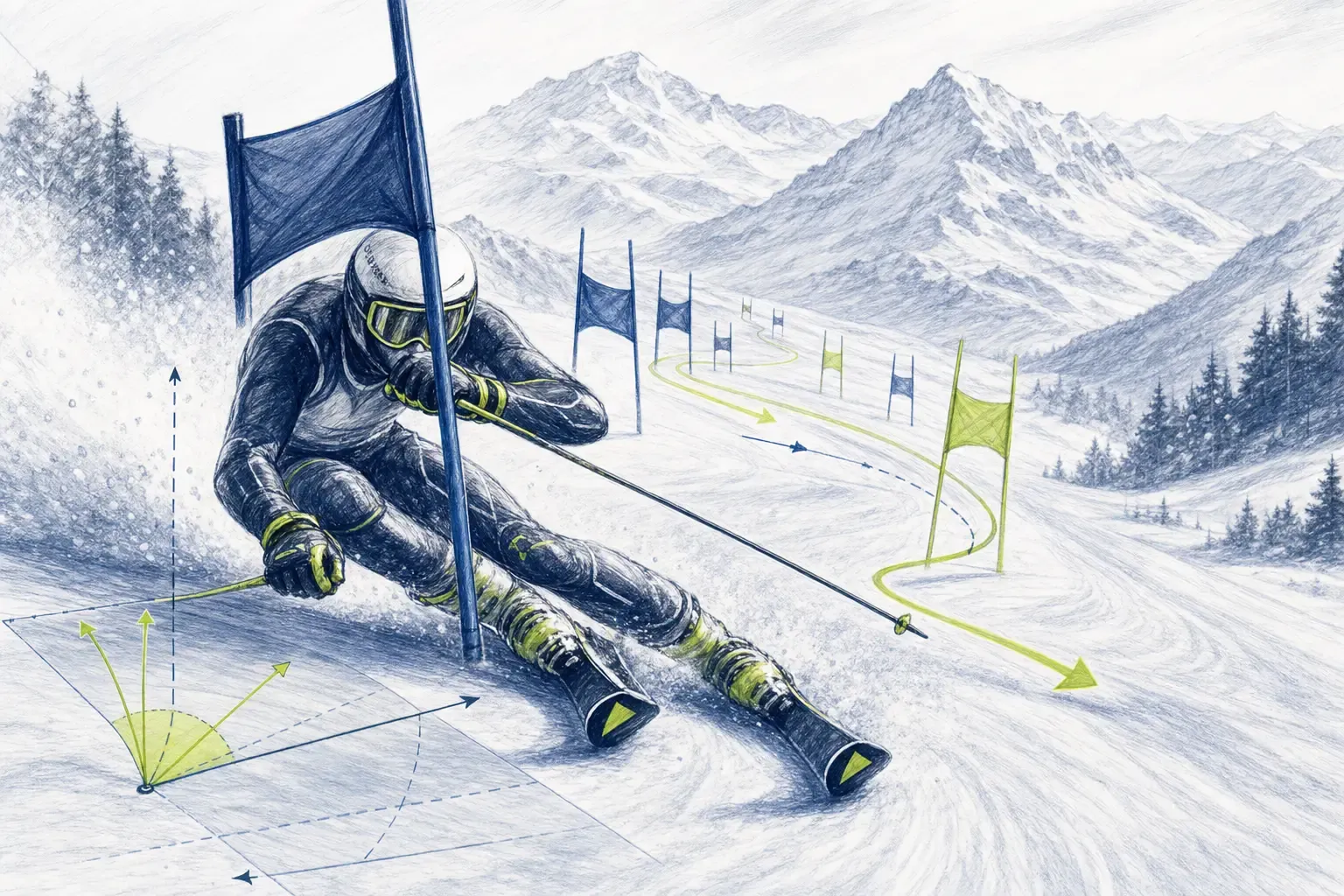
Slalom has the tightest gate spacing of the basic disciplines and requires frequent, quick changes of direction. In the standard FIS format, two runs are raced on two differently set courses, and the result is the sum of the times. The racer must hold a precise line, start the turn early enough, and maintain rhythm between the gates.
Contact with the poles is not the goal of slalom. It is a consequence of a straighter, more aggressive line used by technically advanced racers. Children should first learn to turn correctly and pass through gates; aggressive pole blocking without mastering balance and support on the outside ski leads more to loss of control than to faster skiing.
Giant Slalom – GS
Giant slalom has wider gate spacing and smoother, longer turns than slalom. In standard FIS races, it consists of two runs whose times are added together. It requires precise line choice, effective edging, pressure control, and the ability to preserve speed through changes in slope and course rhythm.
In children’s training, giant slalom elements are often used to develop basic racing technique. However, the gates must be set appropriately for age, ability, snow conditions, and available safety space. Children’s giant slalom therefore cannot be understood simply as a smaller version of an adult course.
Super-G – SG
Super-G combines high speed with technical direction changes. The gates are more widely spaced than in giant slalom, but the course may include pronounced turns, terrain changes, and jumps. The race is decided in one run. The racer inspects the course in advance, but unlike downhill, there is no official timed training run on it.
Super-G is therefore not just a shorter downhill. In a single competitive run, the racer must combine memorized line choice with immediate adjustments to speed, body position, and turn timing.
Downhill – DH
Downhill is a speed discipline on a long course with a large vertical drop. It may include fast turns, gliding sections, compressions, terrain rolls, and jumps. Placings are usually decided by one competitive run. The event also includes official training sessions, during which racers get to know the course and its speed and terrain demands.
In children’s skiing, the skills needed for future downhill are developed gradually: a stable stance, balance while gliding, riding over uneven terrain, safe jumps, awareness of speed, and the correct response to the coach’s instructions. The inclusion of speed training should not be based on age alone. What matters is the child’s technical readiness, motor and psychological development, the quality of the course, safety of the area, and expert supervision.
Combined and parallel formats
Alpine combined combines the speed and slalom parts. In the individual format, the same racer completes a downhill or super-G run and a slalom run; the times are added together. Team combined splits these roles between two racers from the same team - one completes the downhill and the other the slalom. The result is the sum of their times. The exact program and conditions depend on the level and rules of the event.
In parallel competitions racers ski on two side-by-side, as comparable as possible courses. The format may include qualification and elimination rounds for individuals or teams. Parallel races are a separate competition format; they cannot be automatically identified with slalom or giant slalom just based on the distance between gates.
Rules and equipment
Rule: The racer must complete the prescribed course, pass all gates correctly, and respect the rules for the start, finish, and course of the competition. Missing or incorrectly passing a gate can lead to disqualification. The exact method of evaluation is governed by the current rules of the given competition.
Individual disciplines have different requirements for courses and racing equipment. Regulations may set, in particular, ski parameters, helmet use, the properties of racing clothing, and other safety features. FIS publishes technical specifications for a specific season; for children's and national races, the rules of the national federation and organizer must also be checked. Equipment should not be chosen only according to the SL, GS, SG, or DH label, and this text does not replace professional service or the manufacturer's instructions.
Timing and results processing are subject to separate technical rules. At official races, time is therefore not measured by ordinary sports watches, but by an approved main and backup timing system.
Children's and training perspective
Training practice: A child should not specialize too early in just one discipline. Slalom develops movement speed and rhythm, giant slalom develops turn work and line choice, free skiing develops adaptability and safe movement in varied terrain. Practicing gliding, terrain irregularities, and appropriate jumps prepares a skier for higher speed without needing to immediately copy adult super-G or downhill.
The coach watches not only the final time, but also whether the young skier understands the course, can regulate speed, maintains stability, and can continue or stop safely after a mistake. A faster run is not automatically technically better if it came from loss of control or excessive risk.
The most common misunderstanding is the idea that each discipline requires a completely different technique. The basic principles - balance, support, ski control, timing of movements, and awareness of the terrain - remain the same. What changes is how they are used depending on speed, turn radius, gate spacing, and course profile.
The entry is based on FIS rules and documents available as of 2. September 2026. For specific races, the current version of the international, national, and competition regulations is always decisive.
Sources and further reading
- FIS – Alpine Skiing Documents: International Competition Rules and World Cup rules
- FIS – Calendar & Results: overview of alpine disciplines and competition formats
- FIS – Specifications for Alpine Competition Equipment 2026/27
- FIS – Timing & Data: Alpine Skiing Timing Booklet
- FIS – World Championships: team combined rules
- FIS – Milano Cortina 2026: alpine skiing schedule
- FIS – Rules for the Alpine FIS World Cup