Racer Category is the formal group in which a participant in ski races is placed according to the rules of the given competition. In alpine skiing, it is most often determined by year of birth and gender. The category affects separate result evaluation, participation conditions and, depending on the level of the competition, also some requirements for the course, discipline, or equipment.
How the category is determined
A racer is not placed according to how old they are exactly on the day of the race. The decisive factor is usually the year of birth in relation to the competition year or season, as defined by the relevant rules. FIS works with a competition year from 1. July to 30. June, and the age conditions for alpine competitions are governed by article 607 of the International Rules for Ski Competitions. For entry into regular FIS races, it is also assessed whether the racer will reach the age of 16 by the end of the relevant calendar year.
In international children's alpine skiing, the following designations are used most often U14 and U16. The letter U comes from the English under. However, the designation cannot be mechanically understood as the current age on the day of the start. The correct category must always be checked against the year-of-birth table valid for the given season.
A national federation or organizer may also use more detailed children's categories at domestic races, for example U8, U10 or U12, or their verbal names. The names and limits of local categories should therefore not be automatically transferred to another race series. The rules valid for the given competition level and the regulations of the конкретного event are decisive.
FIS records the racer’s year of birth and uses it to verify age eligibility. However, registration itself, assignment of an FIS code, or listing on the points list does not yet mean automatic permission to start in every event. The racer must also meet the conditions of the specific competition.
What the category does not express
A racer category is not the same as:
- performance group in training,
- start group or the draw order,
- ranking by points or seeding,
- level of technical skill,
- the child’s biological or physical maturity,
- the type of event, for example club races, national cup, FIS races, or the World Cup.
Two children from the same birth year can differ significantly in height, strength, coordination, experience, and the ability to handle speed and stress. The category provides organizationally comparable evaluation, not complete physical or performance equality.
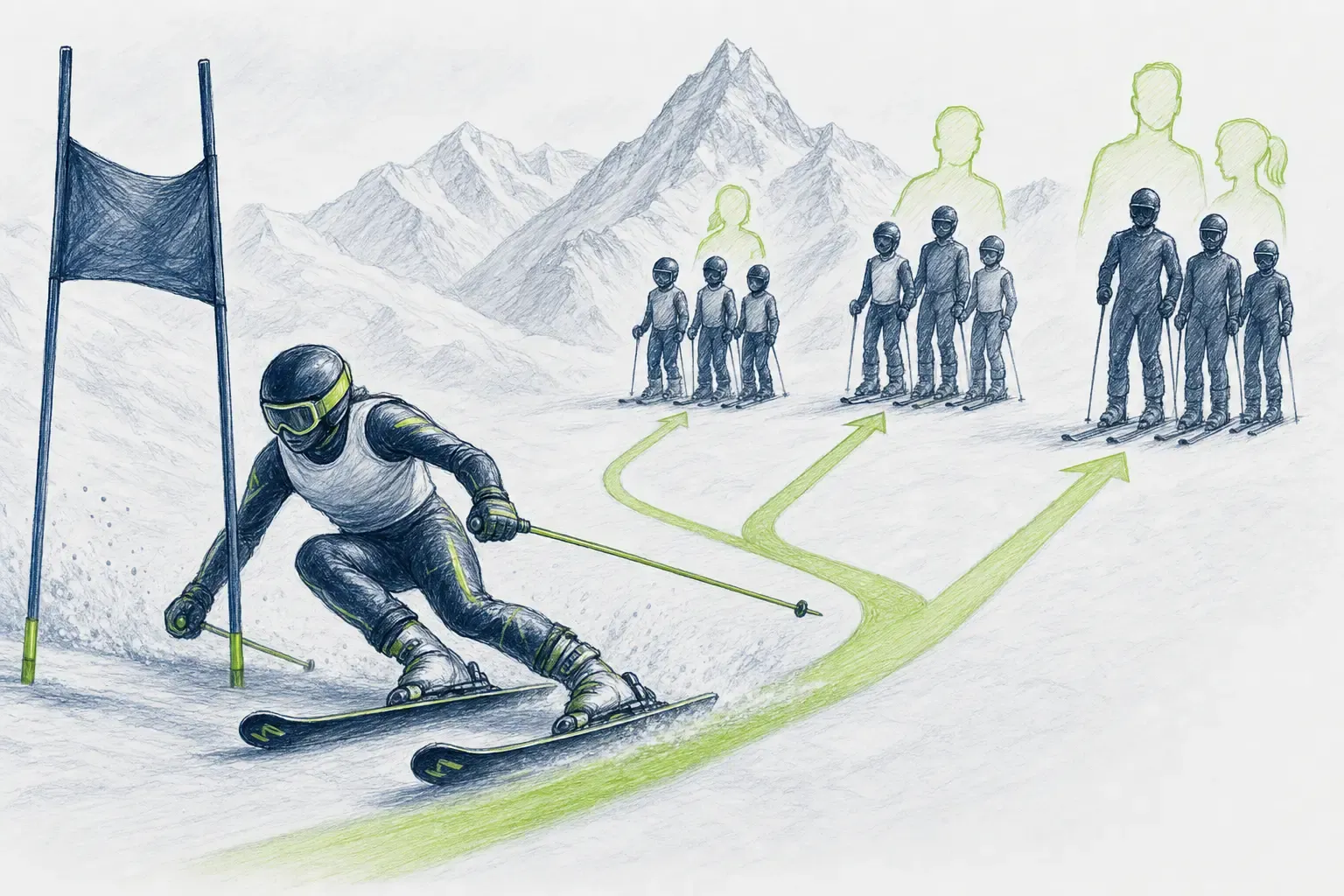
Children’s and racing context
Moving up to a higher category may bring more demanding courses, different competition, and changed equipment or discipline rules. It does not mean that the child should train from one day to the next like an older or more advanced racer. In training practice it is to adjust the load gradually according to technical level, motor development, health, and experience, not only according to the U14 or U16 label.
When comparing results, it is necessary to check whether the racers completed the same course, the same gate setup, and the same conditions. Times from different categories or separately set courses may not be directly comparable.
For adult veteran racers, FIS Masters uses separate age classes. These are divided into several groups by age and gender and follow their own Masters rules.
Typical mistakes
The most common mistake is placing someone according to age on race day instead of according to the valid birth-year key. It is equally wrong to assume that a designation used in one series applies everywhere unchanged.
A parent or coach should check before registering:
1. birth year stated in the registration, 2. categories listed in the event regulations, 3. license or membership requirements, 4. equipment rules for the given category, 5. any special age limits for the discipline.
Coach’s view
The category is an organizational framework, not a training diagnosis. A good coach knows the placement rules, but when planning, mainly takes into account the child’s long-term development. A change of category should not lead to sudden pressure for results, premature specialization, or the use of equipment the child cannot technically handle. If the classification is unclear, the official competition schedule and the position of its organizer or the relevant federation take precedence.
Sources and further reading
- FIS – Alpine Skiing Documents
- FIS – Rules of the FIS Points, Alpine Skiing, edition 2025/26
- FIS – Alpine Skiing, 16th FIS Points List 2025/26
- FIS – International Competition Rules Masters Alpine Skiing
- FIS – Masters Documents
- FIS – Rules for the Alpine FIS World Cup
- FIS – Alpine Skiing, Officials Education and Technical Resources