What Is Ski Tactics
Ski tactics is the decision about where, when, and at what speed a skier will go. It mainly includes choosing the line, where to start and finish the turn, rhythm, speed control, and adapting the run to the terrain, snow, visibility, and course setting.
Technique and tactics are closely related, but they are not the same. Technique describes how a movement is performed - for example edging, guiding the skis, or controlling pressure. Tactics determine where and when these movements are used. A skier may have good technique but still lose time or control because of a poor line. On the other hand, a tactical plan must match the technical and physical abilities of a particular skier.
The Line Is Not Just the Distance from the Gate
In race skiing, tactics are often simplified to choosing the line around the gates. In reality, it is about the relationship between:
- the length of the course covered,
- preserving speed,
- the size and place of the direction change,
- linking into the next turn,
- the terrain and the quality of the surface.
Biomechanical research shows that the shortest path is not always the fastest. A line that is too direct may require a sharp direction change at the gate, create significant skidding, and worsen the entry into the next turn. A slightly longer but smoother line can preserve higher exit speed. The result is therefore not determined by a single turn, but by the continuity of the whole sequence.
The term high line usually refers to earlier preparation and a larger part of the direction change above the gate. Direct line shortens the course and runs closer to the gate, but leaves less margin. Neither is automatically correct. The choice depends on the discipline, slope, spacing, speed, surface, and the racer’s abilities.
A controlled skid is not always a technical mistake either. It can be a purposeful solution when you need to adjust direction or speed quickly. It becomes a disadvantage when it happens late, unexpectedly, and disrupts the rest of the run.
Tactics in the race course
The tactical plan is formed mainly during course inspection. The racer and coach do not watch only individual gates, but entire sections and how they connect. They pay attention to changes in rhythm, transitions between steep and moderate slope, terrain breaks, open slopes, cross-travel sections, gate combinations, snow conditions, and places with limited visibility.
It is important to determine:
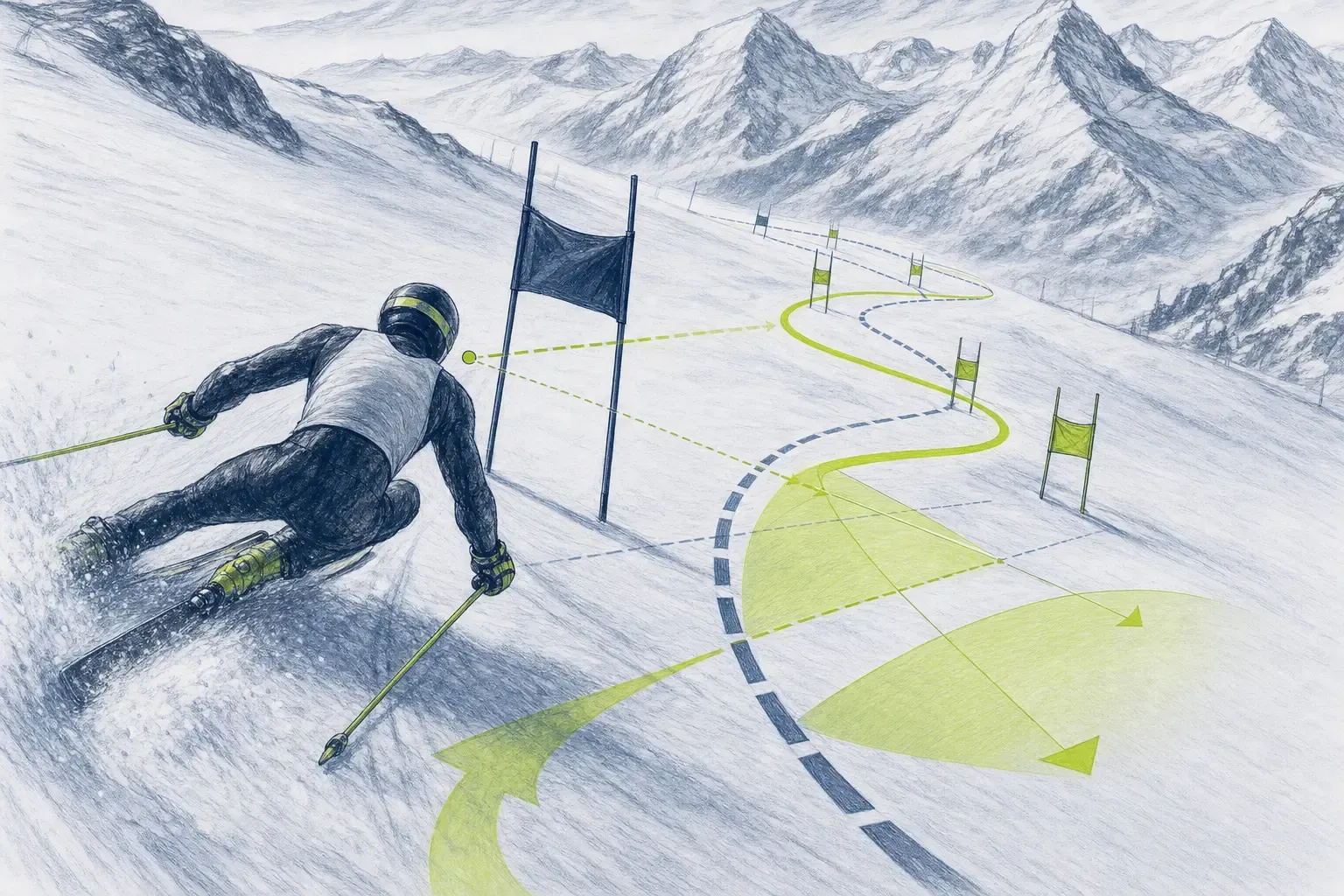
1. where to start preparing the next turn, 2. where the main change of direction should take place, 3. in which direction the skier should exit the gate, 4. where they can accelerate and where they need a bigger reserve, 5. which places are decisive for the whole next section.
In slalom, precision, quick transitions, rhythm changes, and clean passage through combinations are very important. In giant slalom, the compromise between turn shape, line length, and speed on exit becomes very apparent. In speed disciplines, terrain, gliding sections, aerodynamic stance, jumps, and anticipation at high speed become more important. Tactical training for downhill and super-G belongs exclusively in secured training led by a qualified coach.
Rules take precedence over tactics. Course inspection, gate passage, racer behavior, and competition conditions are governed by the current FIS rules and the schedule of the specific race. A tactical effort to shorten the line must not lead to missing a gate or ignoring safety instructions.
Children's context
In children, tactics are not developed by copying the line of an adult racer. They must correspond to the child's level of ski control, speed of processing stimuli, spatial orientation, self-confidence, and motor development.
A beginner first learns to choose a safe line, regulate speed by the shape of the turn, and look where they want to go. A more advanced child can compare two lines, change the point where the turn starts, or handle simple rhythm changes. Only later does detailed planning of the race course make sense.
Suitable training practice is free skiing in varied terrain, simple corridors, courses with several possible solutions, and comparing runs using time or video. However, time should not be the only criterion. The coach also watches control, flow, the ability to link the next turn, and whether the child understands the assigned task.
Common misunderstandings
- “The fastest line is always the shortest.” A short path can cause a bigger loss of speed.
- “You have to go as close to the pole as possible.” Position at a single gate alone does not say whether the line was effective.
- “Every turn must be carved.” The way the skis are guided depends on the situation.
- “One line applies to everyone.” Tactics must respect the skier's abilities, equipment, speed, and physical capacity.
- “The plan does not change during the run.” The surface, visibility, and actual approach speed may require an immediate adjustment.
Coach’s perspective
The coach does not teach only the position relative to the gate. They help the skier understand cause and effect: how starting the turn earlier or later affects the exit, why a mistake at one gate may have been caused by the previous one, and when it is worth sacrificing part of one section for the next one.
A good tactical task has an appropriate level of complexity and a clear goal. Especially with children, it is more effective to work on one theme at a time — for example, exit direction or a change of rhythm — than to give many instructions at once. The goal is an independent skier who can read the terrain, anticipate the next situation, and choose a solution that matches their own abilities.
Sources and further reading
- FIS – Alpine Skiing Documents: International Competition Rules (ICR), current version published on 6. July 2026
- U.S. Ski & Snowboard – Alpine Training Systems
- Alpine Canada – Level 2 Officials Manual, Course Inspection section
- Supej et al. – Recent Kinematic and Kinetic Advances in Olympic Alpine Skiing: Pyeongchang and Beyond
- Gilgien et al. – Influence of Line Strategy Between Two Turns on Performance in Giant Slalom
- Reid et al. – Alpine Ski Motion Characteristics in Slalom
- Spörri et al. – Course Setting and Selected Biomechanical Variables Related to Injury Risk in Alpine Ski Racing
- Gilgien et al. – Characterization of Course and Terrain and Their Effect on Skier Speed in World Cup Alpine Ski Racing
- Brodie, Walmsley and Page – Fusion Motion Capture for the Biomechanical Analysis of Ski Racing