What technical skiing is
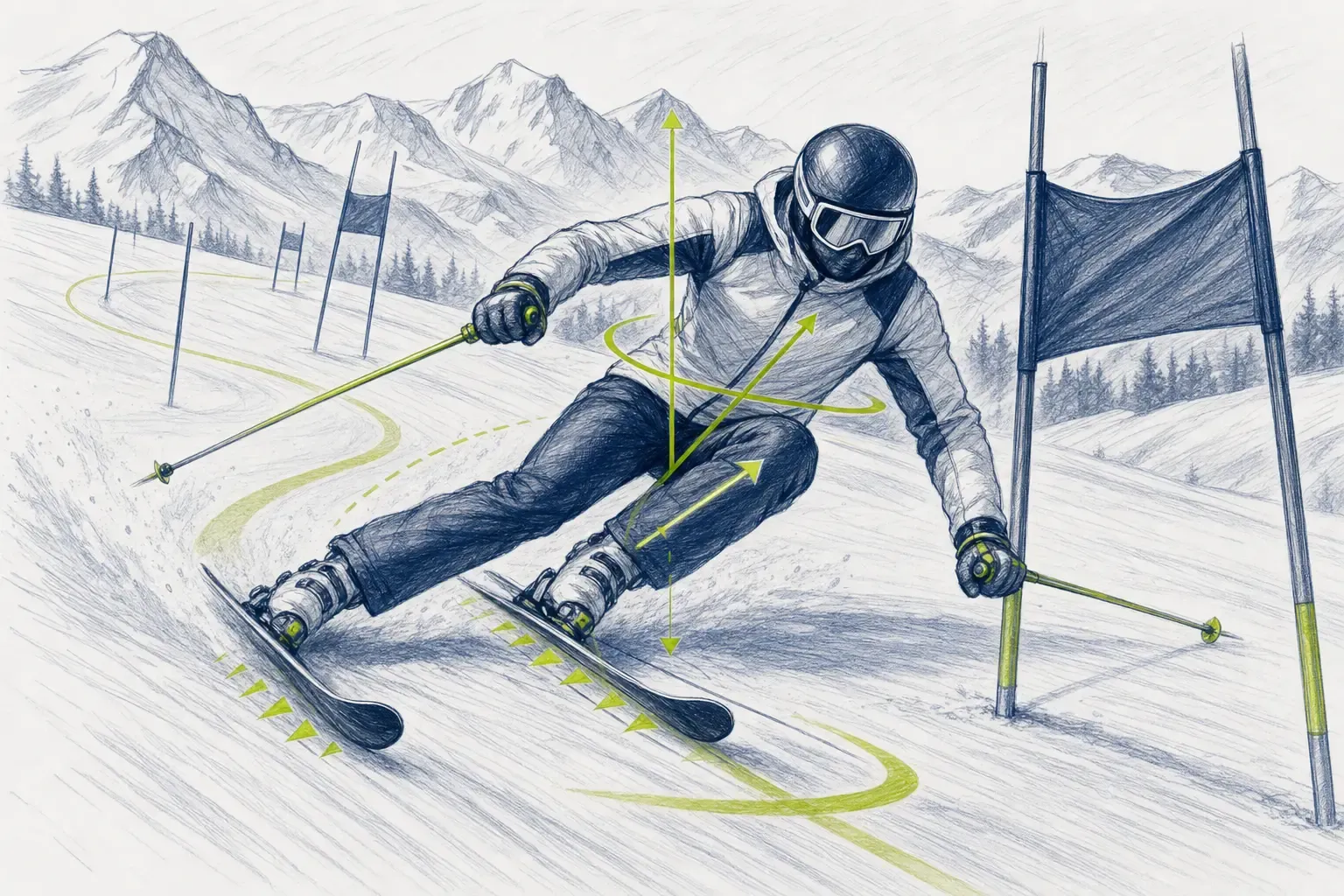
Technical skiing is the skier’s ability to use movements precisely, purposefully, and appropriately to speed, terrain, snow, and the intended turn shape. It is not one prescribed body position. Good technique makes it possible to change direction and speed without unnecessary movements, keep the skis in contact with the snow, and maintain balance even as conditions change.
The term is not the name of a separate discipline or a precisely defined element in FIS rules. In alpine ski racing, skiing is not judged with a style mark: what matters is the achieved time when the course is skied correctly and the rules are met. Technique is therefore a means of performance, not an independently evaluated result. Slalom and giant slalom are commonly referred to as technical disciplines, but the term “technical skiing” has a broader training meaning.
What technical skiing consists of
Different teaching methods may use different names and divisions. In practice, however, the following interconnected areas regularly appear:
- Balance and a mobile basic stance. The skier stays ready to react forward and backward, side to side, and rotationally. It is not a rigid “correct pose,” but a continuous maintenance of balance throughout the turn.
- Independent leg work. The legs can adapt to different tasks. In many turns, the outer ski carries most of the load, but the inner ski remains active and helps maintain balance, direction, and stance width.
- Edging. Changing the angle of the skis relative to the snow affects grip and the ability to guide the turn. The edge angle is created not only by leaning the whole body; the ankles, knees, hips, and the position of the torso all contribute.
- Pressure control. The skier does not create pressure with a single push. He or she works with when, where, and how force is transferred between the body, the skis, and the snow.
- Turn guidance and shape. Depending on the situation, skis can be guided with more carving or with controlled skidding. Technical skiing includes both options; control and the suitability of the solution are what matter.
- Coordination of the upper and lower body. The legs do much of the work when changing edges and direction, while the torso creates a stable but not motionless base. Using poles supports rhythm, timing, and balance, especially in short turns and slalom.
In its materials, U.S. Ski & Snowboard emphasizes, for example, a balanced athletic stance, independent leg work, upper-body stabilization, early use of the lower limbs, ski-to-snow contact, and purposeful use of poles. It presents the “1000 steps” drill as a means to develop balance in motion, independent leg work, edging, and shaping turns, not as an end in itself.
Technique and tactics are not the same
Technique mainly answers the question how a skier performs movement. Tactics address where and when it is used: which line is chosen, where the turn begins, how the skier passes the gate, and where space is created for the next change of direction.
A racer may have strong movement skills but still lose time or get into trouble because of a poor line. Likewise, they may handle a course in the short term with a forceful or defensive style, but it will not be stable or repeatable. Coaching methods therefore combine free skiing, technical drills, skiing in simple corridors, and gate training.
Technical skiing for children
For children, technique does not develop by copying an adult racer’s positions. Movement must match the child’s level of balance, coordination, experience, and ability to understand the task. A younger skier usually responds better to a simple external task - for example, changing the size of turns, skiing through a marked space, or moving in different ways - than to a long description of the angles of individual body parts.
Proper development includes skiing in different turn radii, rhythms, and terrain, balance exercises, changes of line, and a gradual increase in difficulty. U.S. Ski & Snowboard teaching materials include learning the precision of basic skills as part of the athlete’s progressive development while also preserving the importance of skiing in varied terrain.
The drill should have a clear purpose, and the child must be able to manage it at a controlled speed. If the task leads to repeated loss of balance, uncontrolled acceleration, or fear, the coach adjusts the terrain, speed, spacing, or the task itself. The same exercise can help a beginner gain stability and an experienced racer refine timing; its value therefore cannot be determined without context.
Common misconceptions
- Technical skiing is not just carving. Controlled skidding is a necessary skill on steeper slopes, in short turns, for speed control, and in some parts of a race course.
- More angulation does not automatically mean better technique. If a skier loses support, contact with the snow, or the ability to continue into the next turn, a pronounced body position is not functional.
- The outside ski does not mean the inside leg is completely passive. Too much unloading, lifting, or tucking in of the inside ski can disrupt stability.
- A drill is not a technical goal. A mastered drill should improve free skiing or course skiing. Mechanical repetition without transfer to normal skiing has limited value.
- Speed does not hide mistakes. Higher speed can create an impressive angulation, but it can also highlight a delayed initiation of the turn, skiing in the backseat, or unstable ski contact with the snow.
The coach’s view
The coach does not judge technique based only on a single image or the position at the apex of the turn. They watch the whole movement sequence: preparation for edge change, transition between turns, creation of support, the shape of the turn, and the ability to continue into the next direction.
When making corrections, the coach distinguishes between the visible symptom and its cause. For example, an unstable upper body may not be the main problem; it can result from delayed leg action or a poor line. A useful approach is therefore to identify one main priority, choose an appropriate drill or terrain, verify the change in free skiing, and only then transfer it into gates. Technical skiing is not a final state, but the ability to find an effective movement solution in a changing task.
Sources and further reading
- FIS – Alpine Skiing Documents, International Competition Rules 2026
- U.S. Ski & Snowboard – Alpine Guide to Ski Fundamentals: 1000 Steps
- U.S. Ski & Snowboard – Alpine Level 300 Slalom Technique and Tactics
- U.S. Ski & Snowboard – Men's Tech Reboots at Mt. Hood
- U.S. Ski & Snowboard – Athlete Performance Profile
- U.S. Ski & Snowboard – Level 200 Alpine Technique & Tactics Course Outline
- U.S. Ski & Snowboard – Level 100 Alpine Manual
- U.S. Ski & Snowboard – Level 100 Updates and Basic Skiing Drills