What is rotation
Rotation is a turning movement of the body or part of it around an axis. In skiing, it most often means movement in the transverse plane around the skier’s roughly vertical axis. In practical terminology, it can refer to turning the legs and skis, the relative alignment of the lower and upper body, or turning the whole body into the turn. These movements do not have the same purpose or the same technical value.
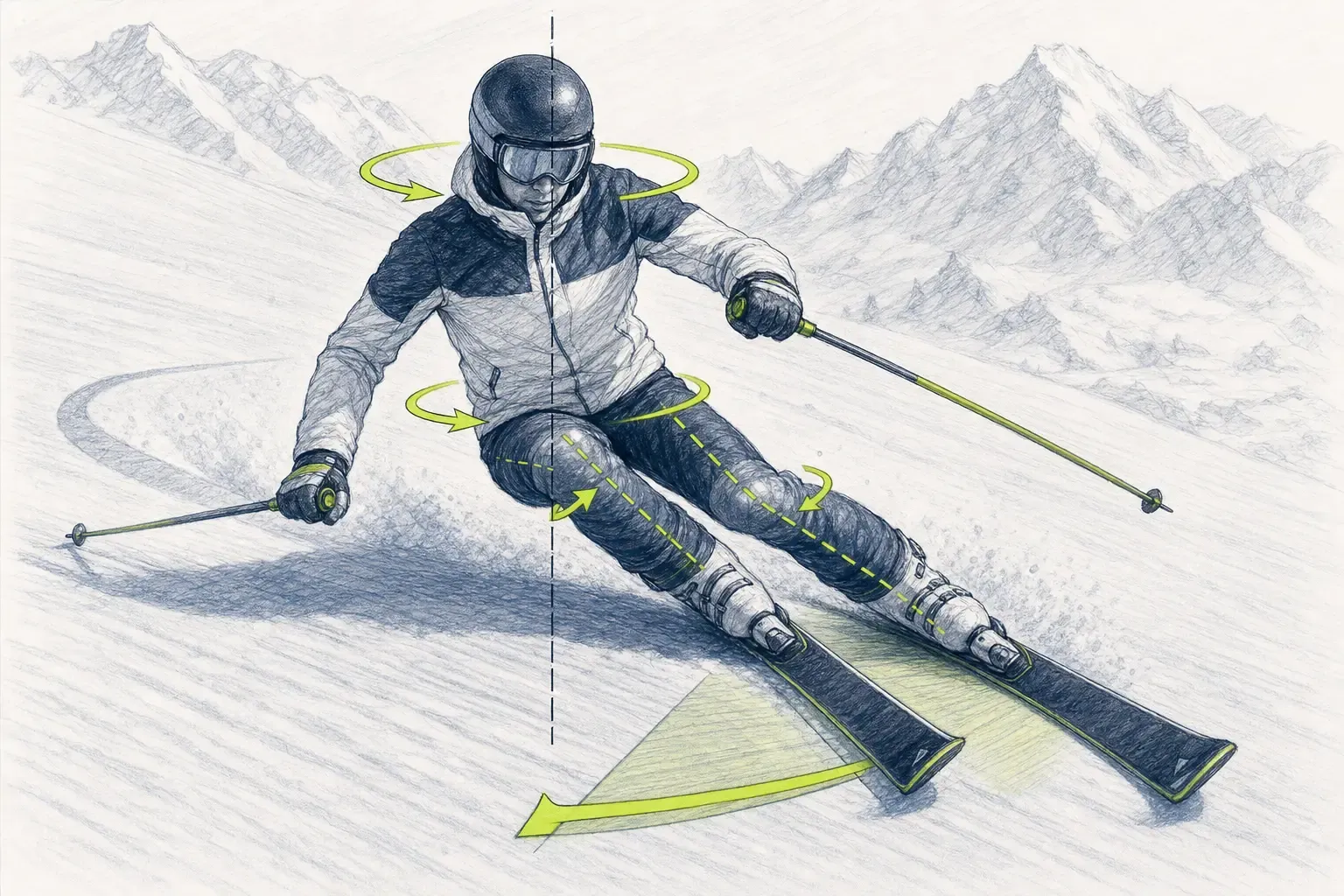
In functional rotation, the skis are turned mainly by leg movement: the thighs rotate in the hip joints, and the lower legs and feet assist the movement. The lower body can therefore change direction beneath a relatively quiet torso. This creates separation of the movement of the lower and upper body, which helps the skier maintain balance and create support on the outside ski.
Rotation does not work on its own. Its effect depends on edging, pressure distribution, speed, turn radius, slope angle, and snow conditions. A flatter or unweighted ski can be turned more easily; with more edging, the ski’s direction changes more through its flex and the edge’s contact with the snow. That is why a controlled skidded turn uses more visible ski turning than a pure carved turn, although rotational leg movements and their orientation remain part of both ways of skiing.
Leg rotation and torso rotation
In coaching language, the warning “too much rotation” usually does not refer to every rotational movement. Most often it means that the skier starts the turn by sharply twisting the shoulders, arms, or pelvis and tries to pull the skis along with the upper body. Such movement can weaken the stance over the outside ski, worsen the timing of edging, and cause uncontrolled tail drift.
However, torso rotation cannot be called a mistake in every situation. The movement of individual body segments changes according to terrain, speed, and task. Rotation of the pelvis or torso can be a situational source of impulse, for example when moving through the air or in special snow conditions. For most turns on prepared slopes, however, the basis remains more precise control of the skis by the legs.
Rotation in children
A beginner cannot yet reliably separate leg movement from the torso. A child may therefore turn the whole body during the first direction changes, swing the arms across the turn, or use large and imprecise movements. It is not appropriate to judge this by the same standards as the technique of an experienced racer.
Gradually, the ability develops to turn both legs in the same direction, regulate the amount of turning, and keep the upper body calmer. U.S. Ski & Snowboard lists rotational abilities among the basic skiing skills and, in its development profile, also tracks the gradual creation of separation between the upper and lower body. The tasks should match the child’s age, experience, and motor level.
Practice is safer on a gentle and open slope, where the child does not need to use defensive movements triggered by fear or excessive speed. Depending on the level, simple turns on the flat, turning the skis while traversing, turns in a marked corridor, or changes in turn size can be used. These are examples of training practice, not a universal method for every child.
Racing significance
In racing skiing, the amount and speed of ski turning are adapted to the discipline, gate setting, snow surface, and chosen line. Slalom usually requires faster direction changes and strong leg independence. In giant slalom and speed disciplines, the racer tries to limit unnecessary skidding, but in a difficult situation may use a deliberate short turning of the skis before firmly edging them. The presence of skid alone therefore does not prove a technical mistake; what matters is its purpose and result.
Rotation is not scored as a separate element in alpine skiing. FIS rules govern the competition, course passage, gates, start, finish, and other conditions, while the assessment of rotational movements belongs to the coach’s technical analysis.
Typical misconceptions
- “Every rotation is bad.” Without the ability to turn the legs, a skier could not accurately control a skidded turn or quickly adapt the direction of the skis.
- “In carving, nothing rotates.” The skis are guided mainly by the edged and bent ski, but during the turn the legs change their orientation and relationship to the pelvis.
- “A quiet torso means a motionless torso.” The upper body responds to forces and terrain; the goal is not stiffness, but purposeful stability.
- “Just turn the shoulders into the new turn.” Sharp steering with the shoulders often hides weak edge release or poor leg control.
Coach’s view
The coach does not only watch whether the skier rotates. They assess which segment started the movement, at which phase of the turn, at what speed, and with what result on the snow. First, they observe the behavior of the skis: the direction of the tips, the movement of the tails, the amount of skidding, and the moment of edge engagement. Only then do they determine whether the rotation of the legs is purposeful or whether the movement of the torso merely compensates for a problem with balance, edging, or pressure.
Good rotation is not the biggest possible rotation. It is applied precisely, follows the release of the old edges, and allows the skier to choose the needed turn shape without losing stability.
Sources and further reading
- Canadian Ski Instructors’ Alliance – The Canadian Teaching Approach
- Canadian Ski Instructors’ Alliance – The Skills Framework
- Canadian Ski Instructors’ Alliance – Fundamentals of Skiing
- U.S. Ski & Snowboard – SkillsQuest
- U.S. Ski & Snowboard – Athlete Performance Profile
- U.S. Ski & Snowboard – Level 100 Alpine Manual
- FIS – Alpine Documents and International Competition Rules