What run analysis is
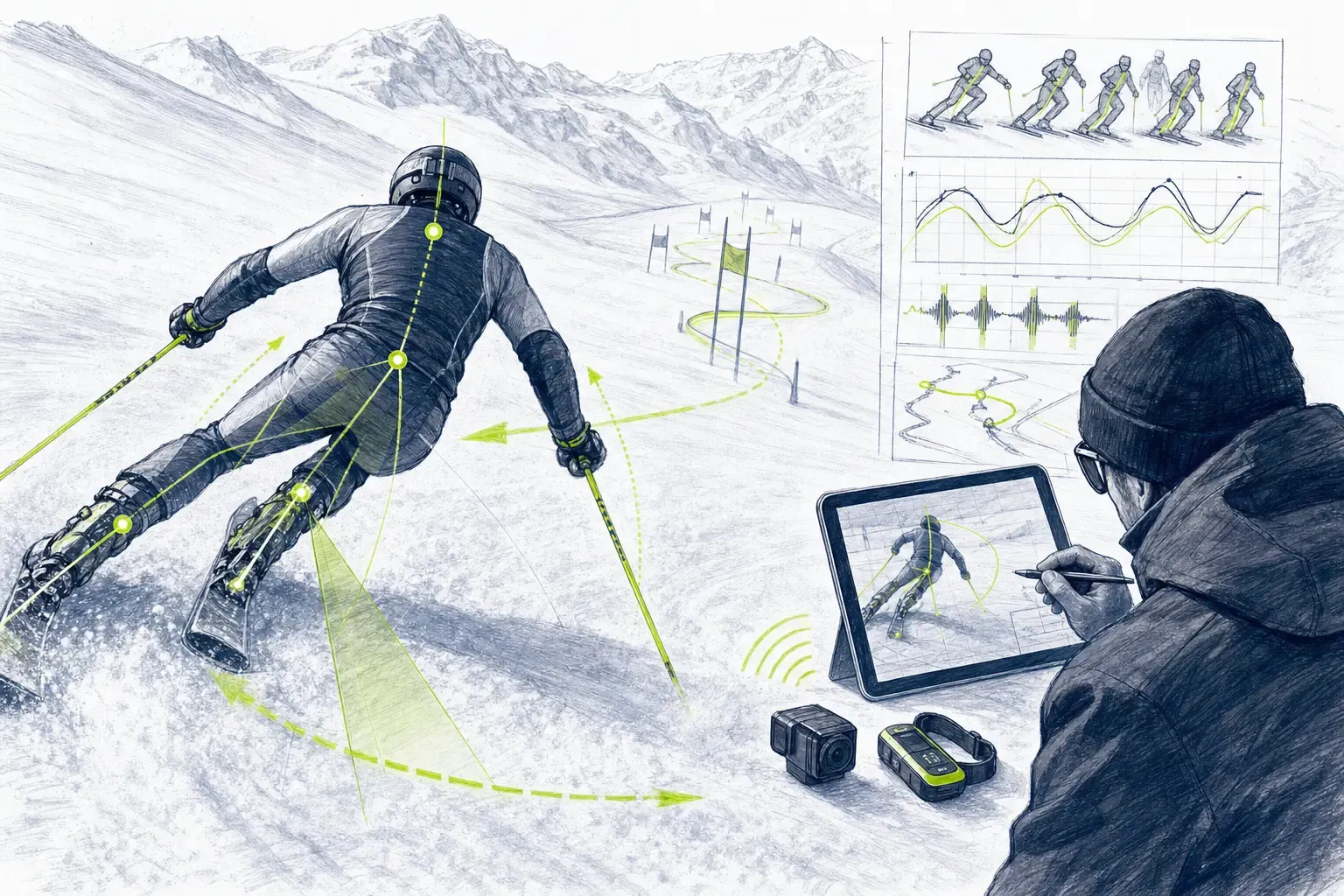
Run analysis is the systematic observation and evaluation of skiing with the aim of understanding the relationship between a skier’s movements, the behavior of the skis, and the result of the run. It can take place directly on the slope, from video footage, or with the help of measurements, such as split times, GNSS, or inertial sensors.
It is not just about naming a mistake or judging whether the run looks nice. The coach first watches, what is really happening, then looks for a possible explanation and only then suggests a change. Analysis is therefore not a final verdict on technique or on the skier’s abilities. It is a working hypothesis that must be verified in the next run.
Specialized technique evaluation systems work with observation of balance, edge angle, ski rotation, and pressure regulation. U.S. Ski & Snowboard also recommends assessing standardized skiing skills together with race performance, because the result time alone does not give a complete picture of a skier’s development.
What the coach watches during the run
Analysis always starts with the question, what the task of the run was. Different criteria apply to a slow technical exercise, a free run, slalom training, or giant slalom. Slope steepness and profile, snow, visibility, speed, course setting, equipment, fatigue, and the skier’s experience also matter.
Observation can proceed from the result to the movement:
- what track and turn shape the skis create,
- where the turn starts and finishes,
- whether the skis mostly run on edge or slide across,
- how speed and direction of travel change,
- whether the skier keeps balance over the support base,
- how and when edge angle is created,
- how pressure between the skis is regulated during the turn,
- what rotational movements are used,
- how movements of the legs, torso, arms, and poles support or disturb the intended outcome.
It is useful to watch several turns in a row. One shot may capture only a brief consequence of the previous movement and may not show the cause. The difference between a right and a left turn can be random, but it can also be related to one-sided movement, the terrain, or the line setting.
Observation, interpretation, and intervention
A good analysis separates three steps:
1. Observation: the outside ski shifts noticeably across in the final phase of several turns. 2. Interpretation: the skier may be creating the needed direction or edge angle too late. This is a possible explanation, not an automatically proven cause. 3. Training intervention: the coach chooses a simple task intended to change the timing or way the skis are guided, and watches whether the result improves repeatedly.
A common mistake is to skip the first step and say, for example, that the child is behind or is not pressing enough into the outside ski. Such a statement can be inaccurate if it is not clear in which part of the turn the phenomenon appears, what the skis are doing, and what the movement results in.
The following principle belongs to training practice, not to competition rules: one piece of feedback should have one main priority. Correcting several body parts at once often masks the essential problem, and the skier does not know what to focus on in the next run. Instructor methods therefore connect movement analysis with a clearly defined outcome and with observing what is currently being taught.
Video recording and measurement
Video makes it possible to replay a run, slow it down, and compare several attempts. Research from alpine ski teaching supports using video together with verbal feedback, while also pointing out that seeing one’s own run can be demotivating for some skiers.
Even high-quality video by itself does not measure pressure on the skis, the forces acting on the body, or the exact position of the center of mass. A two-dimensional image is also affected by the camera angle, distance, perspective, and the shape of the terrain. A slowed-down clip is therefore not automatically an objective explanation of the run.
In coaching practice, it is advisable to record a continuous section that shows the approach, several turns, and the exit. Depending on the question being addressed, the run can be filmed from the front, from behind, or from the side. When comparing attempts, the conditions and the task should be as similar as possible.
Timing shows the result of a section, not its cause. Faster skiing does not automatically mean better technique: the result can be influenced by the line, the start, a change in snow, or a different course layout. In performance skiing, it therefore makes the most sense to combine the coach’s observation, video, split times, and, where possible, other measurements. Professional literature describes the use of inertial sensors and GNSS to track the skier’s kinematics or path, but such data require proper recording and expert interpretation.
Run analysis in children
For a child, the analysis must match age, experience, motor development, and the ability to maintain attention. Younger children usually do not need a detailed biomechanical explanation. A short demonstration, an imaginative name, or a movement task whose result the child can feel and see may be more effective.
Video should not be used as a public search for faults. The coach can first let the child name what went well and what they felt during the run. Feedback should distinguish between behavior in a specific attempt and judgment of the person: an inaccurate turn does not mean a bad or untalented skier.
Standardized exercises can show stronger and weaker areas separately from results in the gates. Their difficulty, however, must be appropriate to the child’s stage of development and experience, which is also respected by the SkillsQuest system.
Typical mistakes in analysis
- evaluating technique from a single turn or a photo,
- describing body position without watching how the skis behave,
- mistaking an observed effect for the proven cause,
- comparing runs in different conditions without pointing out the differences,
- copying the posture of an elite racer regardless of speed, course, and body proportions,
- too many instructions before one run,
- judging progress only by the final time,
- using technical terms that a child does not understand.
From a coach’s point of view, a good analysis is brief, specific, and verifiable. It answers four questions: What was the task? What did the skis do? Which movement was probably related to that? What will we try in the next run?
Sources and further reading
- U.S. Ski & Snowboard – SkillsQuest
- U.S. Ski & Snowboard – Descriptions SkillsQuest Drills
- PSIA-AASI – Alpine Certification Performance Guide
- PSIA-Rocky Mountain-AASI – Alpine Assessment Guide 2025–26
- Ruzicka, Milova – Increasing the efficiency of motor learning with the help of video analysis
- Supej et al. – Monitoring the Performance of Alpine Skiers with Inertial Motion Units
- Gløersen et al. – Quantitative downhill skiing technique analysis according to ski instruction curricula
- Kirby – Development of a real-time performance measurement and feedback system for alpine skiers