What ski service is
Ski Service is a set of inspection, repair, and preparation steps for the base, edges, and binding. Its goal is to restore the skis to working condition and adapt them to their use, snow conditions, and the skier’s level. For race skis, it also means precise, repeatable preparation for a specific discipline.
Service cannot be judged only by whether the skis are “fast.” A properly prepared ski has a flat, undamaged base, the right structure, smooth and symmetrical edges, and a functioning binding. On snow, it should behave predictably: it should not turn on its own, catch an edge, or differ noticeably from the other ski.
What service includes
Base inspection and repair
First, the overall condition of the ski is assessed: damage to the base, edges, tip and tail, layer separation, corrosion, and the condition of the binding. Small grooves in the base can be repaired with suitable repair material. Deep damage reaching into the ski’s construction, a torn-out edge, or separated layers belong in professional service.
Machine grinding can restore the flatness of the base and create its structure – a fine pattern that affects how the ski contacts the snow and the water film. Structure is not a scratch. It is regular, chosen according to use, and created through a controlled service process. Every grinding also removes material, so it should not be done automatically with every waxing.
Edge tuning
The edges are cleaned of corrosion and burrs, their straightness is checked, and they are sharpened if needed. The geometry is determined by two different adjustments: edge bevel at the base and side sharpening. Their combination affects how early the ski starts to engage, how well it holds on hard snow, and how easily it releases from a turn.
There is no single correct angle for all children and all skis. It depends on the ski design, discipline, snow quality, technical level, and the manufacturer’s or team service’s recommendation. Changing angles without precise guiding tools can create uneven edges or damage the base. Flattening the tip and tail is also not a universal rule for modern downhill skis; any adjustment should come from the ski’s specific behavior.
Base waxing
Wax reduces unwanted friction between the base and the snow and helps keep the base in good condition. For ordinary hot waxing, wax suitable for the expected temperature and type of snow is used. It is applied with an iron at the temperature specified by the manufacturer, allowed to cool, and then the excess is thoroughly scraped off and brushed out.
A layer of wax left on the surface does not make the ski faster. When skiing, the tuned base should do the work, not a thick coating. Overheating with the iron can damage the base or the ski construction. The workspace should be ventilated, and children should not handle a hot iron, sharp files, or rotary brushes on their own.
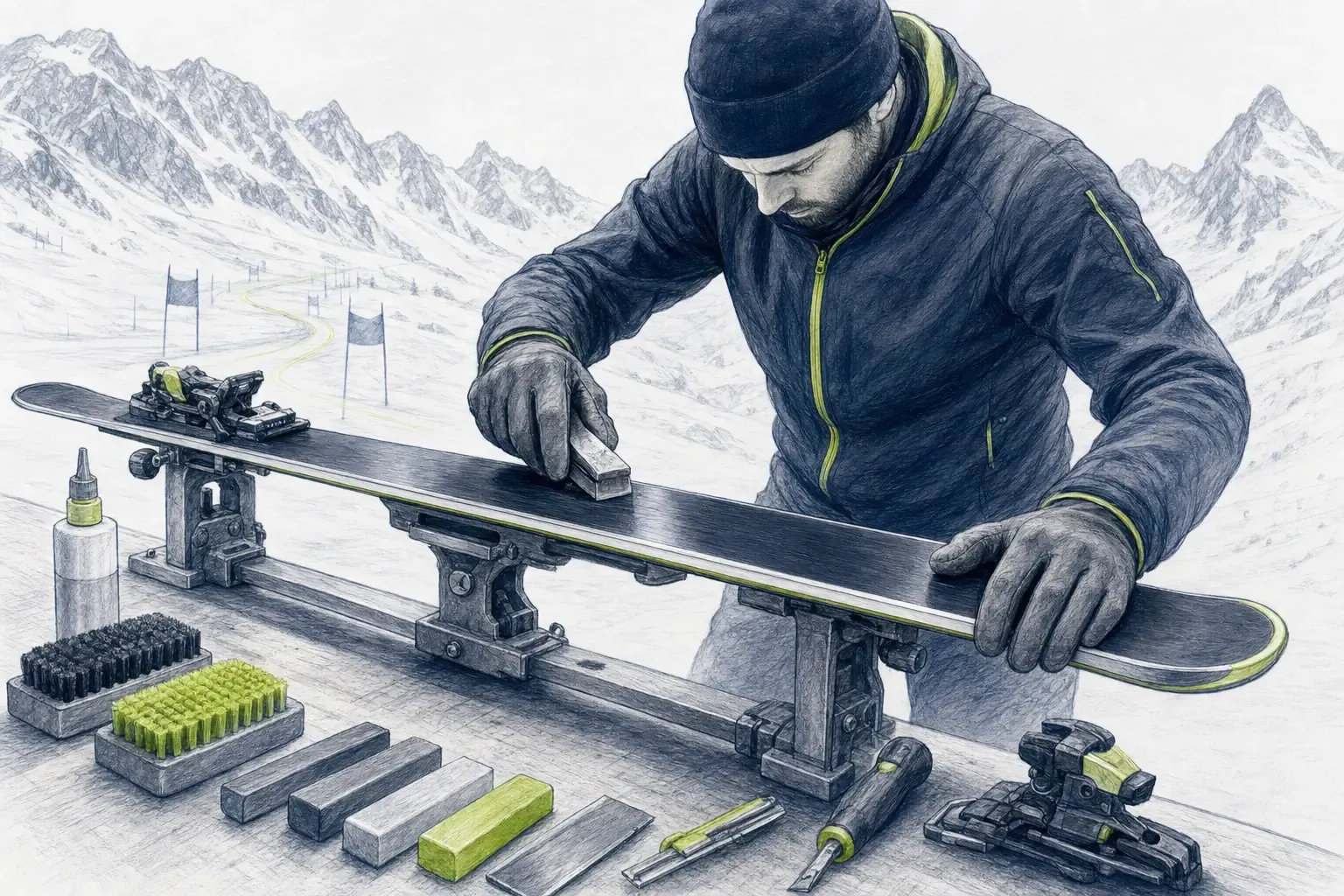
At races organized under FIS rules, products and procedures must be used in line with the current ban on fluorinated waxes. The service team should follow the valid FIS documents for the given season and prevent contamination of tools or the workspace with older fluorinated products.
The binding is a separate safety area
Checking the binding is not the same as sharpening and waxing. Standard ISO 11088:2023 It adjusts the mounting, setting, and inspection of the ski–binding–boot system. The setting value, often inaccurately called just “DIN,” should not be changed by guesswork or copied from another pair of skis.
For a child, body measurements, skiing level, and ski boots can change during the season. A new boot may have a different shell length even if it is marked as a similar size. The binding must therefore be checked by a qualified technician according to the current procedure; if needed, its release function is also verified on the designated test device. Regular home cleaning or waxing does not replace this check.
Children’s skis and race service
A beginner needs above all a predictable ski without significant burrs, corrosion, or unevenness. An extremely aggressive race tune is not automatically suitable for a small child. An edge that grips too much can make gliding drills and releasing the skis more difficult, while a dull or damaged edge reduces confidence on hard snow. What matters is that it matches the child’s age, technique, and training task.
For racers, servicing is adapted to the discipline, the course surface, and the selected pair of skis. More important than constant experimentation is repeatability: the same guide tools, recorded edge settings, clean brushes, and a comparable working procedure. The ski technician or coach should know what was changed on the ski and why.
Typical mistakes
- service is only dealt with once the skis are visibly no longer working properly or no longer holding,
- a file is used without a guide tool and without checking the direction of work,
- a scratched base is mistaken for a functional structure,
- after waxing, a thick layer of wax remains on the base,
- machine grinding is ordered unnecessarily often,
- the two skis are adjusted differently, or the left and right ski used by the racer are not marked,
- a parent changes the binding setting on their own after service,
- race equipment is contaminated with older fluorinated products.
The coach’s view
The coach does not judge service by looking only at the base. They watch whether the child can guide the skis smoothly, whether both skis respond similarly, and whether problems appear only on hard or wet snow. Not every technical mistake is caused by the skis, but a damaged or improperly prepared ski can make learning much more difficult.
The frequency of service cannot be set by one number of days. It depends on snow hardness and contamination, contact with stones, training intensity, and the required level of preparation. After skiing, it is a good idea to dry the skis and check them. Grinding, base repair, and professional binding inspection should be done according to the actual condition, not just the calendar.
Sources and further reading
- FIS – Alpine Skiing Documents: current rules, documents, and information on fluorinated waxes
- FIS – Fluor Documents: rules and implementation of the ban on fluorinated waxes
- FIS – Event Marketing: Specifications for Alpine Competition Equipment 2026/2027
- ISO 11088:2023 – Alpine ski/binding/boot system: assembly, adjustment and inspection
- ISO – Winter sports equipment standards, category 97.220.20
- ISO/TC 83/SC 4 – catalog of standards for snow sports equipment