What Edge Tuning Is
Edge Tuning is a service procedure in which the steel edges of a ski are restored to the specified angle, burrs and damaged spots are removed, and the edge surface is smoothed. The result should be a continuous, even, and appropriately sharp edge, not blindly removing as much material as possible.
FIS describes the edges of alpine racing skis as parts made of hard, wear-resistant material that allow lateral forces to be transferred. Current racing equipment specifications, however, do not define one universal tuning angle that applies to every racer and every discipline. The exact setup is therefore a matter for the manufacturer, the service team, and racing practice within the applicable rules.
Two Sides of One Edge
The steel edge is tuned from two sides:
- From the base side a small deviation of the edge from the base plane is created, referred to as base bevel. It affects how early the edge engages the snow when the ski is edged. This part must be ground carefully, because too much deviation cannot be corrected by simply filing more; it usually requires machine flattening of the base.
- From the sidewall side the side angle is set (side bevel). This surface is adjusted more often during regular maintenance and determines how sharp the transition is between the two edge surfaces.
Servicing tools may label the side angle in two ways. The value 2° of side deviation is usually also expressed as 88° relative to the base plane. When changing tools, it is not enough to compare the number alone; you need to know which labeling method the manufacturer uses. In its service method, Swix likewise distinguishes between the base edge and the side edge, their angles, and the different frequency of maintenance.
File, Diamond, and Burr Removal
File removes steel and is used mainly to create or restore the angle. It is not suitable for everyday unnecessary “tuning” of the edge, because the edge’s lifespan is limited by the amount of material.
Diamond stone removes less material. It is used to remove fine burrs, smooth out file marks, and carry out regular maintenance of the already set geometry. A coarser diamond handles more pronounced damage, while a finer one finishes the surface. It is used with precise angle guidance and in the way recommended by the tool manufacturer.
Rubber sharpening stone can remove fine rust or very lightly dampen a specific part of the edge. With careless use, however, it rounds off the sharp edge. Deliberate dulling of the tip and tail is not an automatic part of every service; on modern shaped skis it can change both the start and the finish of the turn.
Before sharpening the sidewall, it may be necessary to remove part of the sidewall material. If the file hits plastic or laminate instead of steel, it will not work evenly along the edge and the required angle may not form.
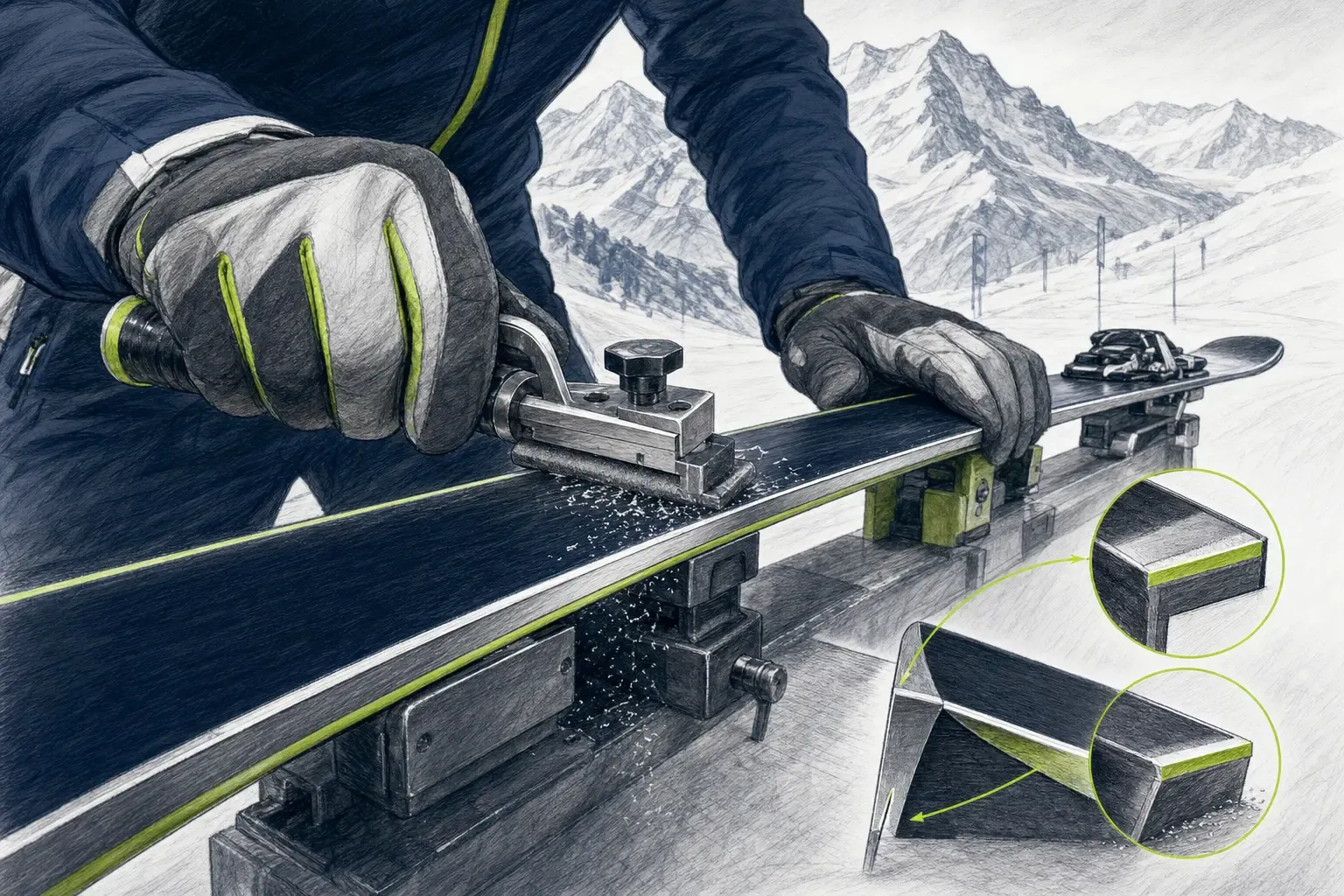
Basic procedure
The ski is first cleaned, dried, and securely fixed in a service stand. The condition of the base, edge continuity, rust, burrs, and stone impact marks is checked. Deep damage, a cracked or torn-out edge, and a markedly uneven base belong in professional service.
If the ski geometry is in order, the usual steps are:
1. removing the obstructing part of the sidewall, 2. setting or correcting the angle with a file in a fixed guide, 3. smoothing the edge with diamond stones, 4. removing the remaining burr from the base side without increasing its bevel, 5. cleaning the ski of metal shavings and checking the full length of the edge.
The tool is guided with light, controlled strokes. The direction of work and any wetting of the diamond follow the manufacturer’s instructions. Strong pressure does not replace precise guidance and can create unevenness.
Children and racing skis
For a child, the best ski is not automatically the sharpest and most aggressive one. A beginner mainly needs predictable ski behavior, the same setting on both edges, and a surface free of dangerous burrs. An overly aggressive edge can make it harder to release the ski from the turn and highlight technical errors, especially if the child still cannot properly control angle and pressure.
On a hard or icy race surface, a precise and smooth edge is essential for turn control. However, the setting is adjusted to the discipline, snow, ski construction, the racer’s abilities, and the agreement between the coach and the service technician. A sharp edge also poses a risk of cutting injury; FIS specifically lists injuries caused by edges among the reasons for tightening requirements for protective clothing in elite racing.
The coach watches not only whether the ski “holds,” but also whether it behaves smoothly at the start and end of the turn. Unexpected catching by an aggressively set edge can be difficult to handle at higher speed.
Typical mistakes
- sharpening without an angle guide,
- mixing up the markings 88° and 2°,
- frequent filing of the edge from the base side,
- too much pressure and unnecessary removal of steel,
- sharpening through the sidewall without preparing it,
- leaving a burr after filing,
- rounding the edge with a rubber stone,
- changing the angle only on part of the ski or setting the pair differently,
- judging quality only by how sharp it feels, without checking evenness and smoothness.
When working, use suitable gloves and never slide a finger along a sharpened edge. Children should not handle files, sharp edges, or metal filings without the direct guidance of an adult. If the original angle or the condition of the base is unknown, a qualified ski service is the safer choice.
Sources and further reading
- Swix – Frequently Asked Questions: Edge Tuning
- FIS – current documents and specifications for race equipment
- FIS – Specifications for Alpine Competition Equipment 2025/2026
- FIS – FIS Alpine Meeting: Focus on Athlete Safety and Season Outlook
- FIS – Safety and scheduling dominate Alpine Ski World Cup sub-committee meeting
- FIS – Alpine Ski World Cup Race Directors Q&A