What hard snow is
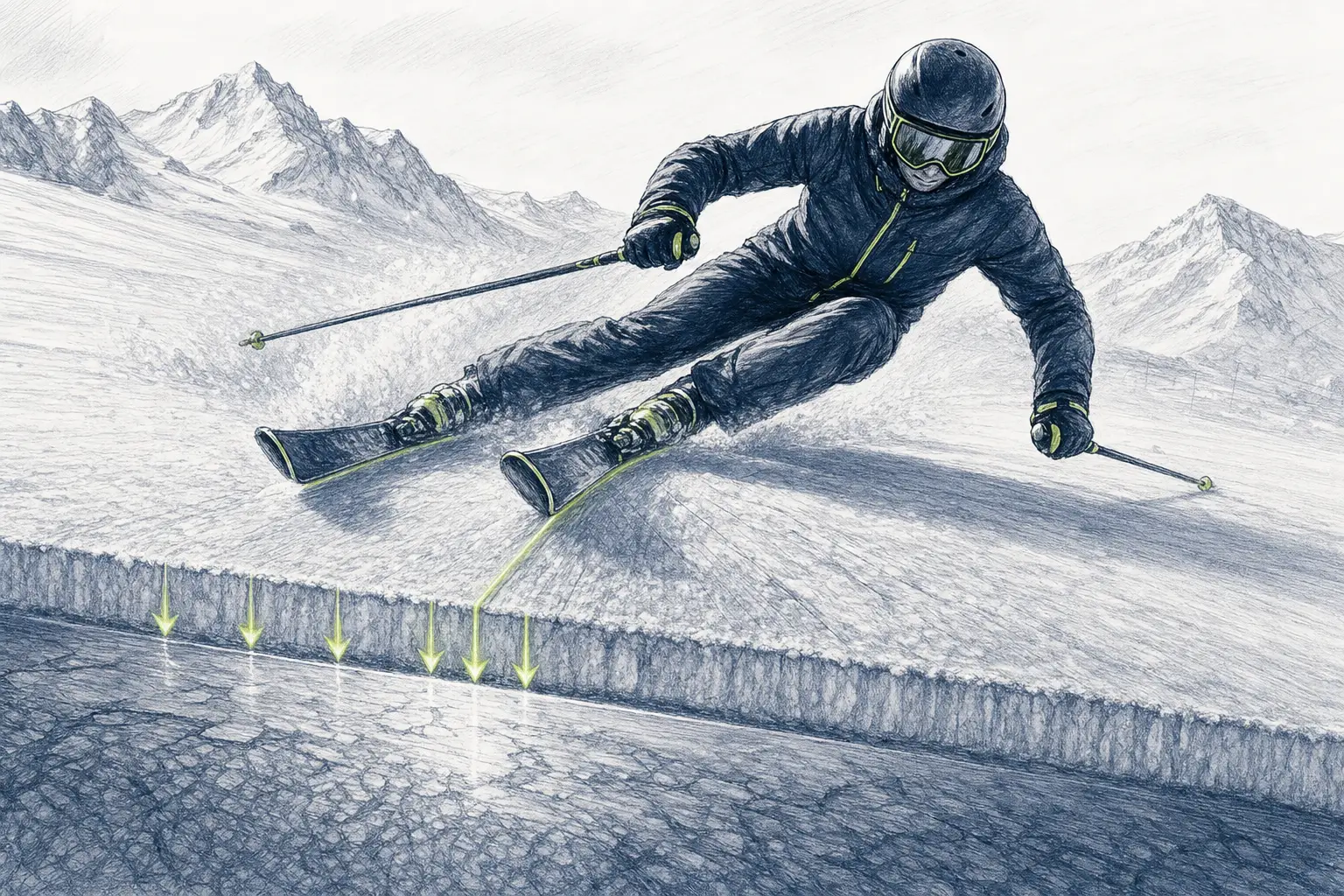
Hard snow is a compact snow surface with high resistance to compression, deforming only slightly under the ski and edge. It can form through repeated passes by skiers and machines, compaction of machine-made snow, freezing of a moist surface, or deliberate preparation of a race course.
Hardness is not the same as density or snow speed. In technical terms, it can be assessed by penetration measurements, but ski behavior is also influenced by temperature, liquid water content, the shape and size of snow grains, the structure of the ski base, skiing speed, and the load on the ski. That is why there is no simple rule that every hard snow surface is equally fast or slippery.
Hard snow also does not automatically mean ice. On a regular downhill slope, the word “ice” is often used for very hard, smooth, or polished snow. From a practical point of view, what matters is how much support the surface gives the edge and how predictably it behaves under load.
What changes when skiing
In softer snow, the ski sinks in slightly and the support also comes from the deformation of the snow around it. On a hard surface, this support is smaller. Contact between the edge and the snow must therefore work more precisely, along with the skier’s balance and the direction of the forces acting on them.
The key is not to “push as hard as possible,” but to:
- keep a balanced, mobile stance above the skis,
- create edging smoothly through lower-body movement,
- use ankles, knees, and hips appropriately,
- apply pressure without sudden impact into the ski,
- shape the turn sufficiently across the slope if speed needs to be reduced,
- adjust the turn radius to the slope, space, and the skier’s own abilities.
In a parallel turn, support is usually concentrated mainly on the outer ski, but its exact share cannot be prescribed with one number for every child and every turn. It depends on the phase of the turn, speed, slope, discipline, and the skier’s level.
A controlled skid is not a technical failure. On a very hard or steep section, it can be a safer way to regulate speed than trying at all costs to carve a clean turn.
Children and training on hard surfaces
Hard snow is a useful training stimulus only when the difficulty of the slope and the speed match the child’s abilities. Younger and less experienced skiers may not yet be able to finely regulate edging, pressure, and the separation of leg movement from the torso. A steep hard slope is therefore not a shortcut to better technique.
A coach can start on a gentle, easy-to-read section with simple tasks: skiing diagonally across the slope, controlled side slipping, gradual stops by edging, garlands, or short linked turns. The goal is for the child to recognize the difference between a relaxed and a loaded edge and to be able to change grip without fear or abrupt movements.
At a higher level, it is possible to add changes of radius, skiing in a designated corridor, and a simple gate course. The quality of movement takes priority over the number of runs. Fatigue worsens balance and precision, so the coach watches not only the final turn but also body tension, delayed reactions, and increasing uncertainty.
Racing context
In alpine racing, the course surface is prepared so that it is compact, durable, and as even as possible for the whole start field. Current FIS rules govern the preparation and maintenance of the competition course; a hard surface here is not an accidental nuisance, but an important part of comparable conditions.
At some races, targeted watering or other permitted preparation methods are also used. Such measures belong to the organizers and the qualified course crew. They are not instructions for making changes to a children's training slope on your own.
On hard snow, a racer learns to time the release and re-engagement of the edge precisely, maintain contact with the snow, and choose a line they can handle technically. A more aggressive line is pointless if the skier cannot create and maintain the necessary support.
Typical mistakes and misunderstandings
- Backseat position: the front of the ski gets too light and the arc is harder to control.
- Sudden edging: a sudden move onto the edge can cause the ski to catch or release unexpectedly.
- Turning the shoulders: upper-body rotation often replaces missing leg work and throws off balance.
- Rigid stance: without continuous movement in the joints, the skier cannot regulate pressure or react to bumps.
- Too much speed: hard snow does not give a beginner a better ability to stop; on the contrary, it demands more precise movements.
- Relying on equipment alone: a sharp, undamaged edge helps, but it does not replace balance, turn control, or an appropriate choice of slope.
The condition of the edges is especially important on hard snow. A rounded, damaged, or burred edge does not hold as reliably. The sharpening angle and servicing procedure should, however, be adapted to the specific ski, discipline, and manufacturer's recommendations; for children's and racing equipment, this work belongs to a qualified service technician.
Coach's view
Hard snow clearly shows whether the skier is centered over the support, can smoothly change edging, and controls speed through turn shape. But the coach does not use it as a test of courage. They assess the slope, space, traffic, surface quality, equipment condition, age, skill level, and the child's current fatigue. If the conditions do not allow safe learning, the right decision is to change the section, simplify the task, or end the training session.
Sources and further reading
- FIS – Alpine Skiing Documents: current rules and documents for alpine skiing
- U.S. Ski & Snowboard – Alpine Training Systems
- U.S. Ski & Snowboard – Straight Run to Sideslip to Edge Set with Pole Plant
- Frontiers in Mechanical Engineering – The Snow-Friction of Freestyle Skis and Snowboards Predicted From Snow Physical Quantities
- Frontiers in Sports and Active Living – A Scientific Perspective on Reducing Ski-Snow Friction
- Tribology Letters – A Novel Ski–Snow Tribometer and its Precision
- Journal of Glaciology – Measurement of Mechanical Properties of Snow for Simulation of Skiing
- Tribology International – Tribological Aspects of Snow Skiing: A Comprehensive Review