What soft snow is
Soft snow is a practical term for a surface that is easily compressed, pushed aside, or broken through under a ski. The name itself does not define the exact type of snow. It can be light dry powder, fresh snow on a slope, chopped-up piles, or damp or very wet spring snow.
In expert classification, hardness and liquid water content are separate properties. Soft snow therefore does not have to be wet, and wet snow does not have to stay soft: after refreezing, it can form a hard bearing layer or crust. The terms “soft snow” and “powder” are therefore not synonyms.
How it affects skiing
On a hard surface, support comes mainly from the contact of the edges and base with a firm foundation. In soft snow, the skis sink in more, and support is also created by the snow they compress and push away. Its resistance may not be even, though. One ski may enter a deeper layer, hit a pile, or reach a hard base sooner than the other.
Light dry snow offers different resistance than dense wet snow. A wet layer can noticeably slow the skis, while dry deeper snow requires a sufficiently smooth movement so that the skier does not stop between turns. Tracked soft snow also often alternates between hollows, piles, and harder spots.
Technique in soft snow
The basic principle is to keep balance over the skis and change pressure smoothly. The exact solution depends on the depth and density of the snow, the slope, speed, skis, and the skier’s skill level.
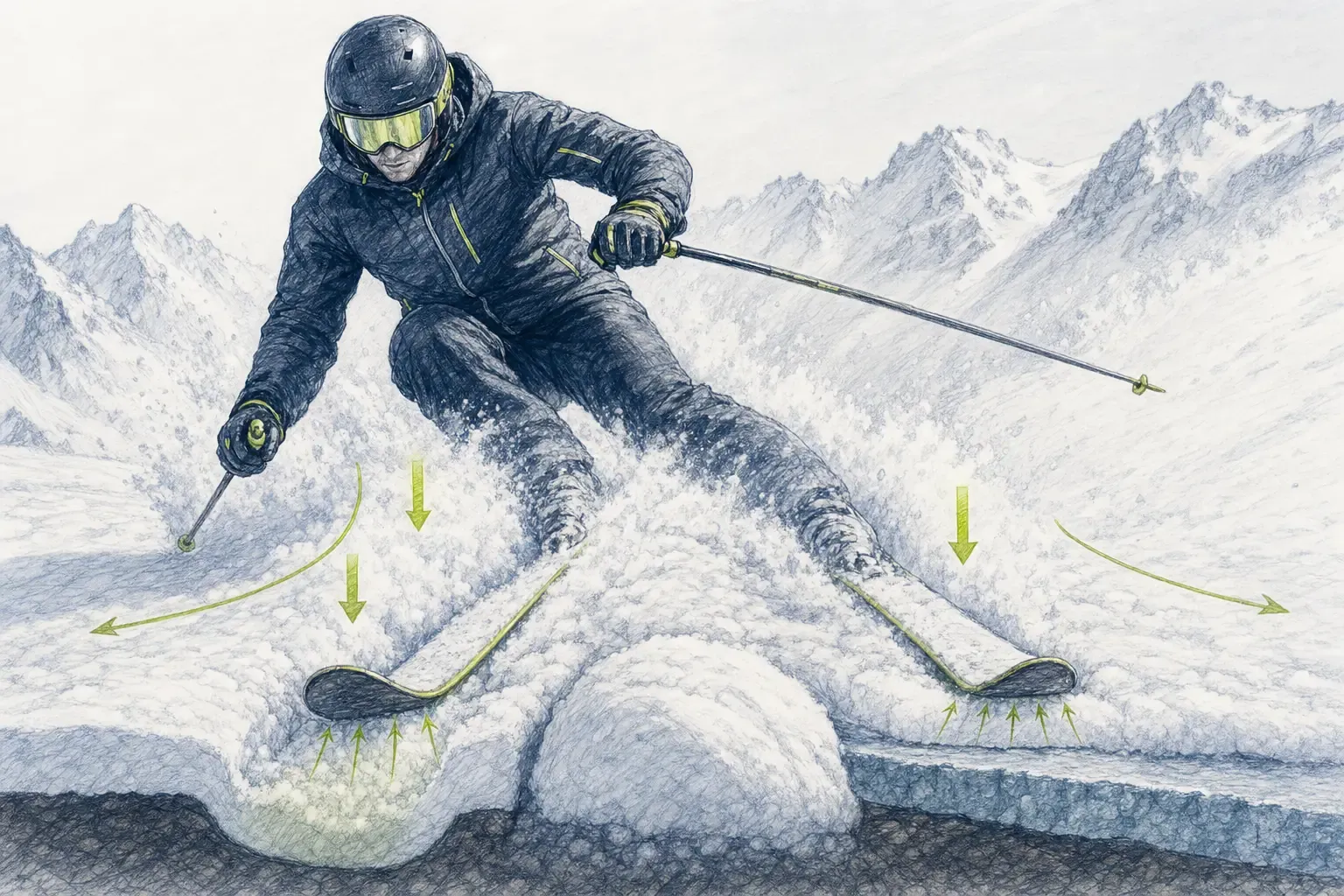
In training practice, it helps to:
- stay in a flexible, functional stance roughly over the middle of the skis;
- not deliberately shift far back, because a “lean back in powder” makes ski control harder and strains the thighs;
- guide both skis in parallel and create a shared, stable platform without forcefully clamping the feet together;
- avoid sudden pressure on one ski, abrupt edging, and jerky trunk rotation;
- use smooth flexing and extending of the legs so the skis can follow the terrain;
- choose turns and speed so the skier keeps control and a smooth ride.
Planting the pole can help a more experienced skier keep rhythm, but it is not a substitute for proper balance.
Children and soft snow
For a child, soft snow is a useful means of developing balance and adapting movement, but only with an appropriate depth and terrain. It is best to start on a gentle, clear slope with a shallow and as even a layer as possible. Deep or heavy wet snow can quickly tire a young skier and make it hard for them to get back up after a fall.
The coach takes into account the child’s age, height, strength, coordination, and experience. Children of the same age may not be equally ready for soft snow. Short runs, simple changes of direction, and alternating with a groomed surface are usually more suitable than long runs in demanding snow.
Race perspective
On a soft training or race course, tracks, depressions, and piled-up mounds gradually form. The racer learns to recognize where the surface provides support and to adapt the line, the timing of the movement, and the intensity of pressure. The mistake is trying to overcome every bump with force. More important is a stable upper body, active legs, and the ability to smoothly absorb changes in the surface.
Common misconceptions
- Soft snow is not always powder. It can be dry, moist, wet, or chopped up.
- A lean-back position is not a universal technique. A quick reaction to a bump must not be confused with constantly sitting behind the skis.
- One stance does not work everywhere. The skier must adapt to the changing depth and density of the snow.
- Soft does not automatically mean safe. On steep unsecured terrain, warmed-up snow or snow soaked by rain can lose cohesion. Spheres and rollers that roll down the slope by themselves, deep sinking in, or a slushy surface are warning signs of wet snow. Outside secured trails, it is necessary to respect the current avalanche situation and leave decisions to appropriately qualified people.
Sources and further reading
- Avalanche.org – Water content
- Avalanche.org – Snow ratio
- Avalanche.org – Refreeze
- Avalanche.org – Wet Loose
- Avalanche.org – Wet avalanche
- INTERSKI International – Educational Hub
- INTERSKI/IAESS – Level of Motor Ability Influences Alpine Ski Learning of Children
- INTERSKI/IAESS – Can We Make Alpine Ski Learning More Efficient?
- PSIA-AASI Rocky Mountain – The Return of the Center Line
- Pielmeier – Textural and Mechanical Variability of Mountain Snowpacks