What is an ice track
Ice track is a practical term for a slope or race course with a very hard, smooth, or in places icy surface. A ski edge bites into it less than into soft or normally prepared snow, so the skier has less room for error when balance is lost, pressure comes on sharply, or the skis are set in the wrong position.
It is important to distinguish between a firm, evenly prepared racing surface and irregular smooth plates on a public slope. Hardness alone does not mean a poor course. In racing, a firm and compact surface is desirable if it remains sufficiently even and predictable for the entire start field. FIS emphasizes in the preparation of top-level events that the goal is not a completely icy surface, but a firm course that allows fair racing.
Why is riding more demanding
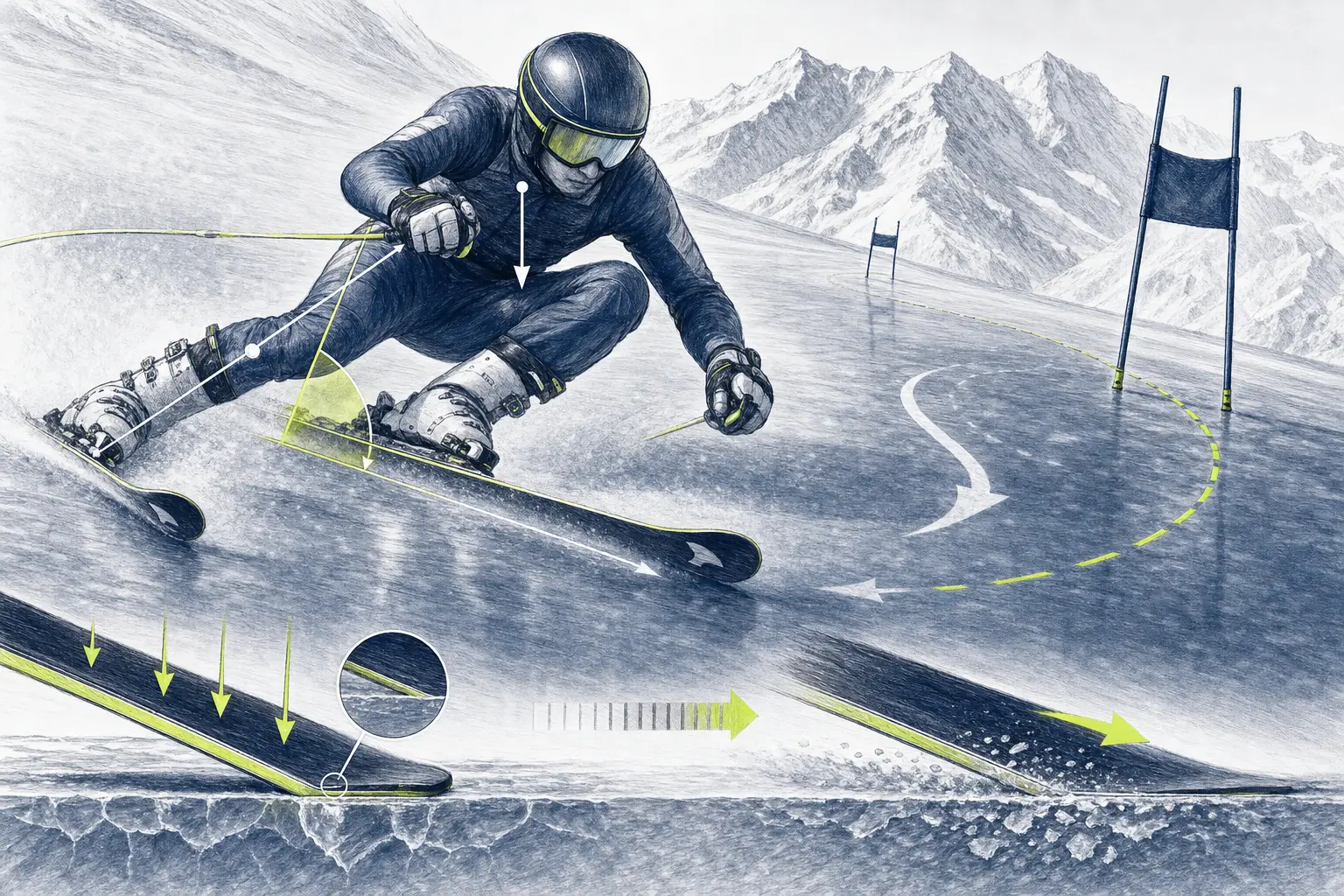
Turning is created by the interaction of the ski, the edge, the load, and the properties of the snow. Expert biomechanical studies show that individual parts of the ski can move during a single turn between carved tracking and skidding, depending on the edge angle, local pressure, and the resistance of the snow surface.
On a hard track, the following therefore stand out more clearly:
- delayed or sudden edging,
- a sharp buildup of pressure only at the end of the turn,
- loss of support on the outside ski,
- excessive leaning inward without proper support from the legs,
- a stiff stance and the inability to adjust pressure continuously,
- the attempt to stop by braking hard directly on a smooth plate.
A larger edge angle by itself does not guarantee grip. If the skier does not create balanced support and the pressure arrives suddenly, the skis may bounce off or slide into uncontrolled skidding. A smoother edge engagement, calm ski control, and pressure matched to the surface’s immediate grip are a better approach.
Children’s training
Riding on hard snow should not be a test of courage. Suitability is judged not only by age, but above all by the child’s ability to regulate speed, link turns, react to instructions, and keep a functional stance even when unsure.
In training practice, the progression starts on a wide, gentle slope with a firm but still easy-to-read surface. Only after balance and smooth edging are mastered can shorter sections with greater hardness be added. The coach chooses slope angle, speed, turn radius, and number of repetitions according to the child’s technical level, fatigue, and psychological response.
If a child leans back too much, becomes rigid, repeatedly loses control of speed, or is afraid to continue, the right solution is to simplify the terrain or the task. Repeated falls on a hard surface are not an effective learning method.
Race course
In races, the hard surface is prepared so that it can withstand repeated runs for as long as possible and provide comparable conditions. The preparation method depends on the weather, the type of snow and the discipline; it may include mechanical compaction and the expert-controlled use of water or approved snow-hardening agents. Such interventions are the sole responsibility of the organizer and qualified course staff.
According to the rules and procedures for alpine competitions, the jury checks the snow conditions, course preparation and safety measures. It may adjust the inspection or training regime and, if conditions are unsuitable, choose not to open the course or cancel the race. The jury’s current decision and the organizer’s instructions always take precedence over the general description of the term.
Coach’s view
The goal is not for a child to “beat the ice,” but to learn to recognize available grip in time and adjust speed, line, edging and pressure accordingly. On hard snow, technical flaws stand out clearly, but training must remain controlled and age-appropriate.
Equipment must be functional and professionally serviced. On a hard surface, the condition of the edges shows up more clearly, but specific angles and grinding methods cannot be set universally. These belong in the hands of a specialist service that takes into account the skis, discipline, racer’s level and the manufacturer’s instructions.
Sources and further reading
- FIS – Alpine Skiing Documents: current international rules and documents
- FIS – Preparing the perfect slope for the FIS Alpine World Ski Championships Saalbach 2025
- FIS – Injury & Return: preparation, testing and injury prevention in competitive snow sports
- U.S. Ski & Snowboard – Alpine Competition Officials Education Resources
- U.S. Ski & Snowboard – 2026 Alpine Competition Guide
- Frontiers in Sports and Active Living – Alpine Ski Motion Characteristics in Slalom
- European Journal of Sport Science – Connected skiing: Validation of edge angle and radial force estimation