What dry training is
Dry training is the common term for a skier’s training off the snow. In a broader sense, it includes all movement activities that build the foundations for skiing: basic movement skills, coordination, balance, strength, speed, endurance, mobility, and the ability to brake safely, land properly, and change direction.
It is not a competition rule or one precisely defined set of exercises. The content changes according to age, motor skill level, biological maturation, health status, stage of the season, and the group’s goals. Training for a preschool child should therefore not be a scaled-down version of a junior’s program.
What belongs in dry training
For younger children, the main place belongs to all-around movement: running, climbing, rolling, throwing, catching, jumping, simple gymnastics, obstacle courses, movement games, and other sports. Swiss-Ski lists suitable complementary activities such as athletics, gymnastics, inline skating, cycling and pump tracks, skateboarding, parkour, and cross-country skiing. Their value does not lie in precisely copying a ski turn, but in broadening movement experience.
As the level rises, more targeted components are gradually added:
- core stability and control of the lower-limb axis,
- running, takeoff, jump, and landing technique,
- reaction speed and direction changes,
- general and later more sport-specific strength,
- aerobic and anaerobic endurance,
- appropriate mobility,
- coordination under time or space pressure.
Strength training for children does not have to mean lifting heavy weights. It begins with mastering one’s own body, correct positions, squats, lunges, supports, pulls, takeoffs, and landings. More demanding exercises with external load belong in professionally guided training, where technique and appropriate progression matter more than the number of kilograms.
Importance for skiing and racing
Good dry training helps a skier maintain quality movement even when tired, react quickly to changing terrain, and handle repeated training or race runs. In racing skiing, it creates the physical base on which technique, tactics, and tolerance for higher loads can be developed.
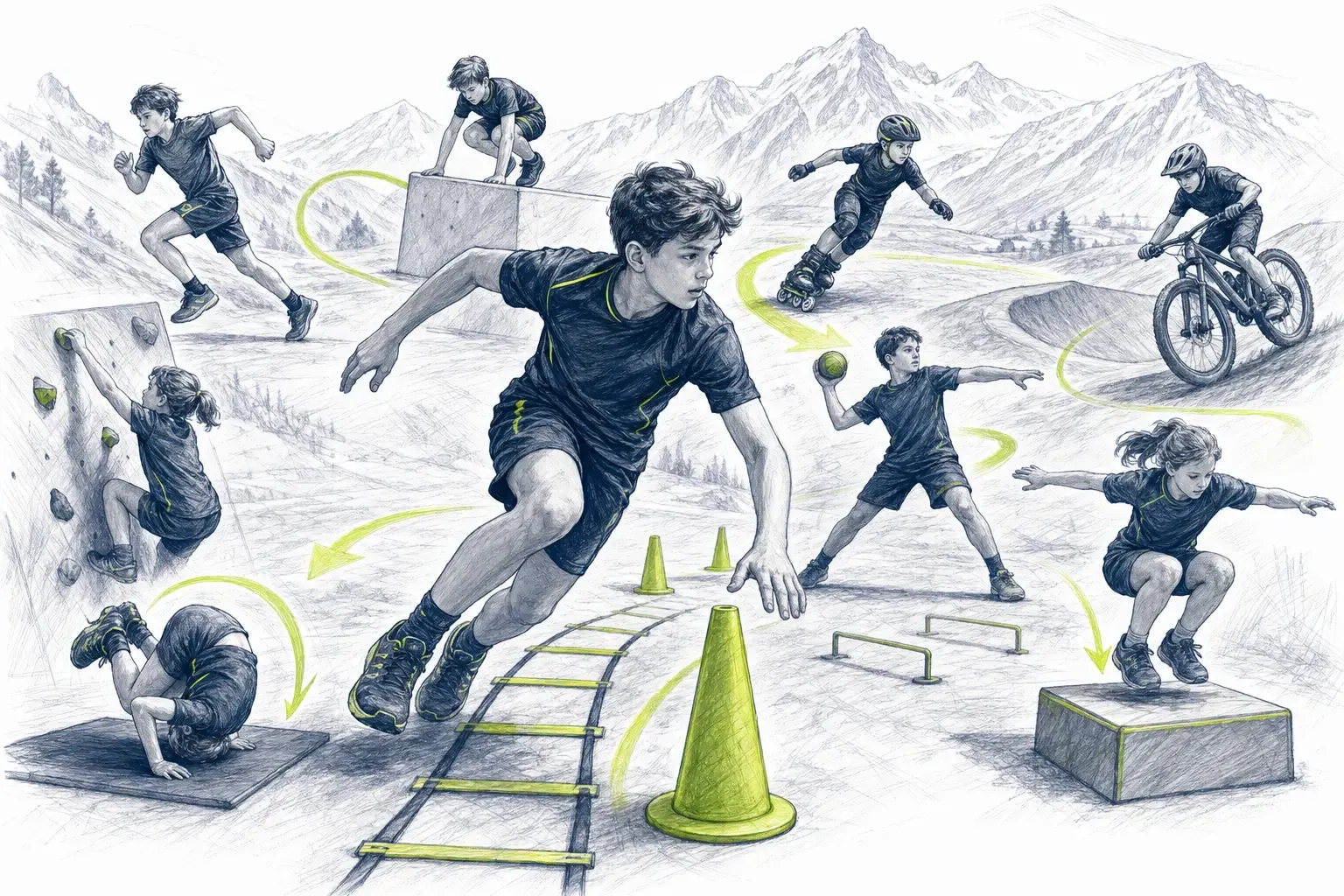
Training off the snow does not replace skiing, however. A balance aid, inline skates, or mimicking turns without skis cannot fully reproduce edge contact with snow, glide, speed, and the forces acting through a turn. Dry training and snow training therefore complement each other.
Children’s context
The official development models of Swiss-Ski and U.S. Ski & Snowboard place the emphasis in the early stages on play, variety, and fundamental movement skills. Targeted fitness training is added gradually. During periods of growth spurts, temporary changes in coordination, mobility, and load tolerance must be expected. Two children of the same age may therefore not be ready for the same exercises or the same training volume.
An appropriate training session has a clear goal, but it does not have to feel like a test of endurance. With children, short and easy-to-understand tasks, frequent changes of activity, a safe space, and quality execution are important. Pain, a marked loss of movement control, or unusual fatigue are not signs that the load should be increased.
Common misunderstandings
- Dry training is just leg strength training. A skier needs the whole body, coordination, speed, endurance, and mobility.
- The harder the training, the better the preparation. Fatigue on its own is not the goal and can worsen movement technique.
- Children should train like adult racers. The content must respect their development, experience, and ability to concentrate.
- One autumn block is enough for the whole season. Movement and fitness abilities are developed and maintained continuously; only their balance and load change.
- Balance exercises are the whole skiing fitness. They are only one tool and should not push out running, jumping, strength, games, or varied movement.
The coach’s view
The coach does not watch only the number of repetitions or the time. They pay attention to posture, knee alignment, landing control, differences between the right and left side, the child’s reaction to fatigue, and the ability to learn a new movement. Based on this, they adjust the difficulty, the game rules, the size of obstacles, the speed, or the length of the load.
Good dry training is long-term, varied, and gradual. Its result should not be just a tired skier, but a physically capable child who can learn on snow, react, and handle appropriate loads safely.
Sources and further reading
- Swiss-Ski – Trainings-Guideline Ski Alpin
- U.S. Ski & Snowboard – Alpine Training Systems
- U.S. Ski & Snowboard – Athlete Performance Profile, Physical Fitness Domain
- Swiss-Ski – Conditioning training with marker cones
- Swiss-Ski – General On- & Off-Snow
- Swiss-Ski – Off-Snow Training and the preventive ISPA program