Definition
Reaction to error is the way a skier responds to the difference between the intended and actual movement outcome. It may involve an immediate balance correction, a change of line, an adjustment of speed, a tactical decision, or processing the mistake before the next attempt. In this entry, it is a training term, not the name of a specific competition rule.
An error cannot be determined only by whether the movement looks different from a technical model. The decisive factors are the task objective, the conditions, and the skier's level. The same movement may be ineffective in one context, yet in another it can be a functional response to uneven terrain, a change in snow, or a disrupted line. Information about the outcome describes, what was achieved, while information about the execution describes, how the movement was carried out.
What follows after an error
A skier first receives their own internal feedback from sight, balance, pressure under the skis, and awareness of movement. A coach, video, or timer can add external feedback. The coach's role is not to replace the skier's own perception, but to help connect the feeling, the observed course, and the result.
A purposeful reaction to an error usually:
- maintains or restores stability,
- respects the current speed and space,
- deals with the nearest part of the run instead of forcing a return to a situation that is already lost,
- does not trigger a bigger follow-up error,
- gives the skier information that can be used on the next attempt.
In training practice, the problem is often overcorrection. After starting a turn too late, a skier may brake sharply, lean back, or forcefully twist the upper body. The original error then triggers a chain of further problems. A better reaction may be to finish a manageable turn, accept a wider line, and gradually restore rhythm.
Children's context
A child's ability to recognize and correct an error is influenced by age, experience, motor level, attention, task difficulty, and the environment. That is why all children cannot be given the same number of instructions or expected to show the same level of independent analysis. Research on feedback in children's motor learning also does not provide a simple universal rule for the ideal frequency or form of instructions.
Younger or beginning skiers are usually helped by one clear task, a demonstration, a track in the snow, or a figurative comparison. An older and more experienced child can be guided with questions: "Where did you lose the rhythm?", "What did the skis do?" or "What do you want to change on the next run?" This approach supports the ability to evaluate one's own run instead of waiting for a ready-made correction from the coach.
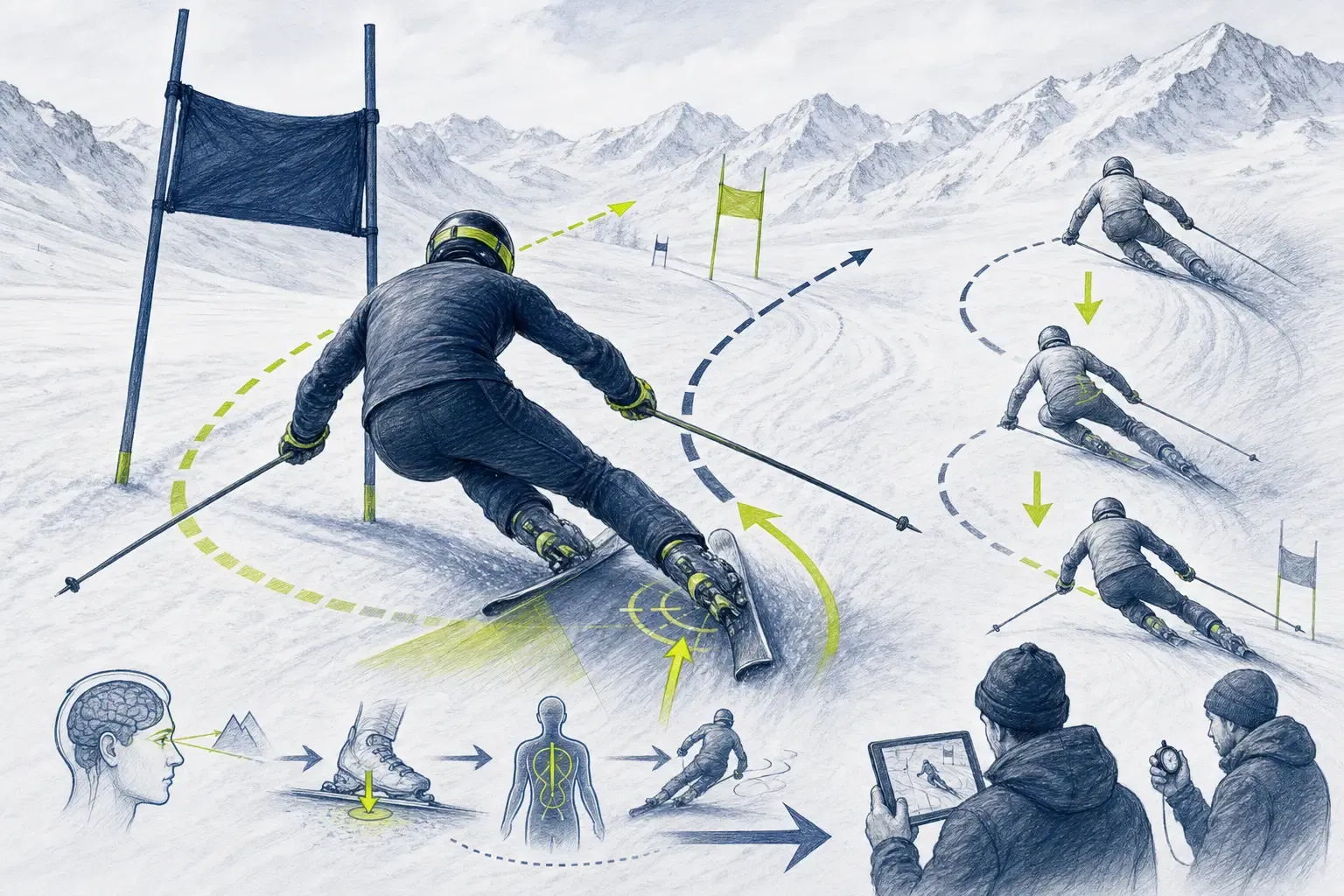
Instructions focused on the effect of movement — for example, on ski direction, track, or pressure into the snow — may be more useful than a detailed list of the positions of individual body parts. Research on sports skills often finds an advantage for external focus of attention, but results in children depend on the task, level, and way the instruction is delivered. From this, no rule can be made that an internal cue is always wrong.
Racing skiing
In races, a mistake does not have to show up as a fall. It may be a late pressure on the ski, loss of rhythm, an unsuitable line, or too much slowing down. The value of the response becomes clear in the following turns. The racer needs to solve the situation that has arisen, not copy the originally planned line at all costs.
In slalom, a delay at one gate may require adjusting the approach to the next one. Trying to immediately “catch up” to the ideal line can lead to another delay. The coach therefore watches not only where the first mistake occurred, but also how long its consequences last and when the racer restores balance, direction, and rhythm.
Coach’s view
A practical approach after a mistake can have five steps:
1. Safety: was the descent still under control? 2. Observation: where did the first significant deviation occur? 3. Self-assessment: what did the skier feel and see? 4. Priority: which single change matters most? 5. Verification: did the next attempt improve both the result and the skier’s independence?
Feedback after every attempt does not have to be automatically best, but deliberately limiting feedback is not a universal solution either. Studies with children have brought different results depending on age, task, and type of instruction. The coach therefore adjusts the frequency of help according to whether the child still cannot recognize the mistake, or already knows how to evaluate it independently.
The goal is not to ski without a single deviation. The goal is a skier who does not panic when a mistake happens, stays appropriately active, chooses a safe solution, and uses the experience in the next run. A mistake then becomes information for learning, not automatically a reason for criticism.
Sources and further reading
- How can instructions and feedback with an external focus be designed to improve motor learning in children? A systematic review
- When and how should feedback and instructions be provided to athletes?
- Improving the learning of sports skills through feedback with an external focus
- Movement pattern and parameter learning in children: effects of feedback frequency
- Frequent external-focus feedback enhances motor learning
- Focus of attention in coach instructions for technique training in sports: a critical review of review studies
- U.S. Ski & Snowboard – Alpine Ski Fundamentals, Level 100 Instructor Manual