What Pressure on the Ski Means
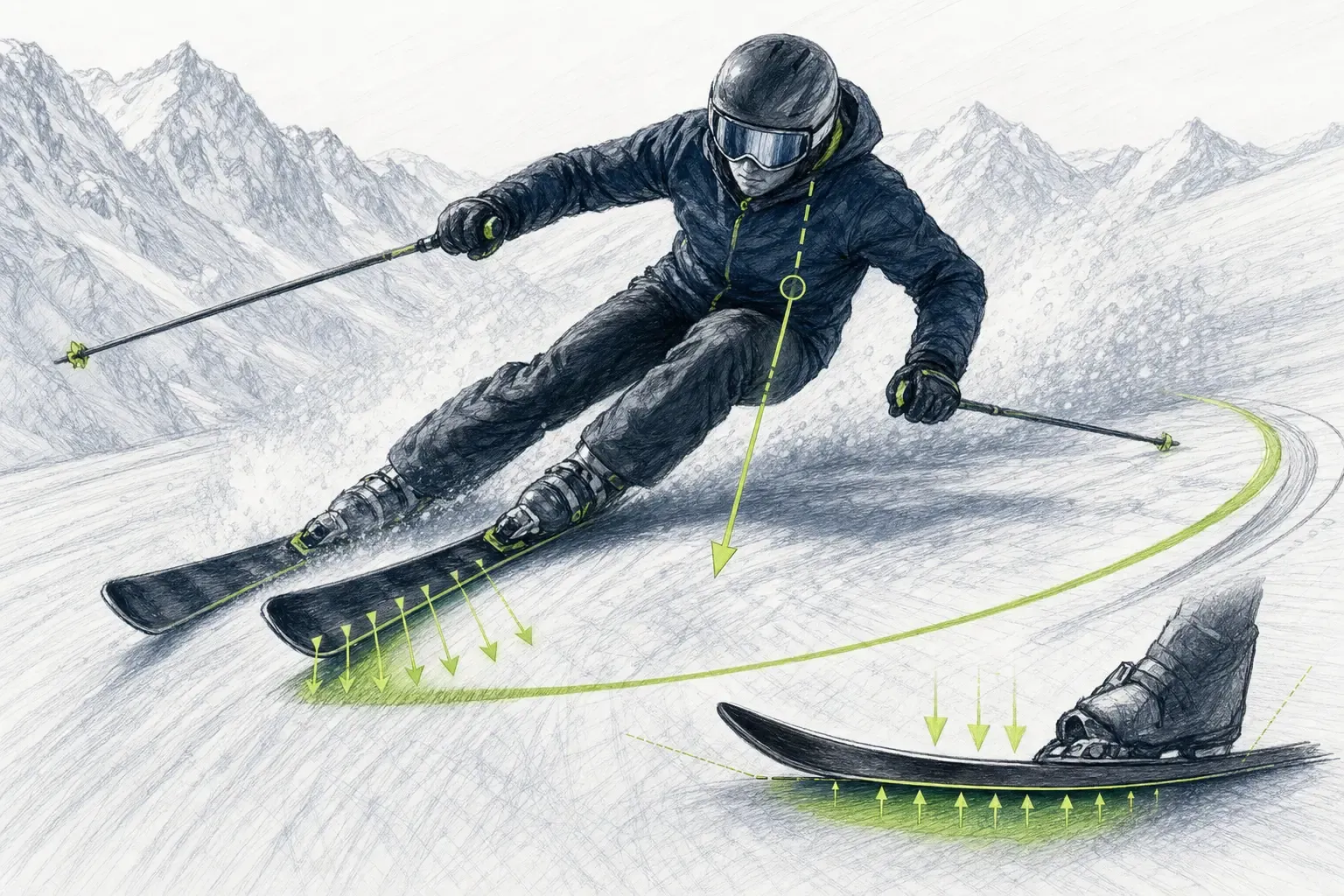
Pressure on the Ski is a commonly used coaching term for loading the ski and managing the forces that arise between the skier, the equipment, and the snow. In the precise physical sense, pressure is a force acting on a certain area. In ski instruction, however, this word usually refers to the broader ability to regulate the size, direction, distribution, and timing of the load.
Pressure is therefore not one isolated movement or the command “push harder.” Modern teaching methods describe it as regulating the forces created by the contact of the skis with the snow. Part of these forces comes from the skier’s weight, part from movement in the turn, and part from active leg work. The skier influences them through stance over the skis, bending and extending the lower limbs, edging, and guiding the turn.
Why Ski Loading Is Important
Appropriate loading helps keep the ski in contact with the snow. Together with the correct edge angle, it allows the ski to grip, bend, and guide the turn. But pressure alone does not guarantee a good turn. If the ski is loaded too late, too abruptly, or without proper edging, it may slide instead of carving.
Loading should be understood in three contexts:
- between the right and left ski – especially between the outside and inside ski,
- along the ski – between the front, middle, and back of the foot and ski,
- over time – pressure is released, created, and reduced again during the turn.
In a regular parallel turn, the outside ski: in a left turn the right ski, and in a right turn the left ski, usually carries most of the load. The inside ski, however, is not inactive. It helps with balance, direction, and a smooth transition into the next turn. Research shows that the ratio of forces between the skis changes depending on the type of turn, its phase, the slope angle, speed, and the skier’s technical level. There is therefore no single correct percentage split.
How Pressure Changes During the Turn
At the end of the old turn, the skier reduces the load and allows the skis to move onto new edges. At the start of the new turn, the skier looks for support on the future outside ski. The load then increases depending on speed, turn shape, and terrain, and before the next edge change it is released again.
In giant slalom racing, a shift in the action of forces along the length of the foot has also been observed: more forward at the start of the turn and then toward the heel later in the turn. However, this result is not an instruction for the skier to sit back at the end of the turn. The stance must remain functional, and the skier must be ready for the next change of direction. In addition, the pressure pads in ski boots do not capture all the forces, because part of the load is transferred through the shell and cuff of the boot.
Pressure on the Ski in Teaching Children
For a small or beginner skier, an abstract instruction like “create pressure” usually does not help. It is better to give a movement task in which the child finds support naturally: stand over the outside ski, steer the turn to a stop, or briefly unweight the inside ski.
The training task must match the child’s age, balance, and ability level. A brief lift of the tip or tail of the inside ski can show whether the child is standing on the outside ski. Long skiing on just one ski already requires good stability and belongs on a gentle, open slope under the coach’s guidance. The goal is not for the child to lift the inside ski in every turn.
With children, the coach mainly watches whether:
- support appears smoothly and without stomping,
- the upper body does not fall into the turn,
- the outside leg stays active, not rigidly straight,
- both skis continue in roughly the same direction,
- the child can release the pressure before the next turn.
Research comparing more experienced and intermediate skiers confirms that the quality of skiing is not shown only by the amount of force. What also matters is the coordination of loading with body movement and the similar quality of right and left turns.
Race context
In gates, what matters is not only how strongly the racer loads the ski, but above all when and in what direction they do it. Late, abrupt loading after the gate often leads to skidding and a loss of height or speed. The coach therefore usually looks for earlier support on the new outside ski and a smooth increase in forces according to the chosen line.
With increasing speed and a smaller radius, the forces can be significantly higher, but results from elite or adult skiing cannot be mechanically transferred to children. A young racer must first master balance, edge changes, and directing the skis. Maximum “pushing” without this technical foundation is not the goal.
Typical mistakes and misunderstandings
- Stomping on the ski: a short удар? no
- A short impact does not replace smooth support building and can disturb balance. Constant pressure into the boot tongues:
- the shin can be in contact with the cuff, but continuous strong forward pressure is not a universal solution. Sitting back:
- pressure on the heel does not mean the hips should stay behind the feet. Falling the whole body inward:
- the skier loses support on the outside ski and tries to replace it with forceful pushing, maxims like 100: 0 or 80: 20 do not apply to every turn, terrain, and snow condition.
- Confusing feeling with measurement: the feeling of pressure under the foot is not the same as the total force transferred to the ski.
From a coach’s point of view, pressure into the ski is the result of a well-timed movement, not a force task for its own sake. What is monitored is the behavior of the skis, the track in the snow, body stability, and the smoothness of the transition between turns. Only their combined picture shows whether the skier is truly controlling the load.
Sources and further reading
- PSIA-RM Alpine Assessment Guide 2025–26
- U.S. Ski & Snowboard – Level 100 Alpine Fundamentals Instructor Manual
- Influence of slope steepness, foot position and turn phase on plantar pressure distribution during giant slalom alpine ski racing
- Recent Kinematic and Kinetic Advances in Olympic Alpine Skiing: Pyeongchang and Beyond
- Comfortable and Convenient Turning Skill Assessment for Alpine Skiers Using IMU and Plantar Pressure Distribution Sensors
- What Are Kinematic and Kinetic Differences between Short and Parallel Turn in Alpine Skiing?
- Asymmetries in Ground Reaction Forces During Turns by Elite Slalom Alpine Skiers Are Not Related to Asymmetries in Muscular Strength
- Comparison of the Turn Switch Time Points Measured by Portable Force Platforms and Pressure Insoles