What is weight transfer
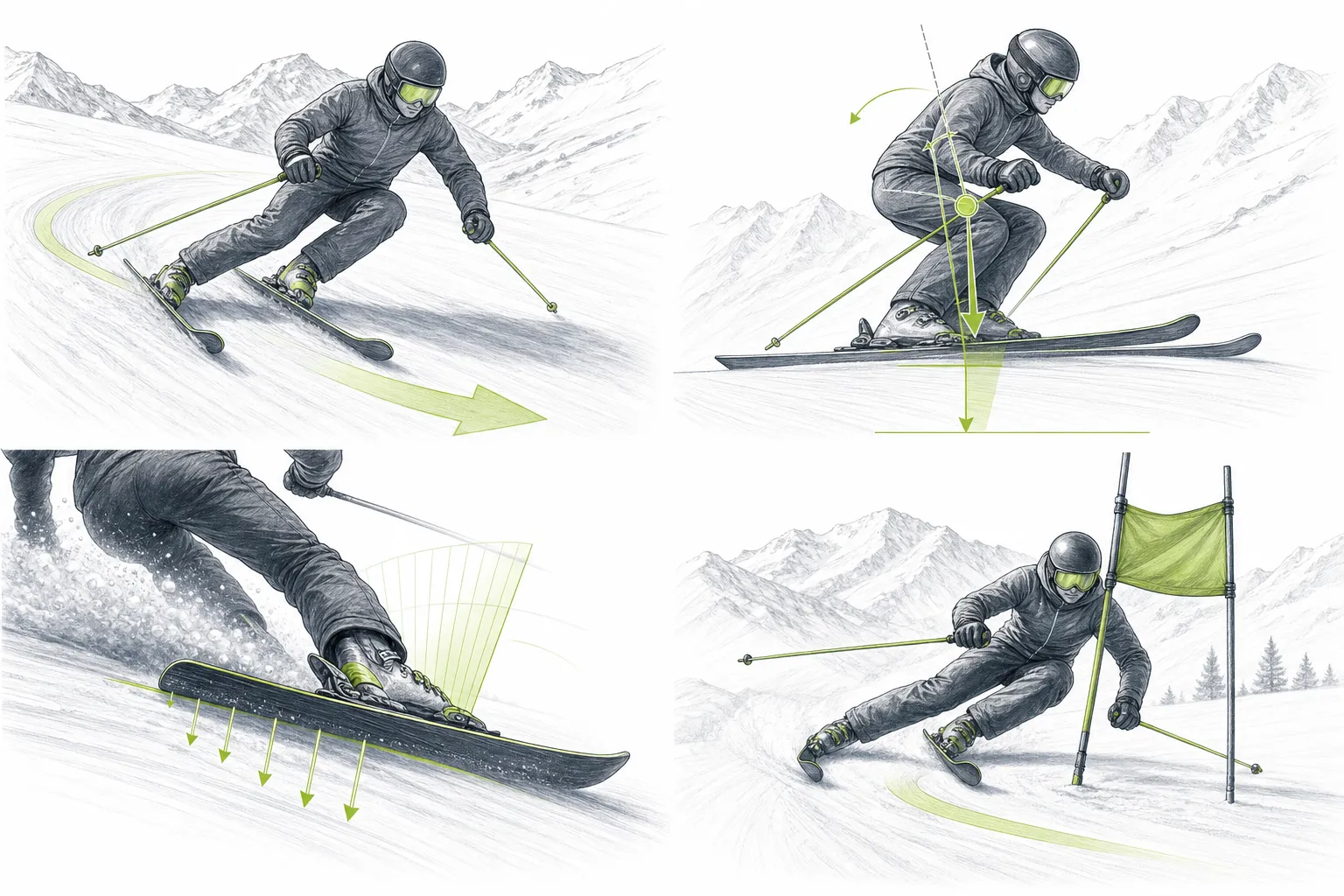
Weight transfer is the common term for a change in the distribution of support and pressure between the left and right ski. It is most clearly seen when moving from the old outside ski to the new outside ski between two turns.
From a physics point of view, the skier's mass does not change and does not literally “move over.” What changes are the forces with which the skis act on the snow and the snow acts back on the skis. The more precise technical term is therefore pressure management between the skis. The skier influences it by the position of the center of mass relative to the support area, by bending and extending the lower limbs, by edging, and by the timing of movements. Modern teaching methods also distinguish pressure transfer between the skis from pressure management in the fore-aft direction along the ski.
Outside ski as the main support
The outside ski is the ski farther from the center of the turn: in a left turn it is the right ski, and in a right turn the left ski. In a controlled turn, it is usually the main support and generally carries most of the load. This does not mean, however, that the inside ski must always be lifted or completely unloaded.
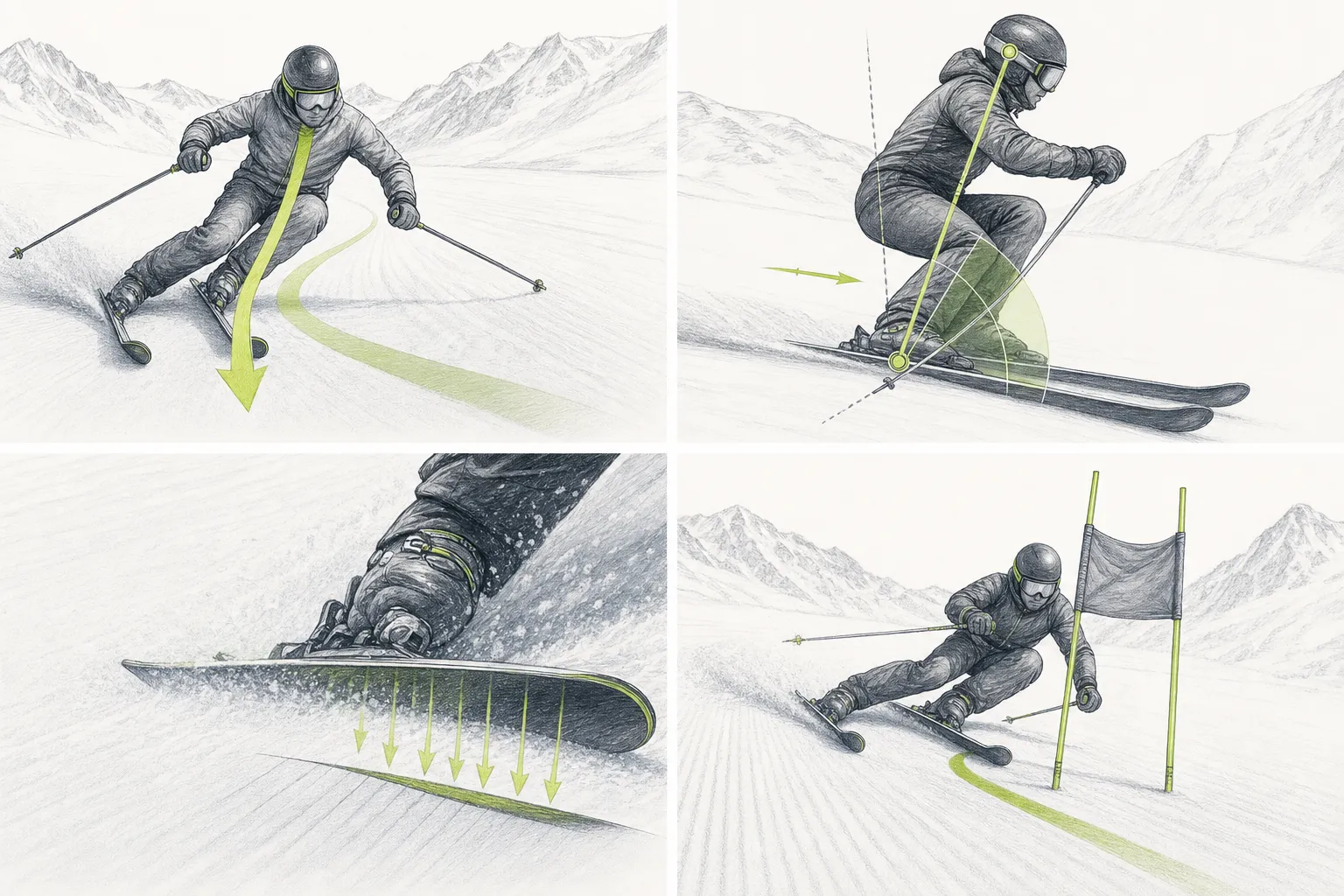
Pressure distribution is not a fixed ratio. It changes according to the phase of the turn, speed, radius, slope, surface, and chosen line. Measurements in giant slalom have shown that during the start of the turn, when the overall forces are smaller, the load on the skis can be fairly even. A more noticeable difference between the outside and inside ski develops during the shaping phase of the turn.
During the transition between turns, the old outside ski is gradually released and support is built on the new outside ski. Before the fall line, it may still be the upper ski and only later become the lower ski. Therefore, it is not accurate to confuse the terms outside ski and lower ski. Biomechanical analyses describe the transition as a separate part of the turn in which the load on the skis changes and the movement of the center of mass is directed into the next turn.
Importance in teaching children
In the first wedge turns, a child discovers that different support on the skis affects the direction of the ride. But simply “pressing down” one ski is not enough. The result comes from the combined effect of balance, edging, turning the skis, and pressure management.
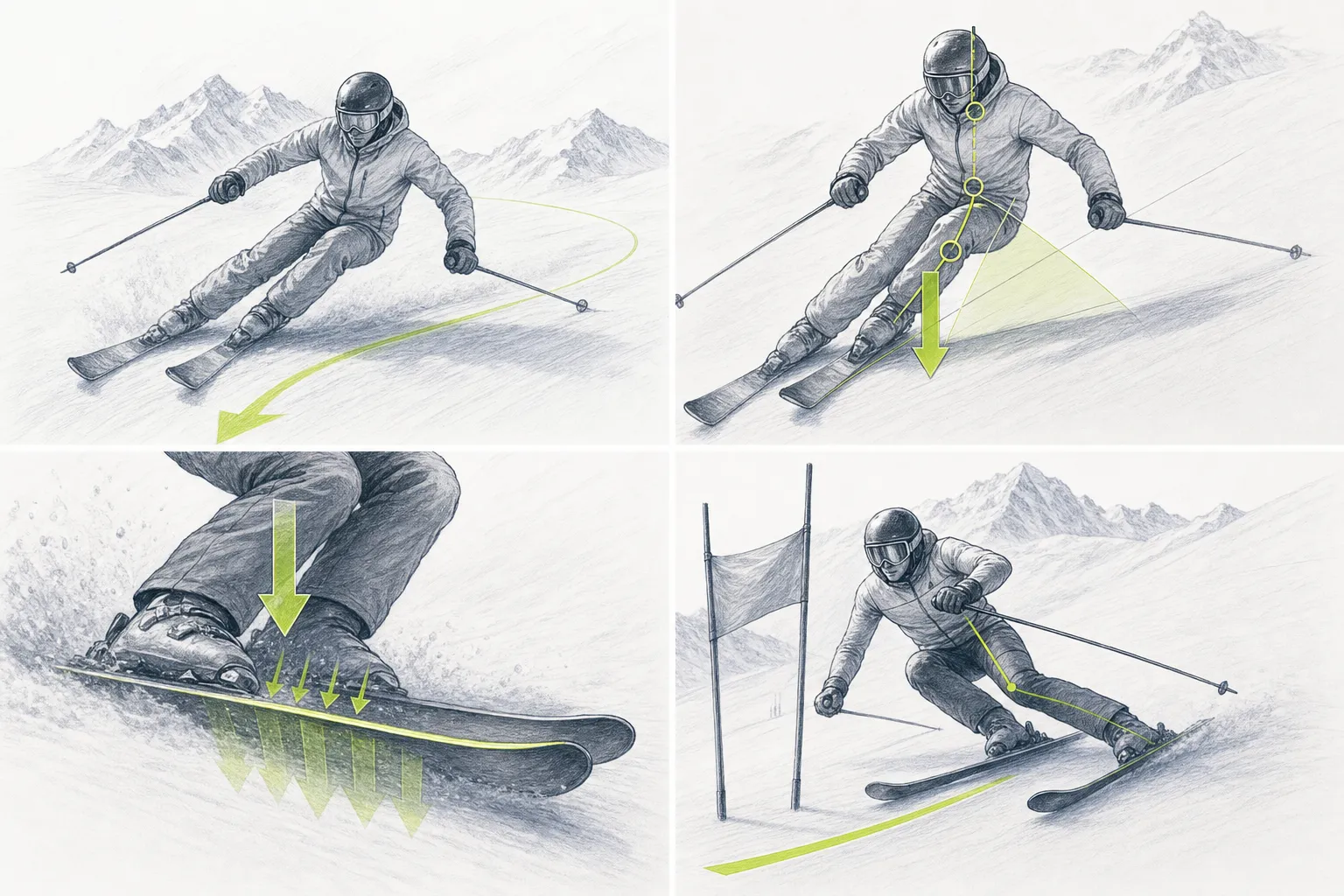
The cue “put your weight on the outside ski” can be too abstract for a small child and often leads to leaning the torso or sharply extending the leg. More understandable are tasks focused on the result, for example finding firm support on the outside leg, making smooth steps during easy turns, or keeping the inside ski light without forcing it upward.
The exercise must match the skier's age, balance skills, and level. Step turns, skiing with a brief unloading of one ski, or turns mostly on the outside ski belong on a gentle, clear slope. More demanding one-ski exercises are suitable only for a sufficiently stable skier and under a coach's guidance.
Racing context
In racing skiing, what matters is not only which ski is weighted, but especially when and how quickly support is built on it. A late transition can leave the racer too long on the old outside ski or the new inside ski. A sudden "stomp" onto the new ski can, in turn, disrupt smoothness, ski steering, and contact with the snow.
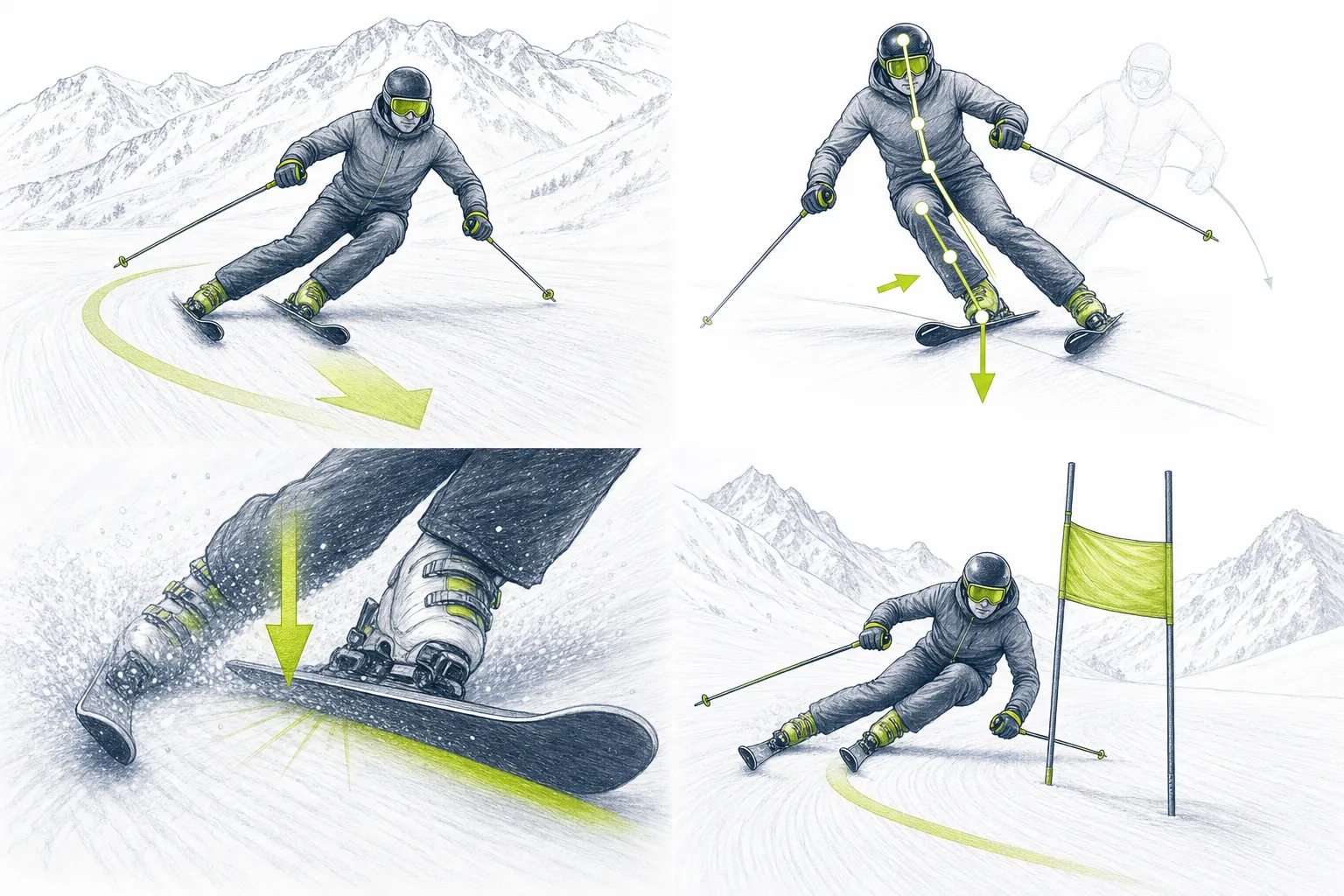
The goal is not the greatest possible pressure at all costs. A racer needs to create, absorb, and release pressure according to the turn and the course. That is why U.S. Ski & Snowboard development materials first look at a balanced transition between the skis, and only at higher levels at the ability to actively change pressure as needed, keep a strong outside leg, and work with pressure along the length of the ski.
Typical mistakes and misunderstandings
- Leaning the whole torso over the outside ski: pressure may change briefly, but the skier often loses mobility and balance.
- Sudden stomping: creates an impact instead of smooth support and can disturb the ski’s guidance.
- Late transition: the new outside ski starts working only deep in the turn, when the skier is already catching up with delayed movement.
- Constantly lifting the inside ski: can serve as an exercise, but not as a universal picture of correct skiing.
- Leaning back during the ski change: pressure shifts toward the ski tails and the skier loses readiness to start the next turn. The forces transferred through the ski boot also cannot be judged only by the feeling of pressure on the foot or tongue of the boot.
- Looking for a fixed percentage split: the correct distribution is not always 100: 0 or 50: 50; it depends on the specific situation.
Coach’s view
A coach does not evaluate weight transfer only by the body position in a single frame. They watch the whole sequence of movements: releasing the old outside ski, directing the center of mass through the transition, building support on the new outside ski, and the smooth increase of pressure during the turn.
A good transfer of support shows up as stable guiding of the outside ski, an appropriately quiet upper body, and the ability to change radius or line quickly. The training cue must come from the cause of the mistake. A child who is afraid of the fall line needs a different task than a racer who changes skis too late at high speed. Weight transfer is therefore not an isolated movement or a competition rule, but part of dynamic balance and pressure control in the turn.
Sources and further reading
- U.S. Ski & Snowboard – Level 100 Alpine Manual
- U.S. Ski & Snowboard – Athlete Performance Profile
- PSIA-Rocky Mountain – Alpine Assessment Guide 2025–26
- Influence of slope steepness, foot position and turn phase on plantar pressure distribution during giant slalom alpine ski racing
- Mass point versus whole-body modeling of skiers for performance evaluation in alpine skiing
- Subdivision of skiing turns using ground reaction forces
- Studying Force Patterns in an Alpine Ski Boot and Their Relation to Riding Styles and Falling Mechanisms
- Recent Kinematic and Kinetic Advances in Olympic Alpine Skiing: Pyeongchang and Beyond