What Hip Work Is
Hip Work is a coaching term for the coordinated control of the position and movement of the pelvis and hip joints relative to the legs, skis, and torso. It is not one isolated movement or the cue “push the hip inward.” It mainly includes flexion and extension in the hip joints, sideways movement of the pelvis, angulation, and appropriate pelvic rotation during the turn.
Modern biomechanical descriptions of ski technique distinguish forward and backward movements, lateral tilt, and rotation of individual body parts. Hip work therefore only makes sense in connection with the movement of the ankles, knees, torso, and with how the skis behave on the snow.
Tilt and Angulation
With tilt (inclination), the skier as a whole moves toward the inside of the turn. With angulation, that is, lateral bending, an angle is created between the legs, pelvis, and torso. Angulation in the hip area can increase the edge angle of the skis without the entire body leaning by the same amount. This helps the skier maintain support against the outside ski and adapt the torso position to the forces at work.
These movements do not exclude each other. In a turn they are usually combined, and their ratio depends on speed, radius, slope angle, snow quality, and the skier’s intention. Research also shows that carving and skidding turns have different coordination patterns of the pelvis, torso, lower limbs, and skis.
Practical Significance
Proper hip work allows:
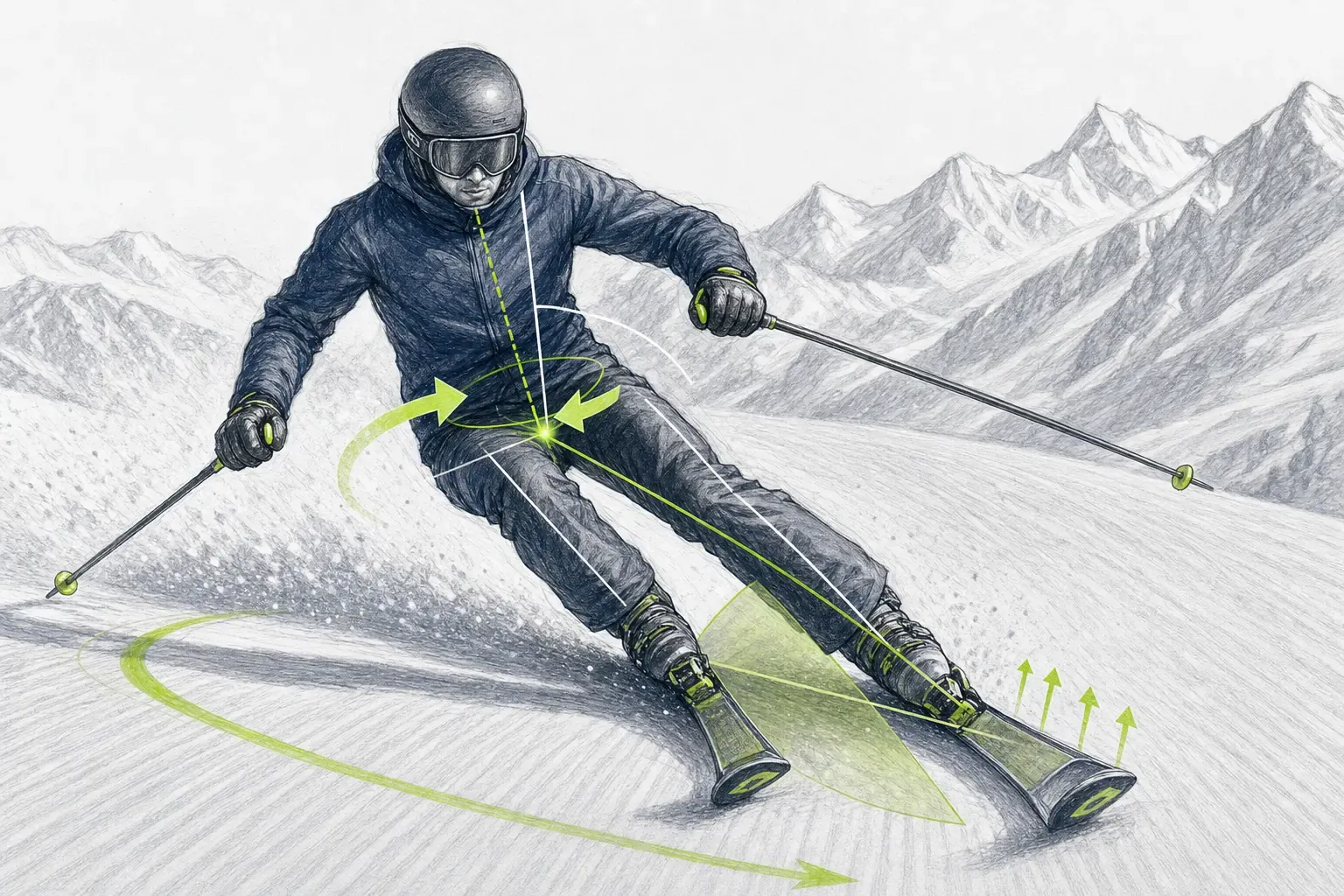
- to move the center of mass smoothly across the skis into the new turn,
- to regulate edge angle and turn shape,
- to maintain functional support, especially against the outside ski,
- to adjust the height and position of the pelvis to the load,
- to let the legs work partly independently of the torso.
However, the hips alone do not create proper pressure or carving. The result comes from the interplay of balance, edging, ski rotation, and flexing or extending the lower limbs. Model and field studies show that both the hip joints and the lumbar region carry significant load during the turn; an exaggerated position is therefore not a substitute for precise timing and support.
Children and Young Skiers
For children, the goal is not the biggest possible angulation or touching the side of the body to the snow. First they need a stable basic position, mobility in the ankles, knees, and hips, the ability to change stance height, and gradually find balance over the outside ski. Teaching should match age, motor development, and the current skiing level. Official US Ski & Snowboard development materials therefore link technical tasks with long-term, age-appropriate athlete development.
A coach can develop hip movement with simple movement tasks on a suitably easy slope. More important than a striking static position is smooth movement of the pelvis through the transition, gradually building support and the ability to change position. Range of motion should not be forced through pain, loss of balance, or limited mobility.
Race context
In competitive skiing, there is no single ideal hip position that applies to every turn. Pelvic movement changes depending on the discipline, speed, gate setting, and phase of the turn. Measurements of elite skiers confirm differences between disciplines and also between the inside and outside leg. A photo of a racer at maximum inclination therefore does not show the whole movement or how they got into that position.
Typical mistakes and misunderstandings
- Dropping the hip inward too early: the pelvis sinks before there is firm support on the outside ski.
- Leaning the whole body as one block: the skier does move inward, but cannot regulate edging enough through angulation.
- Excessive twisting of the pelvis: a sharp hip rotation pulls the torso or skis with it and disrupts the smoothness of the turn.
- Static hips: the pelvis stays back or to one side and does not move with the skier into the new turn.
- Trying to touch the snow with the hip: a low hip can be a possible result of high speed, a large edging angle, and good balance, not a separate criterion of correct technique.
From a coach’s point of view, hip movement is not judged by a single body pose. What matters is its timing, its relationship to the legs and torso, and above all the result on the skis: balance, track, turn shape, smooth edging, and the ability to adapt movement to changing conditions.
Sources and further reading
- Journal of Sports Sciences – A framework for measuring alpine skiing technique
- Frontiers in Sports and Active Living – On-Field Ski Kinematic According to Leg and Discipline in Elite Alpine Skiers
- ISBS Proceedings – Coordinative Patterns Between Carving Turn and Skidding Turn During Alpine Skiing
- ISBS Proceedings – Differences Between Parallel Skiing and Carving Based on Wearable Sensor Data
- Sports Biomechanics – Balanced carving turns in alpine skiing
- US Ski & Snowboard – SkillsQuest
- US Ski & Snowboard – SkillsQuest Drill Descriptions
- US Ski & Snowboard – Alpine Development Guide
- Estimation of Joint Moments During Turning Maneuvers in Alpine Skiing