Inside ski is the ski closer to the center of the turn being made. In a left turn, the inside ski is the left ski; in a right turn, the right ski. So the label does not change according to which ski is permanently left or right, but with every transition into a new turn, the skis switch roles.
The term cannot always be replaced by the expression upper ski. In the typical steering phase of a turn, the inside ski is also higher up the slope, but during the transition between turns or in broken terrain, such a name may be inaccurate.
The role of the inside ski
In a parallel turn, both skis are in contact with the snow and both contribute to stability. The outside ski, however, usually carries most of the load and provides the main support against the forces acting in the turn. Measurements in giant slalom showed a higher load on the outside leg during most of the turn, while the inside leg had a more supporting and stabilizing role. The difference was not the same in every phase of the turn.
The inside ski is not inactive. The skier guides it in the direction of the turn, tips it onto its edge, and adapts its line to the outside ski. It stands on the edge along the little-toe side of the foot, while the outside ski is edged along the big-toe side. As the inclination increases, the inside leg usually bends more and becomes functionally shorter; the outside leg is usually longer and more heavily loaded. Research on elite skiers confirms that the movement and loading of both legs differ and also change according to the discipline.
There is no generally valid percentage for how much weight should be on each ski. Weight distribution is influenced by the phase of the turn, its radius, speed, slope, surface, chosen technique, and the skier's level. In addition, pressure insoles do not measure all the forces transferred through the boot, and their results may differ from data from force plates. For that reason, exact numerical ratios cannot be used as a universal technical rule without context.
Inside Ski for Children
For a beginner, a simple explanation is usually enough: the inside ski is the one around which the turn bends, and the main support gradually builds on the outside ski. When skiing in a wedge, the importance of both skis depends on the specific task, speed, and slope; therefore, a child should not be forced into precise conscious weight distribution.
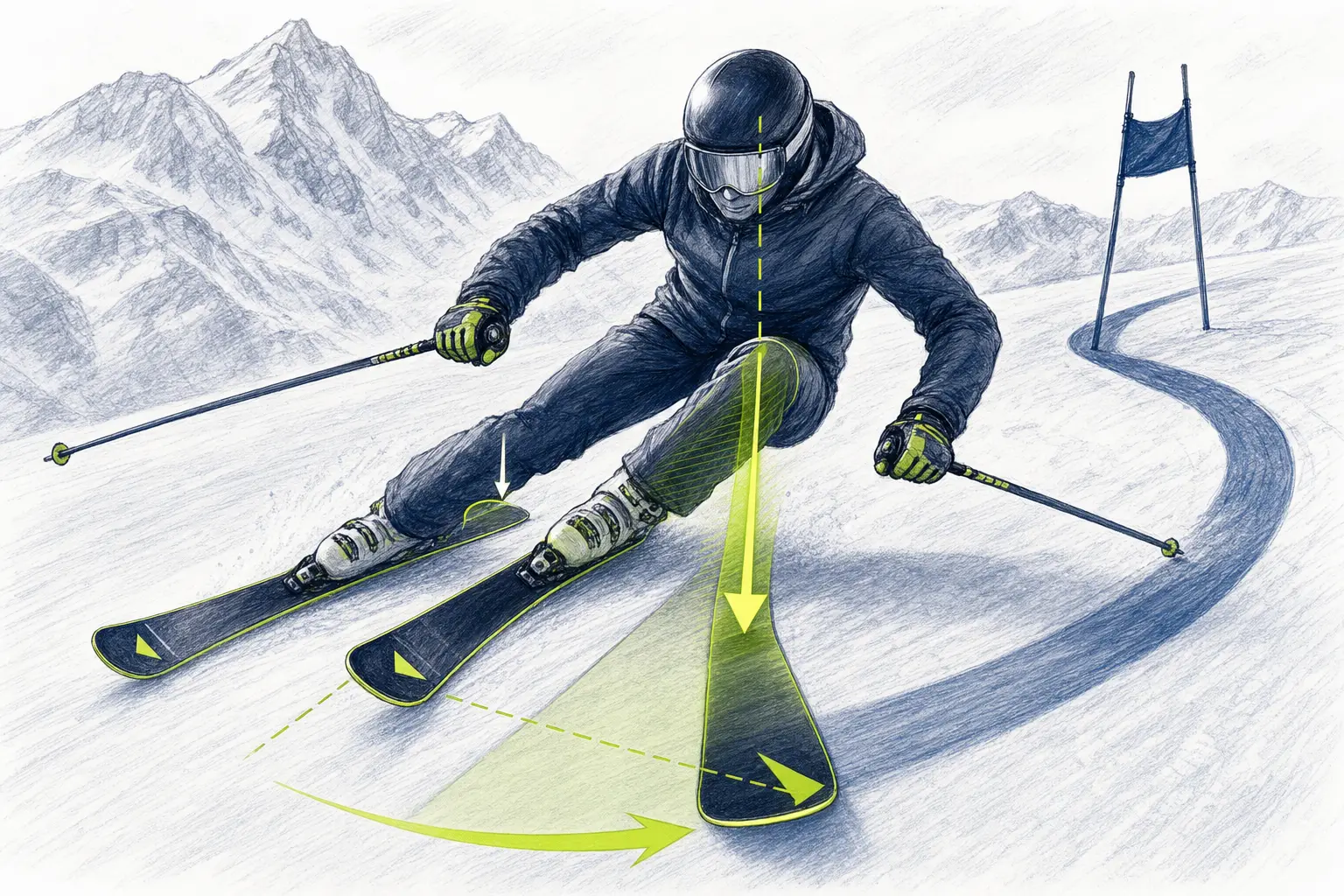
As the skier improves, they learn to relax the inside leg, bend it appropriately, and guide the ski parallel to the outside one. The goal is not to keep the inside ski lifted permanently, but to prevent it from becoming the main support in an unsuitable phase of the turn. Official coaching materials describe alpine skiing as being mainly dominant on the outside ski and consider balance over it a basic technical skill.
With children, the coach must choose cues and exercises according to age, confidence on skis, terrain, and current fatigue. Brief unloading of the inside ski or skiing on one ski can serve as training exercises, not as a description of the technique for the whole turn. They belong on a gentle, clear slope and under the coach's guidance.
Typical Mistakes and Misunderstandings
- Overloading the inside ski: the pelvis and torso stay too far inside the turn without firm support on the outside ski. The outside ski becomes light and may lose guidance or contact with the snow.
- Lifting the inside ski completely: a useful balance drill turns into a permanent habit. The skier loses some stability and adapts worse to bumps.
- The ski moves independently: the inside ski follows a different track, crosses the line of the outside ski, or catches an edge.
- Excessive lead: the tip of the inside ski is noticeably ahead of the outside ski, and the pelvis often slips backward or inward. However, a small natural lead on its own does not necessarily mean a mistake.
- A-stance: the knees are closer together than the skis, and both skis do not have matching edging. The cause should be looked for in the whole stance, not just the position of the inside knee.
- Confusing unloading with inactivity: the less-loaded inside ski still has to be controlled and guided.
Coach’s view and racing context
The coach does not watch only whether the inside ski touches the snow. They mainly assess balance over the outside ski, the timing of the support change, parallel ski guidance, and the ability of the inside leg to create room for inclination. Instructions such as unload the inside ski, shorten the inside leg or stand on the outside ski are training aids, not absolute rules that apply in every turn.
In racing, the inside ski can help with stability, line adjustment, and even a brief save of balance. Dominant loading of the outside ski, however, makes it possible to create support more effectively and bend the ski into the desired arc, especially at higher speeds and with a smaller radius.
The inside ski is a technical term, not a separate rule for passing a gate or a prescribed load ratio. When evaluating course skiing and race situations, the current FIS rules are decisive.
Sources and further reading
- FIS – Alpine Documents: International Competition Rules (ICR), edition 6. July 2026
- Falda-Buscaiot et al. – Influence of slope steepness, foot position and turn phase on plantar pressure distribution during giant slalom alpine ski racing
- Meyer et al. – On-Field Ski Kinematic According to Leg and Discipline in Elite Alpine Skiers
- Nakazato et al. – A comparison of ground reaction forces determined by portable force-plate and pressure-insole systems in alpine skiing
- Snyder et al. – Connected Skiing: Validation of Edge Angle and Radial Force Estimation as Motion Quality Parameters During Alpine Skiing
- Roman et al. – Inline Skating as an Additional Activity for Alpine Skiing: The Role of the Outside Leg in Short Turn Performance
- U.S. Ski & Snowboard – Level 100 Alpine Coach Manual
- Professional Ski Instructors of America – Fundamental Mechanics of Alpine Skiing