What timing is
Timing is the technical and organizational system for measuring a skier’s time from the start to crossing the finish. It includes measuring equipment, cables or approved transmission solutions, operators, data recording, calculation software, and checking procedures. The term timing therefore does not refer only to the display at the finish or to one stopwatch.
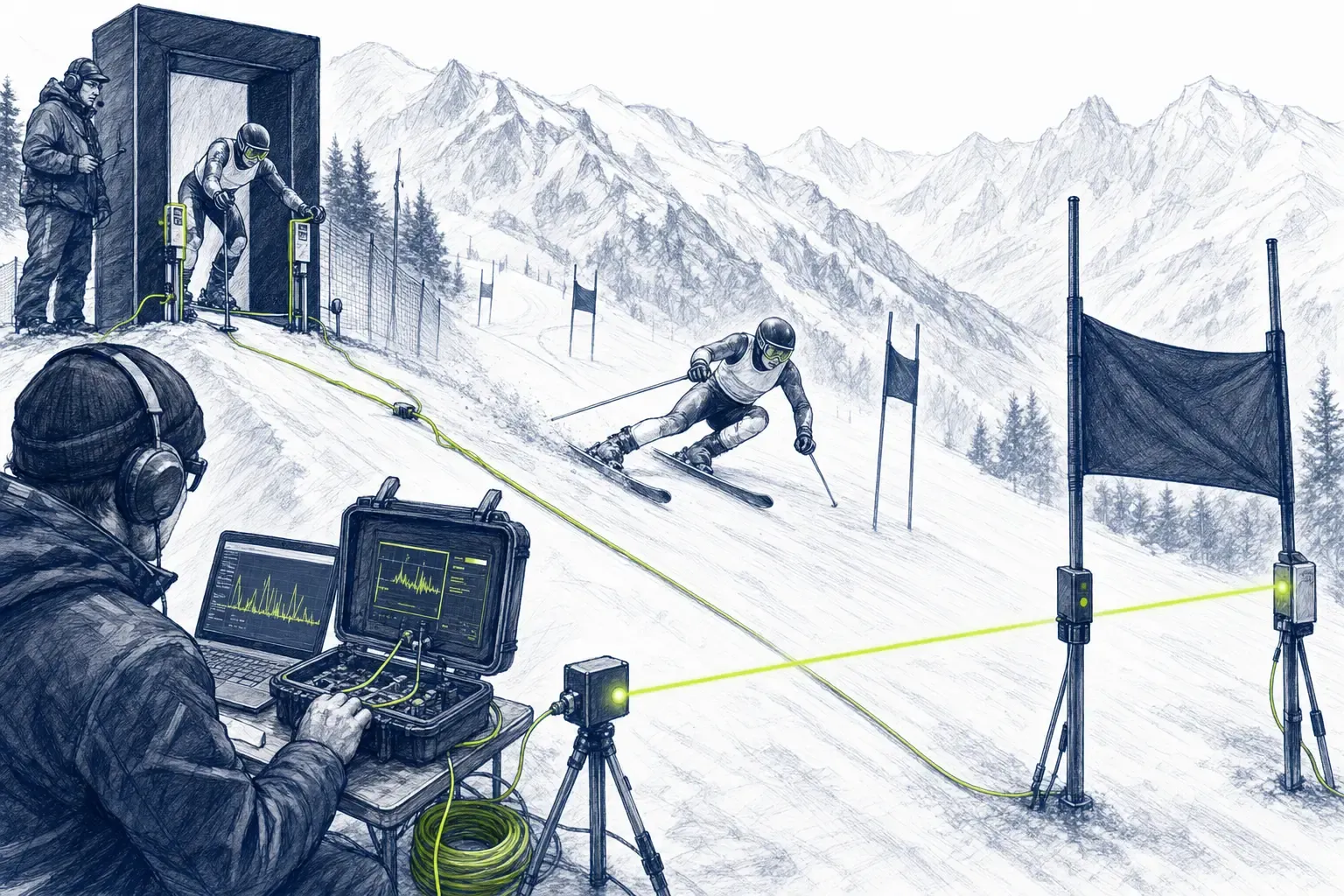
In electronic timing, the start gate records the moment the racer opens the start wand. The finish impulse is created when the beam of the finish photogate is interrupted. The devices operate in absolute time-of-day mode (time of day, ToD): the final run time is calculated by subtracting the start time from the finish time.
The sound countdown or the starter’s command help organize the start, but they do not start the timing themselves. The decisive signal is the impulse from the start gate.
Race timing according to FIS
At events included in the FIS calendar, homologated electronic timers, start gates, and photogates must be used. Current FIS rules require two synchronized and electronically separate systems for international alpine competitions:
- system A is the main one,
- system B is the backup,
- both receive a separate impulse from the start gate,
- at the finish there are two homologated sets of photogates, separately connected to systems A and B.
The systems are synchronized before the run and must not be resynchronized during it. The technical installation must be placed or protected so that, as far as possible, it does not endanger the racers.
According to FIS rules, the final time is given to the hundredth of a second. The calculated time is truncated, not mathematically rounded. A time of 52,349 seconds is therefore recorded as 52,34 seconds.
If system A fails, the backup electronic data from system B is used according to the prescribed correction procedure. For all competitions in the FIS calendar, independent manual timing at both the start and the finish is also mandatory. Manual times are recorded as time of day and can be used to calculate an equivalent electronic time (EET) if usable electronic data is missing. This is not a simple transcription of the stopwatch time: a correction based on comparing the electronic and manual times of the surrounding racers is carried out.
A transponder or training sensor cannot automatically be considered a replacement for system A, system B, or mandatory manual timing at FIS races. The current competition rules and the list of homologated devices are decisive.
The electronic finish time is created when the beam of the photogate is interrupted. If a racer falls at the finish without coming to a complete stop, the recorded time may be valid, but the racer must immediately fully cross the finish line with or without skis. The finish judge assesses whether the crossing is valid.
Unofficial and official time
The time shown on the board or in the online broadcast is immediate, but usually unofficial information. Before results are confirmed, the records from systems A and B, manual times, start and finish data, any substitute calculations, and decisions of the jury are checked. That is why the time may be corrected after the run without it being an arbitrary change to the result.
In two-run disciplines, the ranking is determined by the sum of the valid times from both runs, unless the rules of the specific format say otherwise. A split time shows performance only on a certain section of the course and does not by itself decide the result.
Timing in children’s training
In training, timing can be simpler than at official races. It is used to measure the whole course, a short section, the start phase, or the passage through a selected set of gates. Such data is training feedback, not an official race result.
A faster time does not automatically mean better technique. The difference may come from the chosen line, the quality of the start, speed entering the measured section, an error in the previous gate, a change in the snow surface, wind, or a damaged course. Split times also need careful interpretation: the place where the time difference appears does not have to be the place where its cause arose.
With younger children, timing should support mastering the task, not push safety and the development of basic skiing skills into the background. For example, a coach can compare two tactical solutions, track the consistency of repeated runs, or combine time with an assessment of rhythm and precision. What is appropriate depends on age, motor skill level, experience, and the training goal; there is no universal number of timed runs for every child.
For a parent, it is important not to overrate a difference of one or two hundredths, especially if the children did not ski on equally well-preserved terrain. A more useful question than just “What was the time?” is often “What went well in this run, and where can time be gained through safer or more precise skiing?”
Coach’s view
Timing gives an objective number, but its meaning comes only with expert interpretation. The coach compares the time with video, observation of technique, the course flow, and the assigned task. When comparing runs, the coach tries to keep the start, setting, direction of measurement, and conditions as similar as possible.
A young skier should learn to react to the start procedure, open the start wand with a decisive movement, and safely cross the entire finish line. They should not brake before the photo cell or turn around to look at the display just after the finish. Time is the result of the run; safe passage through the finish area remains part of it.
Sources and further reading
- FIS – International Competition Rules, Book IV: Alpine Skiing, edition July 2026
- FIS – Timing Booklet Alpine, Para Alpine, version 2.67, 16 June 2026
- FIS – Homologated Timing Equipment
- FIS – Timing and Data Technical Report Software User Manual, version 13
- U.S. Ski & Snowboard – 2026 Alpine Competition Guide
- U.S. Ski & Snowboard – Alpine Competition Officials Education Resources
- U.S. Ski & Snowboard – Athlete Performance Profile and Competition Domain
- Alpine Canada Alpin – Resources for Officials
- Is there a contextual interference effect for sub-elite alpine ski racers learning complex skills?