What DNF means
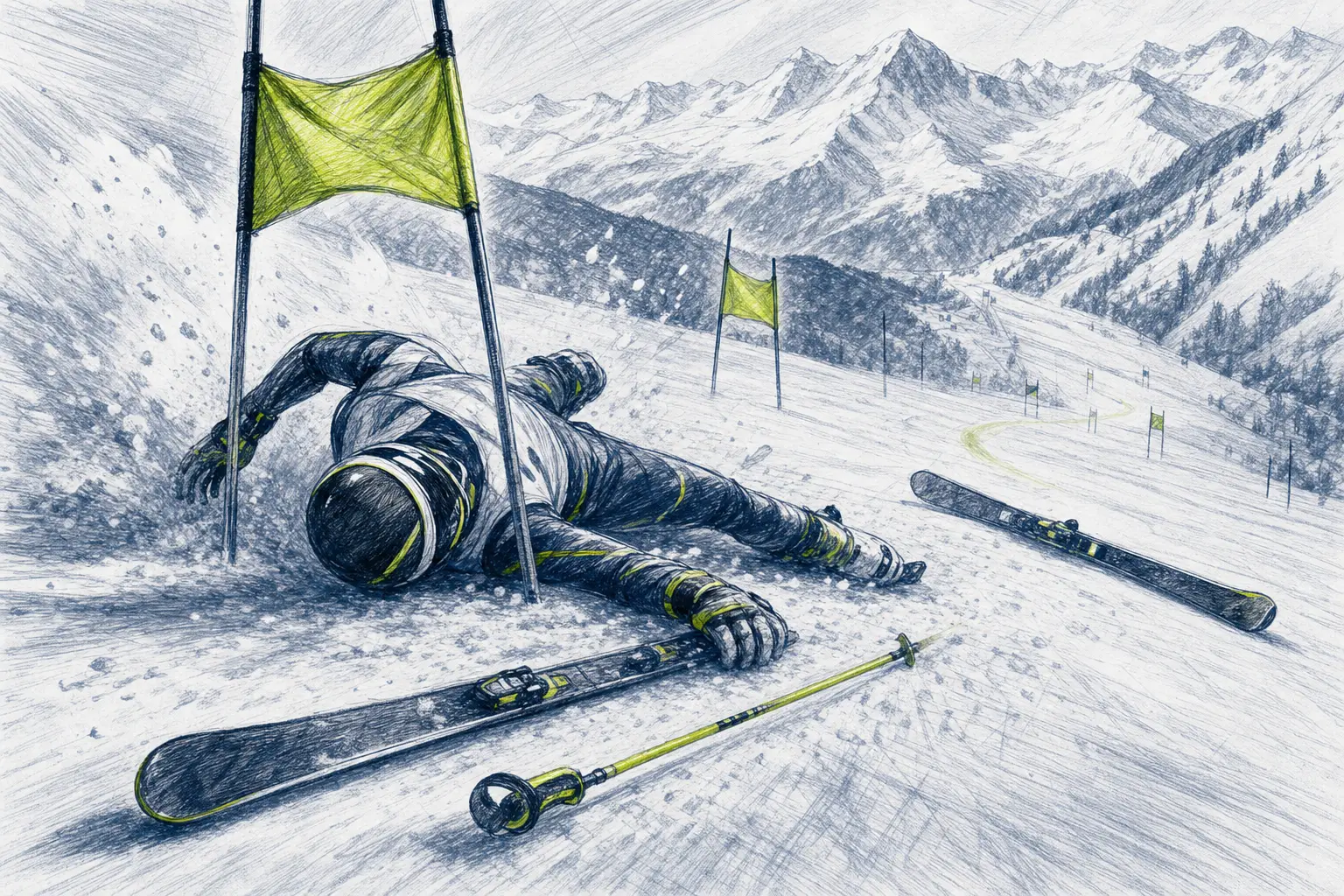
DNF is the abbreviation of the English phrase Did Not Finish, meaning “did not finish.” In official results it marks a racer who started but did not complete the run. In multi-run races, a more specific notation may also appear DNF1 or DNF2, depending on whether it was the first or second run.
DNF is above all a result status. By itself, it does not explain why the racer did not finish the run. The cause may be a fall, going off course, stopping after a mistake, equipment problems, or a decision not to continue. A fall alone does not yet mean DNF: if the racer gets back up safely, continues according to the rules, and finishes the run, they may still have a valid result.
DNF is not the same as disqualification
In the results, these abbreviations should be distinguished in particular:
- DNS – Did Not Start: the racer did not start the run.
- DNF – Did Not Finish: started, but did not finish the run.
- DSQ – Disqualified: was disqualified for breaking the rules.
- DNQ – Did Not Qualify: did not meet the qualifying criterion for the next round or phase.
- NPS – Not Permitted to Start: was not allowed to start.
DNF is therefore not automatically a penalty. For example, if a skier misses a gate and then stops or leaves the course without crossing the finish line, DNF will typically appear in the results. If the skier continues to the finish but did not complete the course in accordance with the rules, the jury may list the skier as DSQ after a decision. The official status is not decided by the racer or coach, but by the organizer’s procedures and the jury under the applicable rules.
In standard two-run races, a racer with a DNF in the first run generally has no valid combined time or overall placing. With a DNF in the second run, the results may show the first-run time, but not a valid overall result. The exact consequences always depend on the discipline and format; special rules may apply, for example, in qualifiers, parallel events, or team competitions.
DNF in young racers
For children, not every DNF can be judged as the same mistake. There is a difference between a fall after an appropriate sporting effort, an unhandled line, loss of concentration, and unnecessary risk that did not match the child’s abilities. Finishing the run should never take priority over safety.
In training practice it is useful to name the specific cause after the run without blame: Where did the problem start? Was the speed appropriate? Did the child choose a suitable line? Did the child react to the terrain and gate setup? Did fatigue, visibility, or equipment affect the run? With younger children, feedback should be short and tied to one clear task.
The number of DNFs alone is not a full indicator of a skier’s quality. Repeated non-finishes can, however, point to a technical weakness, poor tactics, weak course reading, or a concentration problem. The coach’s job is to distinguish a sports-appropriate mistake from a recurring pattern and adapt the next practice to the child’s age, level, and motor development.
Sources and further reading
- FIS – Alpine Skiing Documents: International Competition Rules (ICR), current documents for the 2026/27 season
- FIS – General Abbreviations: DNF, DNF1, DNF2, DNS, DSQ and DNQ
- FIS – Alpine Data Software Booklet, version 1.11: result statuses DNF, DNS, DSQ and NPS
- FIS – Rule Precisions for the Alpine World Ski Championships 2025: listing DNF in result sheets
- U.S. Ski & Snowboard – 2026 Alpine Competition Guide
- Alpine Canada Alpin – Alpine Officials Level 2 Manual: definition of DNF
- Alpine Canada Alpin – National Level 2 Course Manual: racing terminology DNF, DNS and DSQ
- FIS – Team Combined: example of the consequences of DNF in a special competition format